• Welcome to the DeeperBlue.com Forums, the largest online community dedicated to Freediving, Scuba Diving and Spearfishing. To gain full access to the DeeperBlue.com Forums you must register for a free account. As a registered member you will be able to:

    • Join over 47,943+ fellow diving enthusiasts from around the world on this forum
    • Participate in and browse from over 531,990+ posts.
    • Communicate privately with other divers from around the world.
    • Post your own photos or view from 7,455+ user submitted images.
    • All this and much more...

    You can gain access to all this absolutely free when you register for an account, so sign up today!

blood tests as training tool

Thread Status: Hello , There was no answer in this thread for more than 90 days.
It can take a long time to get an up-to-date response or contact with relevant users.

shoutatthesky

Generalist
Mar 4, 2006
943
162
0
47
I have seen a lot of posts talking about the levels of different substances in their blood - haematocrits for example.
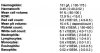
I am only into my second season of freediving and starting to get some real training happening - cardio, weights, tables, diet changes, etc. I thought I would have a blood test so I can see where I am at now and to compare with in the future.
What should I be looking for and can anyone offer an opinion on my current results?
 

Attachments

  • blood test.jpg
    blood test.jpg
    22.9 KB · Views: 369
Having good blood is one big factor of a good freedive performance. However it do not seem to be THAT important unless juggeling with every variable to the extreme.

I usually have an HB of 150-160. In egypt the day after the last competition day i took part in a little research project on the spleen. Blood samples were collected to se how much the blood value increased following breathholds.

I started of with what was for me a very low value. Hb of 129 wich is at least 20 units lower than my usual value. The day before i had been doing a personal best.

I do not know how much it had to do with hydration status and exhaustion from three weeks of training and competing. I doubt however that all came over night since i did not party that hard on the closing ceremony ;)

My point is that there seem to be, at least for me, some factor that is way more important then blood values. I would probably have done better with top notch blood, but if it would have been a limiting factor my dives during the comp would have been a disaster instead of PB in 2 out of 3 disciplines and a reasonable result in the one not beeing a PB.

I am unsure how crucial the blood levels affect the performance after this finding. I would like to add that a PB still is pretty easy for me since i have not really reached my full performance, but the results are nothing but beginner results.

I still beleive that working on a good blood is one of the ways to go, but working on spending little oxygen is the key.
 
Per, did you by any chance take the blood from the fingertip?

We had very strange results last year when we did a similar, totally unofficial "study". With most divers the hb actually seemed to DROP a little as a result of the breath hold.

The best explanation I've heard so far is that the sample was just not very good taken from the fingertip because of the vasoconstriction and such and maybe the level of serum was higher than usual in the sample. I don't know...

Hydration can definately throw the hb value with 10-20 points day to day...

Anyway, I agree, blood is not everything. It may offer a boost in the right conditions, but it's not something to be fixated about. My values vary between 140-170 and I've actually set a pb in static 2 days after donating blood.
 
Actually they inserted a little plastic catheter into the vein of the underarm. Before the first brethhold they took a little blood and after each 2min breathhold.

I started off with 129 and got up to 139 on the third or fourth apnea, I don´t really remember. The measurements inbetween were a gradual increase. The increase was pretty much in line with what they had seen in the other participants. I am pretty confident that it was a good measurement, but i was startled with the result. 129 is borderline anemic for a man, and I thought I was in shape at the time.

They tried to explain in by me having been in egypt a while and adapting to new weather and drinking a lot and so on. I know i suffered a bad stomach infection the week before aswell. Still I did not really notice it in my results.

I do not know if drinking a lot can "dilute" the blood. Since a Hb measurement is a concentration maybe my blood volume might have been greater still carrying the same amount of Hb making the blood able to carry as much oxygen in total (just less/ volume unit of blood).

On the other hand I had been training better than ever and I do not KNOW if my results vere bad in comparison to what they had been if I hadn´t had that "problem" with my blood.

It is hard to know without having the osther version of myself as a control subject. :head
 
Ok, well that more or less verifies that our experiment was faulty, since it showed very consistenlty a decrease in hb measured from the fingertip, which of course is know to be rather inaccurate anyway.

Overhydration can indeed dilute blood, it is a phoenomenon called "athletes anemia" or something like that. But at least in traditional sports it does not decrease performance and I would guess the same goes for diving, since your total oxygen store is still the same (ie absolute amount of red cells).

If you want to impress a nurse, don't drink for a few days and then do a short static just before donating blood. You'll have blood like a professional crosscountry skier :)
 
If you want to impress a nurse, don't drink for a few days and then do a short static just before donating blood. You'll have blood like a professional crosscountry skier :)

Thanks for that little tip:t Think I will go for accuracy rather than impressing the 60 yr old nurse.

Does anyone use regular blood tests as a tool for training. If so is it with the view of increasing certain values or just to keep an eye out for any drastic changes- e.g. low ferritin, high cholesterol, etc?
 
I think a diet of aerobic activity perhaps 70 to 85 percent of max heart rate over 45 mins on regular basis would do the trick. I am not sure if there is any hard evidence of b12 supplements or iron supplements increaseing hb. I have read lots about training at higher elevation increasing hb however myself i live at or near sea level no elevation to be found. I think hb above normal value is common in smokers and may not reflect better oxgen carring capacity. I have seen tents you sleep in at night that give you same oxgen you would receive at 8000 meters damn expensive however. Brings question to my anyone out there ever here of a device called a vo2 maximizer popular 25 or more years ago it was a cheap device you breathed into and it gave same amount air you would receive at several thousand feet so product was advertised in runners world magazine.
 
Does anyone use regular blood tests as a tool for training. If so is it with the view of increasing certain values or just to keep an eye out for any drastic changes- e.g. low ferritin, high cholesterol, etc?

I think that if you want to find the greatest way to evaluate your progress it is smartest to use the discipline you are training for as the method. All the disciplines are a combination of many factors. Even static has so many things to it that it is hard to pinpoint every factor. To start in the other end and see what reluts you can get is the best way of analyzing your training. Otherwize you tend to train for a specific blood content other than length depth or time.

Keeping a track of your blood can on the other hand be a good way of finding out the reason for something, like unexplained tiredness or something.

I do not use it, but I wish I had access to measuring theese walues every other day, mostly out of curiosity.
 
Folks in the USA can get self-prescribed and very complete blood panels done through the Life Extension Foundation (googleable) for a ridiculously low fee - around $35. The blood can be drawn at any of thousands of locations around the country, Fedexed to their lab down the road from me here in Florida and the report shot back to you days later. I don't know whether LEF is set up to service foriegn residents.

I've used LEF tests for self-monitoring and for a little ad hoc investigation of the effects of sleeping in a hypoxic tent. Results are a trade secret for now, though !
 
Thanks guys for your replies.
Sure it is important to focus on goals of depth, time etc. and I do that, but this is just another tool assess how training is affecting your body. As I am no medical expert I don't know what to look for but in the long run I hope that having regular tests e.g. monthly -would help in assessing where weaknesses might be in terms of diet/nutrition, and also as study tool for freediving research. I am trying to reach the highest level possible so every little thing contributes.

Paul, PM me please with your secrets. I won't tell
 
Hi,
I don`t think, that blood tests are good trainig tool.It is money waisting, coz it is very expenzive.
Because to examinate it exactly, You need to know haematokrit, haemoglobin concentration and blood volume.Only with this You can get amount of all haemoglobin in Your body, wich is more or less constant.
First three values are changing every day and during each day, depending on water intake and output.To discover an ivtravasal volum is dificult, it is based on colouring substance dilution.
So, from my point of view basic blood test are good only for rutin healh state examination by Your physician.
I hope, that my English is not too horrible...
Bye
 
yes - seems i've opened a can of worms.

This thread highlights the dilemma athletes face. With so many variables in the human body. So how do we know what to look at? I guess at this stage for me my focus should be on timing, length, and depth - not haematocriticalisationally stuff.
 
B12+Fe+Folic asit combination makes hemoglobin, 1hemoglobin has 4 hem and 1 globin molecules shortly but we can say this HB
below 130 means you are a line anemia and you have a great risk, over 175 means you have a dissease and risk , can not remember name right now
in body hemoglobin binds 02 and cary it to cells , 150-160 optimum ,
in deep dive below -50m my idea hemoglobin is very important , cos you have only tools carrying 02 to vital organs.. when you have a small ratio hemoglobin means you have small ratio 02 carying mechanizm 1 hemoglobin only caries one 02, the best is between min-max values or optimum values(close to center range), your ratio is PERFECT! but as jome said that it has not a big affect on breathhold :D
me no doctor but i know but i am searchingon this subject nowadays :D :D
http://forums.deeperblue.net/freedi...s/70214-aquatic-adaptation-dna-molucules.html :head
 
DeeperBlue.com - The Worlds Largest Community Dedicated To Freediving, Scuba Diving and Spearfishing

ABOUT US

ISSN 1469-865X | Copyright © 1996 - 2026 DeeperBlue Global Media Limited.

DeeperBlue.com is an independent digital media platform dedicated to Scuba Diving, Freediving, Ocean Advocacy, and Dive Travel.

Since 1996, we’ve been informing, educating, and inspiring the global diving community through trusted news, features, and shared community experience.

ADVERT