
I brainstormed a few ideas and having a second or even third barrel is definitely doable if size allows. However in the Mirage itself, if it was possible to have 2x the power of the main chamber (so basically twice the shot power, no pumping) instead of the pump, which one would you think would deliver the most power? And in terms of kgf where are the secondary barrel's pumps hovering around? (I know they decrease with each pump so I'm already expecting that) Let's say for 4 pumpsHmm, I think it's tricky. The thing is, a Mirage needs two diffent barrels to work. One smaller diameter one for the "loading piston" besides the main one. And having a shaft with sharkfins will really limit how small you can make that secondary barrel. A notched shaft would work, I guess. But the real "next level" that I am also dreaming off someday is to not have the secondary barrel but instead a little lever type pump built into the gun. But it becomes a bit complicated and it's hard to find a good place to put it if you want to keep the gun from getting bulky. The secondary barrel really is the simplest, lightest way to do this. And it moves quite a lot of air compared to what a lever pump would. But it's an idea I revisit from time to time.
But not only will it need that loading barrel or a pump of sorts, it will certainly need a bulkhead to partition the air chamber into a tiny one and the main one. And some way of closing and opening that bulkhead. So, it's doable but a lot of extra parts, some more complexity and maybe also some space constraints.


Guest viewing limit reached
- You have reached the maximum number of guest views allowed
- Please register below to remove this limitation
- Already a member? Click here to login
-
Welcome to the DeeperBlue.com Forums, the largest online community dedicated to Freediving, Scuba Diving and Spearfishing. To gain full access to the DeeperBlue.com Forums you must register for a free account. As a registered member you will be able to:
- Join over 47,943+ fellow diving enthusiasts from around the world on this forum
- Participate in and browse from over 531,990+ posts.
- Communicate privately with other divers from around the world.
- Post your own photos or view from 7,455+ user submitted images.
- All this and much more...
You can gain access to all this absolutely free when you register for an account, so sign up today!
You are using an out of date browser. It may not display this or other websites correctly.
You should upgrade or use an alternative browser.
You should upgrade or use an alternative browser.
GeckoSub Mirage Evo - And Adventures in 3D Printing Speargun Parts
- Thread starter Diving Gecko
- Start date


I brainstormed a few ideas and having a second or even third barrel is definitely doable if size allows. However in the Mirage itself, if it was possible to have 2x the power of the main chamber (so basically twice the shot power, no pumping) instead of the pump, which one would you think would deliver the most power?
Not sure I can answer your questions that precisely, I will try.
But I don't think I even understand the first one, hehe. Can you try to explain that one again?
In the meantime, I will share some thoughts on the general constraints of the Mirage classic platform. You have figured out most or all if it already but here we go:
As we know by now, the bigger the difference in cross area between the two barrels, the bigger the "Mirage Effect" becomes - the easier the preloading becomes.
So, you would want that delta to be as large as possible. The ratio on a stock Mirage is ~1:1.7 (10mm pumping piston vs. 13mm shooting piston).
On a Mirage, the smallest you can make the pumping barrel depends on the shaft size and the OD of the tang (tail end). So, the Mirage was designed to accomodate an 8mm shaft with a 9mm tang and then you need a bit of a flange at the end of the pumping barrel so the piston doesn't fly out - hence the barrel ID of 10mm.
Now, on this shorter Mirage I am working on right now, I have dropped the ID to 9mm - I just have to stick with a 7mm shaft. And yes, that gets me to around a ~1:2.1 ratio. So, x2 the power/force acting on the shooting piston.
From this, the logical thinking is that for a bluewater Mirage shooting a thicker spear (8-9mm) where I will need a 10-11mm pumping barel, I will also need to go up in the shooting barrel ID to having enough of a difference between the two.
If I go to a 15mm shooting barrel I can get a ratio of 1:1.86 with a 11mm pumping barrel (for max 9mm shafts) or as much as 1:2.25 with a 10mm pumping barrel for 8mm shafts.
The difficulty is finding the right material for a a bigger ID shooting barrel and having it smooth enough on the inside. Alu is probably out of the question but I have shorter samples of stainless and titanium tubes on the way that I will try to see if I can polish well enough to make them work. The problem then becomes one of mass and having enough buoyancy. Which leads me to the dream - a custom made, carbon fiber cuttlefish shaped high pressure reservoir. Or the stepping stone of adding a bit of a belly/wings to a normal tube.
Now, I should mention that there is one 'cheat code' you could easily make. If you switch to what we call free/nude shafts without sliders where the tang has the same OD as the shaft itself (the shooting line is tied to the front of the shaft), then you "gain" 1mm. Meaning you can now use an 8mm shaft in a 9mm pumping barrel. Or even a common 7mm shaft in an "small" 8mm pumping barrel.
The latter is something I am considering for my girlfriend who is not only less physically strong but is also, like I am, battling with an injured wrist.
That would result in a ratio of 1:2.6 meaning that to load, say, a 23bar gun she would only need to put in about 12kgf of peak loading force. And a 23bar gun would still be a formidable thing on the reef. Again, remember, the original Mirage came with a 10mm secondary barrel and a 1:1.7 ratio
 .
. Anyhow, all this above can possibly start to explain why I sometimes try to make a little lever pump idea work in the CAD. Then no worry at all about the size of the pumping barrel and the limitations on shaft sizes. Also, one thing a full length pumping barrel inevitably results in is the need for a large enough nose to house both the shooting and pumping barrel. I would love to slim down the nose for easier tracking. I also have some CAD work done where the pumping barrel ends halfway up the gun and then the reservoir can taper from there on forward. Again, that would need a fancy custom made reservoir.
Anyways, that was the thoughts on the constraint of the Mirage platform as I see them
Let's assume we are after max power and haven't yet been able to overpower a shaft to the point where it hurts accuracy and penetration. In that case, the approach would likely be to just pump up the gun to the point where the secondary piston sees the same force on it as you can physical push it with. So, for me, let's call that 30kgf. I think it's that simple. (Remember, the pressure on the secondary piston is the same as on the main one.)And in terms of kgf where are the secondary barrel's pumps hovering around? (I know they decrease with each pump so I'm already expecting that) Let's say for 4 pumps
And then, of course, the more you can increase the delta/ratio/Mirage Effect - the more force you end up with on the main piston for the shot.
Anyways, I think that's evident to you already. But yes, the pumping/secondary piston can/should start at your max possible peak loading force (well, a tad lower to allow for the slight increase in kgf due to compression during the stroke).
And then you are asking what the pressure drop is like. That one depends on a few things. The length and diameter of the pumping barrel (how much air is being moved) as well as the volume of the smaller air chamber that you are "emptying out". I think Mares' old manual for the Mirage 80 stated that 5 pumps would get you down to ~5 bar (can't recall if that's from 30 or 40 bar but the manual is uploaded here somewhere). The original Mares handle and the bulkhead really don't have much internal volume at all, just about enough to let the air flow whereas I am using a more modern Mares handle not made to be a Mirage so it has a larger volume and so does my custom DIY bulkhead. The upside is that my low power shot has "more air in it" whereas on a Mirage the low power shot can be quite "weak". Somewhere in the middle would be good, I think. The downside, as explained is needing more pump strokes. But the rear volume is one of the things I would reduce on a custom handle. And for a BW gun, I would reduce it even more as you wouldn't need a low power shot at all so having less pump strokes would be preferable.
Actually, my goal this year is to make a custom handle in alu. And am thinking I can reduce the internal volume by inserting 3D printed plastic (or silicone) blocks into the handle for the BW version.
On my present gun, since I dropped the piston diameter and have a larger rear volume I have to pump more. I feel like I have to pump perhaps 10-12 times to get to the same as on the Mirage. But it's not a big deal as each pump is just a few seconds and as you say, they get easier and easier. Also, I could stop at five and just load the gun in the bigger barrel with a bit more effort. But at around 10, it doesn't take much effort at all to do final loading.
Basically, the pressure drop curve is one of diminishing returns. Like the first stroke may reduce the pressure by e.g. 7 bar whilst the 10th stroke may only drop it less than 1bar.
I am not smart enough to explain it to others but it has to do with Boyle's law, the remaining air expanding and that you are moving molecules of air and not just a simple volume. But the math is pretty simple for the right people once you have the chamber and pump volumes established.
An example of a pressure drop table could look like this:
A simple way to check this is to measure the pressure in the gun at the end of the pumping routine as the pressure is being read at the rear chamber. Also, a factor in how efficient the air transfer is, is how much dead space you have in your one way valves where the pump can't compress the air.
Now, back to a hybrid type gun. Unless I am missing something, you could get a huge delta/ratio on those as their main pistons are so much larger than a pumping piston would need to be. If you can somehow keep the smaller part of the air chamber really tiny, you could make an incredibly powerful gun which wouldn't even take many pumping strokes.
Last edited:
Pool Testing - No Results But a Test Rig?
@rollerGR
BTW, I think it was you and I and @tromic who talked about measuring speed in pool tests a while back.
And I mentioned there is a way to measure the moment the trigger would let go and when the impact happens. Now, all this recent talk about the Velair finally made me look back at some of Pete's old posts about that gun and then go visit their facebook from where I grabbed these frames from a low res video:
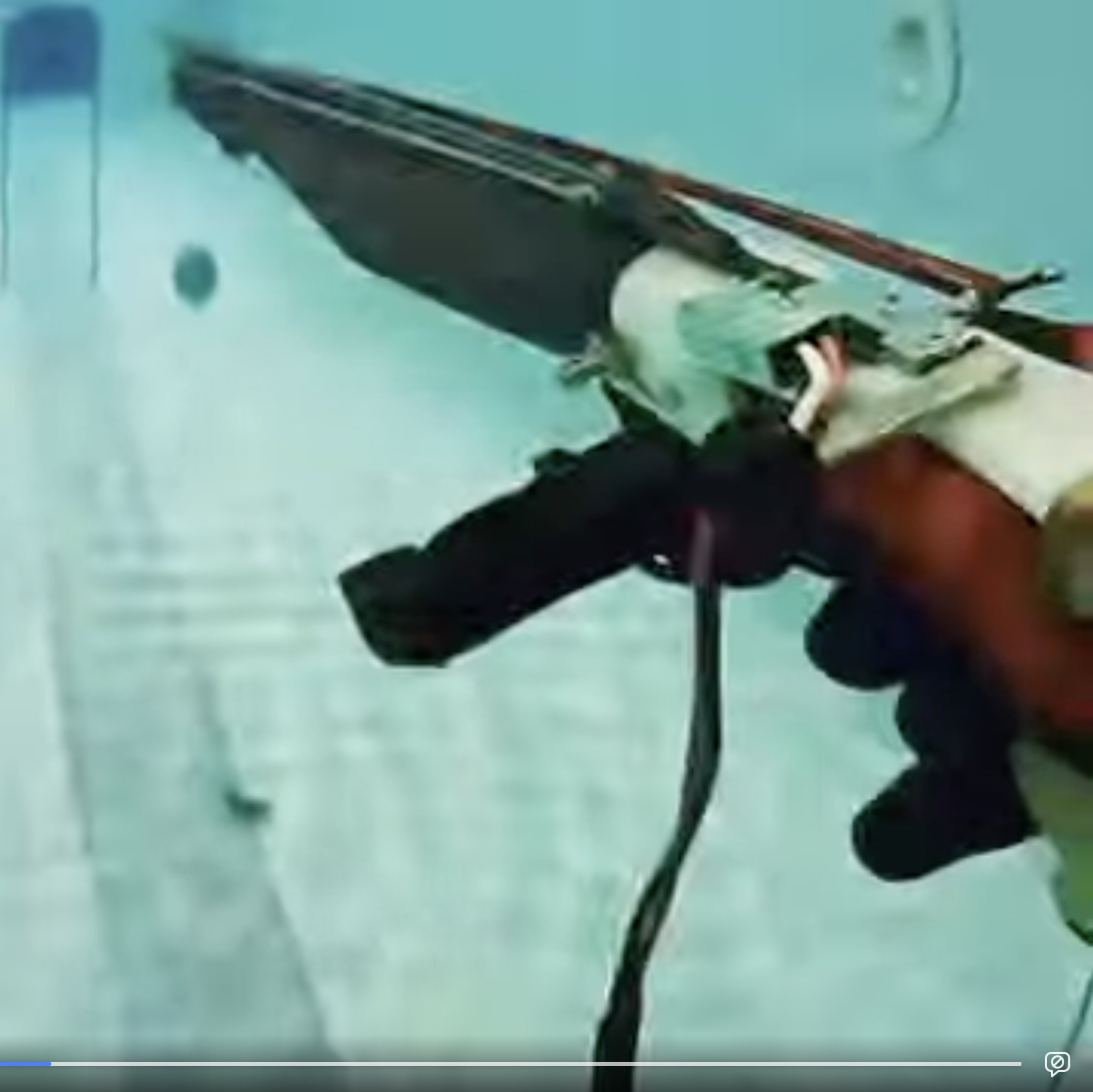
Notice the add-on to the left of the trigger and the electrical wires going down from there.
Now, look to the right of the target, also wires going to the surface
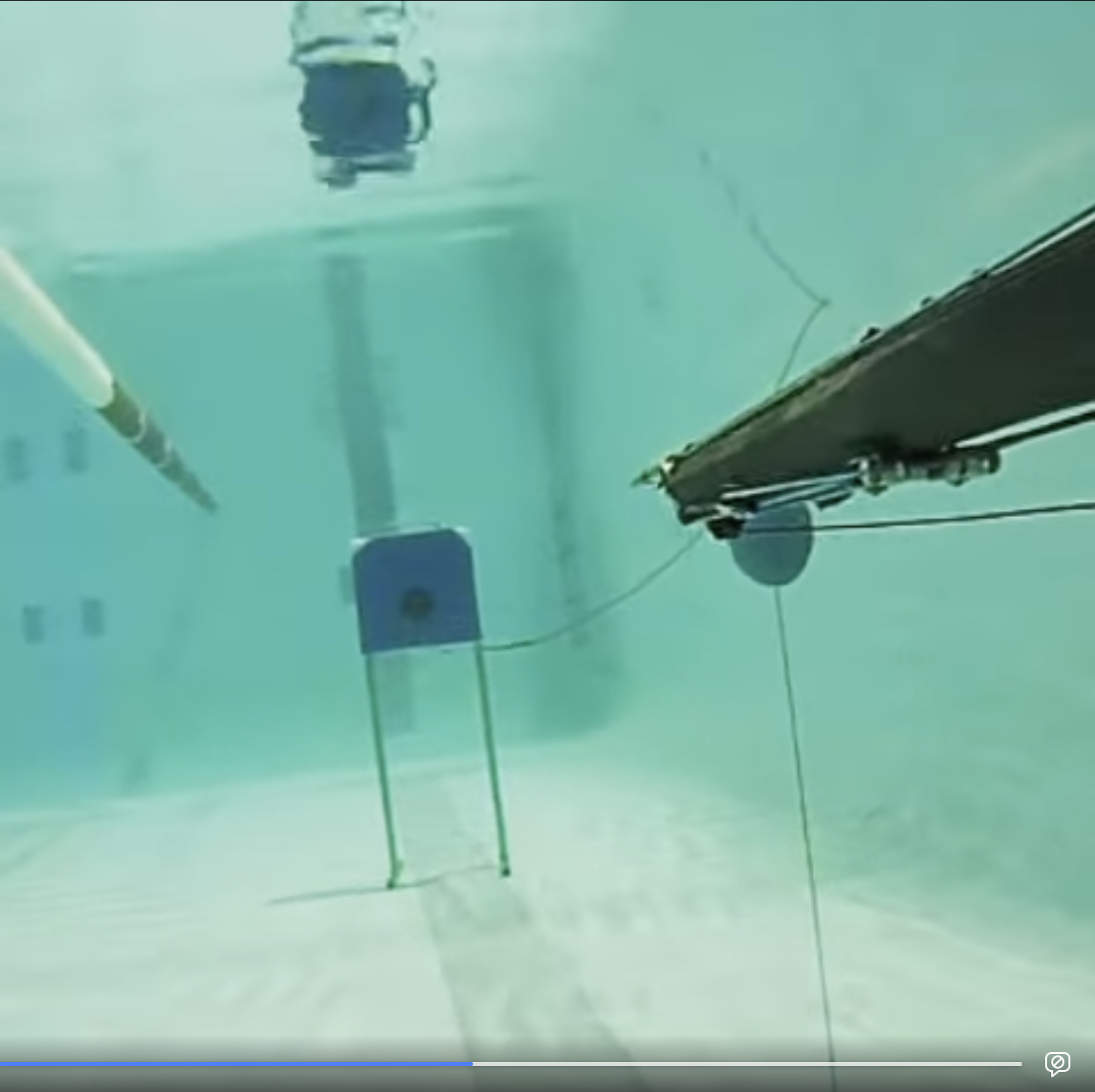
And a closer view:
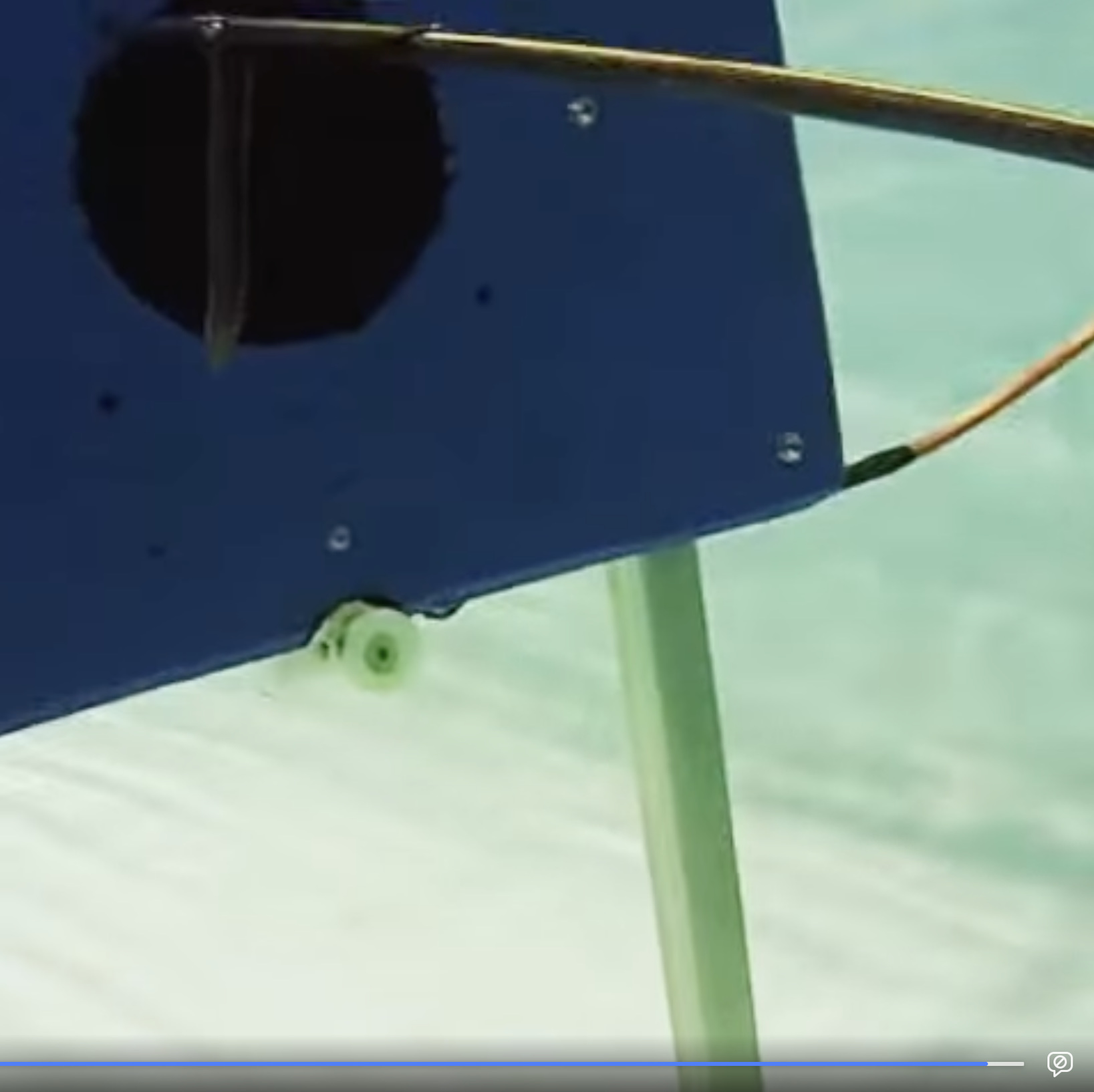
There are a few ways to collect this data. If it's only for time, then this is one way: They could be using either a switch or a simple piezo element on the handle to sense the shaft leaving the trigger. I am actually guessing it's a switch since it looks a bit bulky, but a piezo should be able to do the same but its signal may need amplifying.
On the target, I am not sure how they are sensing the impact. I have always thought a piezo could do the job, but not sure what they are using.
You would then run these cable to some small analog to digital converter circuitry(?) and into a laptop to time the delta between them and you have the average speed. Or if you used piezos, you could even "just" run them straight into the mic jack of a small audio recorder or a laptop and do an audio recording (in e.g. the free Audacity software) and then measure the time between the peaks. Maybe a small amplifier before the recording would be needed.
There is a chance they may even have some sort of sensor on the target to measure impact energy, maybe some sort of accelerometer, but my guess is it's "just" for speed.
Either way, it was nice to see this. I think I was off the forums when they posted this so may not have seen it at the time but I feel like somewhere else, long time ago, someone presented a similar idea. I am not smart enough to have come up with the piezo and audio idea on my own .
.
Speaking of pool testing, I was finally back in the pool today:
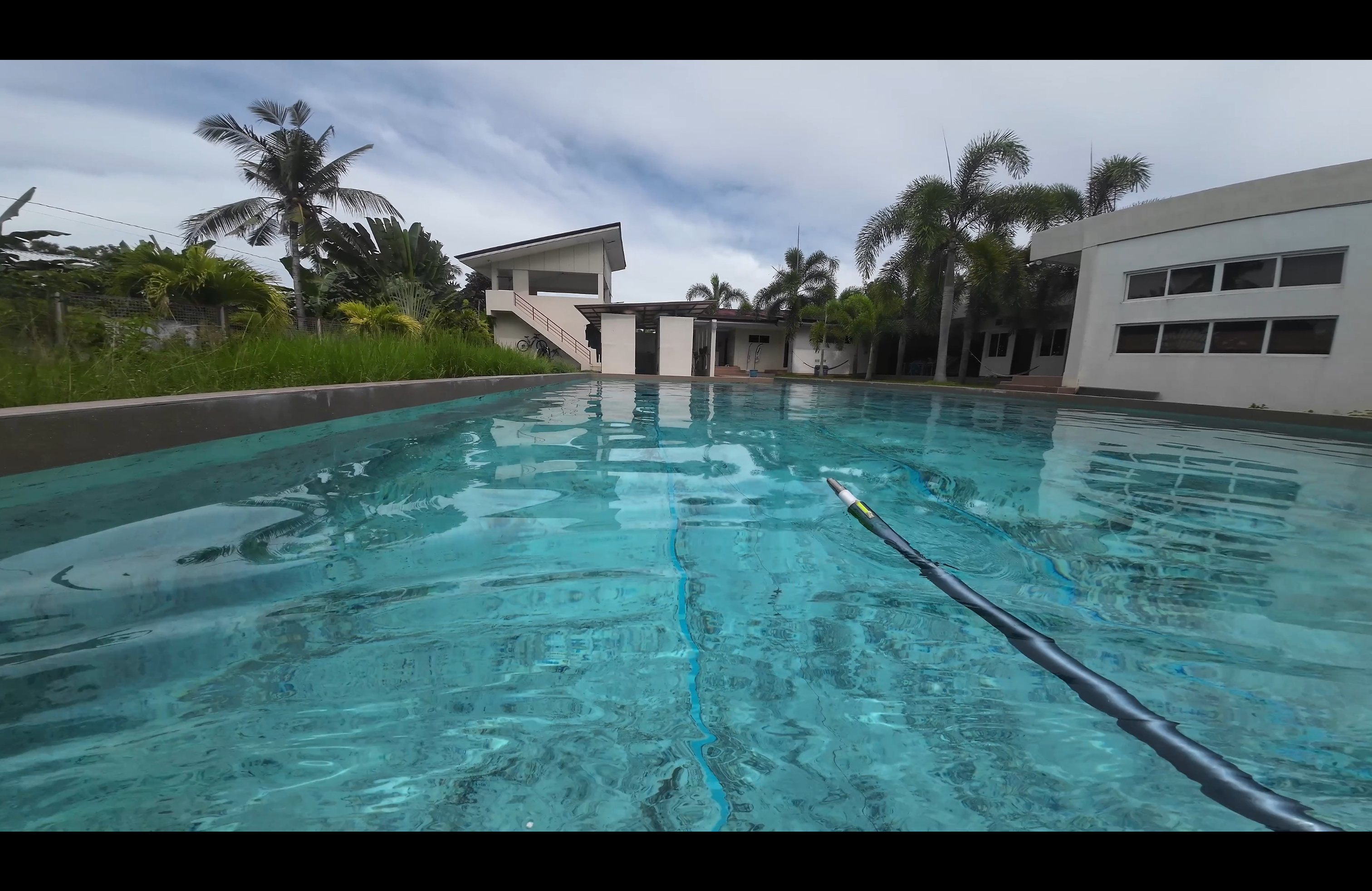
On the plus side the gun works, the Mirage pumping system was fine through a bunch of shots and loading cycles but it was a bit humbling overall as my aim was super off. I got it dialed in a bit better towards the end. And at least, I was always off in the same direction. Up and left. I think the high shots is me compensating for a shaft drop that isn't there. You really have to aim super flat along the top or side of the tube on an airgun, at least until you get your instinctive aiming sorted but I am starting from scratch again, haha.
But the left shooting is interesting. I think the gun shifts in my hand during the shot. The muzzle swings right which drags the tail of the shaft - which hasn't yet left the gun - with it and thus the shaft leaves the gun at an angle pointing a bit left. And maybe having a bit of a side profile presented to the water can make the shaft drift left?
It sounds counter-intuitive: The muzzle turns right during recoil but the shaft ends up shooting left... But if the muzzle nudges the tail, I think it can explain this behaviour.
Isn't it the same phenomenon with muzzle flip leading to low shots or how some rollers supposedly lift the end of the shaft by the wishbones leading to low shots (the end of the shaft gets lifted up before it has left the gun)?
Also, when I shot with two hands and gripped harder, the issue almost went away.
Here are three frames in a row, if you look really carefully, you may be able to see the muzzle dragging the shaft tail to the right just before the shaft has left the muzzle.
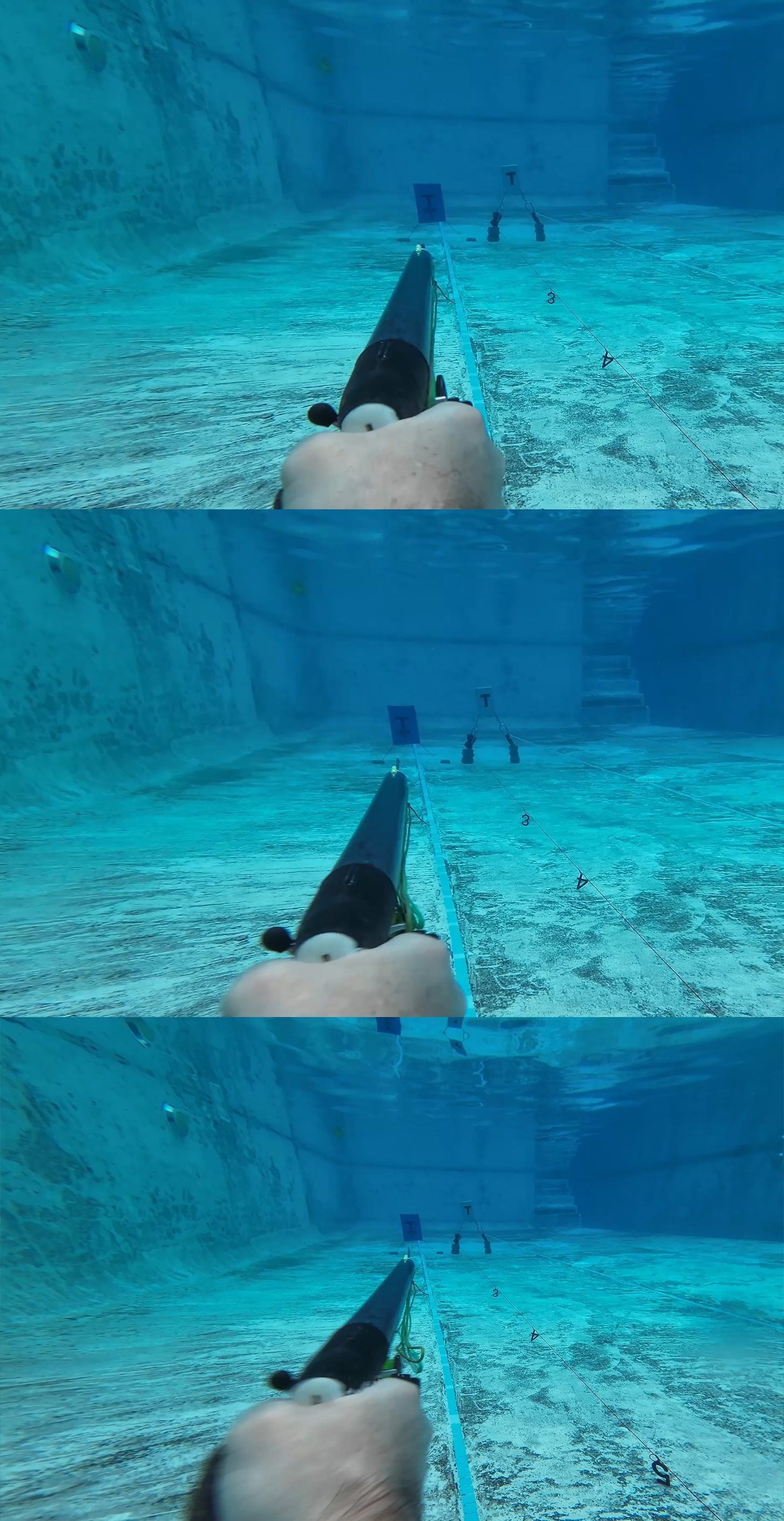
Anyhow, it was good getting to shoot a gun again.
And yes, my friend's pool looks dirty but that's just the paint getting old and supposedly it's not easy painting under water... The viz is the best I have seen for a long, long time. Made it really easy to see the targets. I shot everything at 4m from the tip today except a few shots at 5m to check for penetration. I generally try to check for both. The penetration target is the quite sturdy yoga brick:
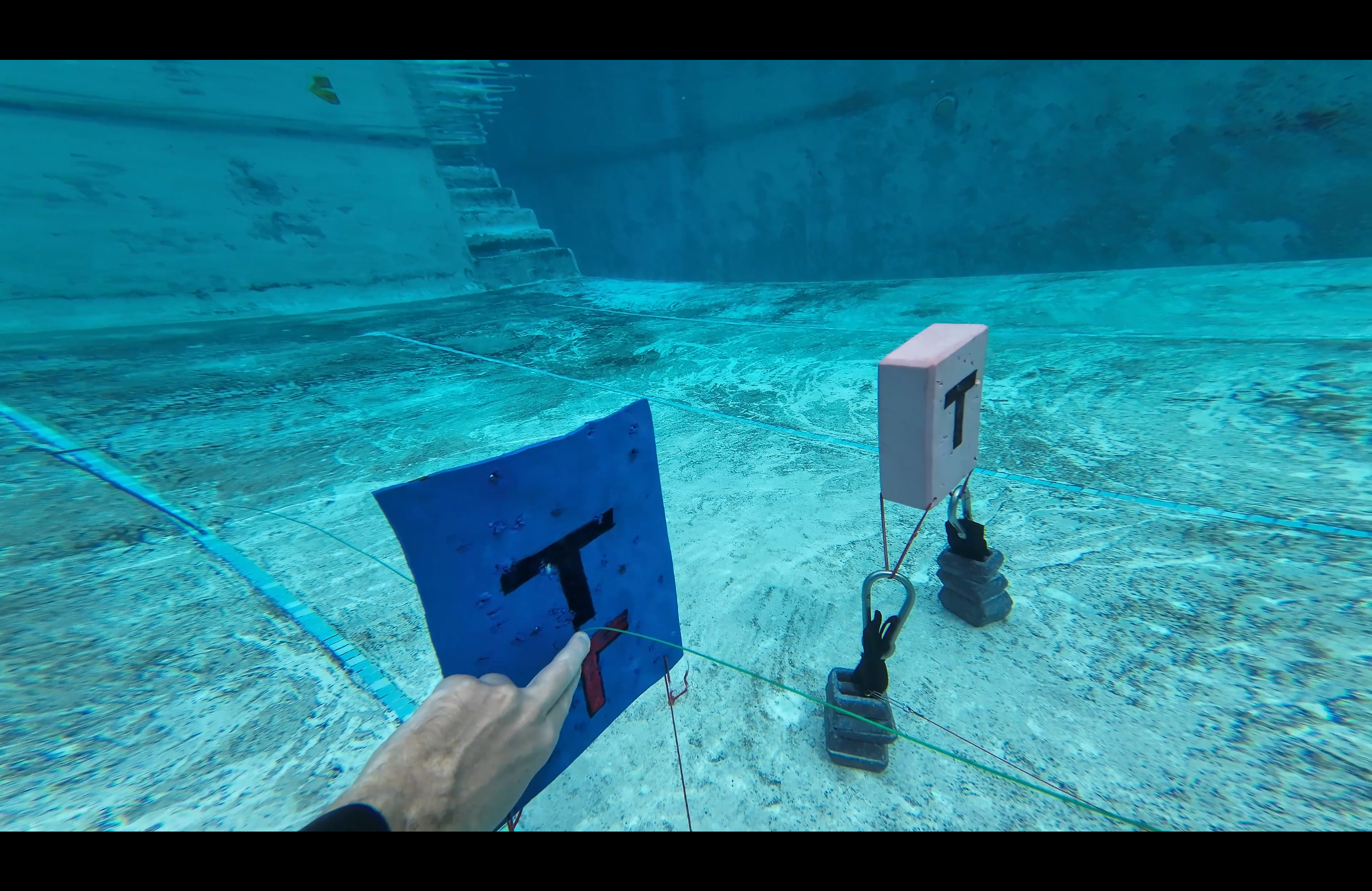
I didn't shoot anything else than the Mirage 100 today but since I knew I had some older video of shooting the Pathos 100 on the exact same target, I wanted to compare the two a bit.
Here's the Mirage 100, shooting a 7mm x 105cm shaft:
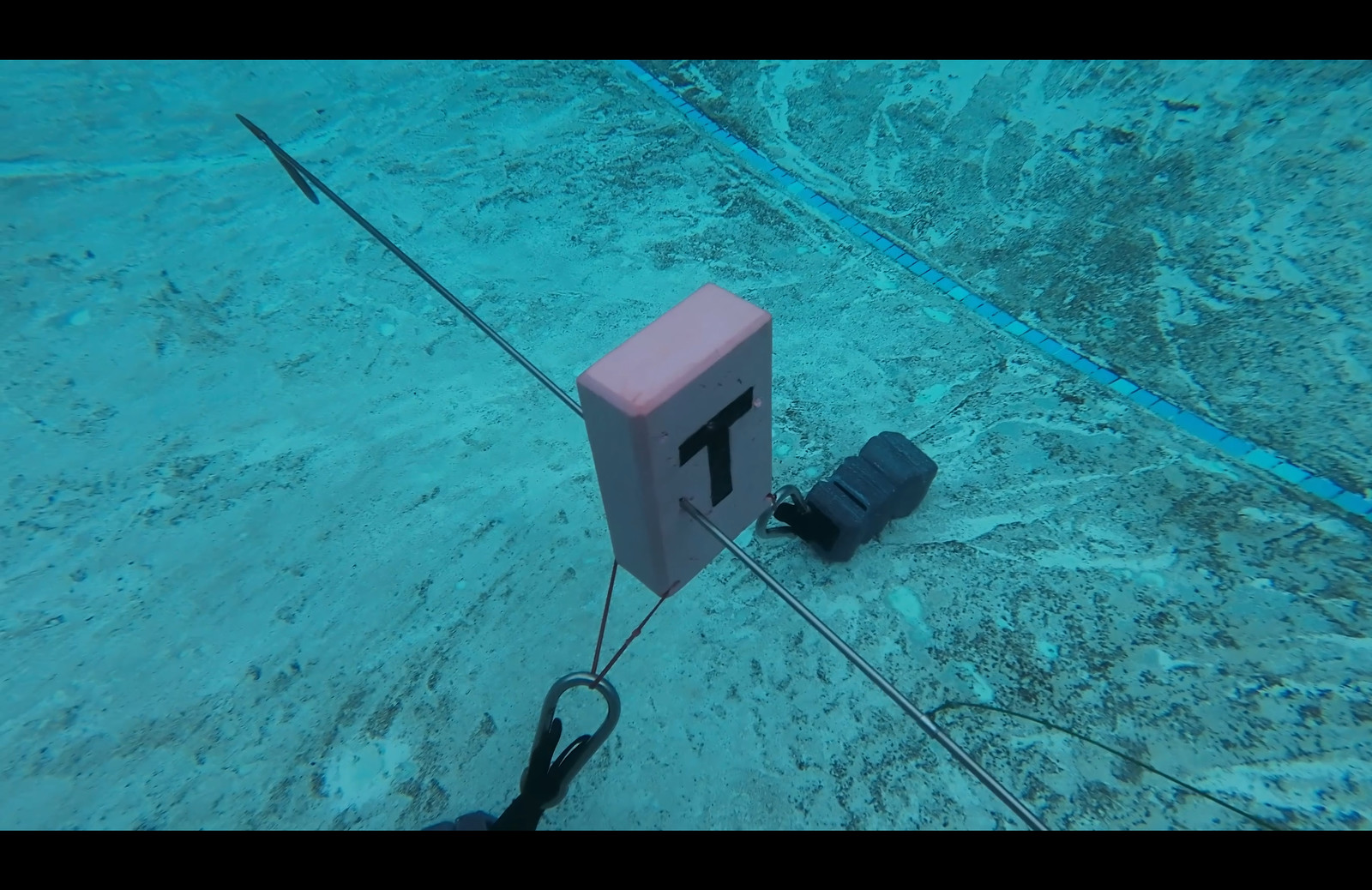
That's almost six-and-a-half hand widths of penetration on the backside of the brick.
And from the archives, the Pathos 100 shooting a 7mm x 130cm shaft had this much penetration, also at 5m:
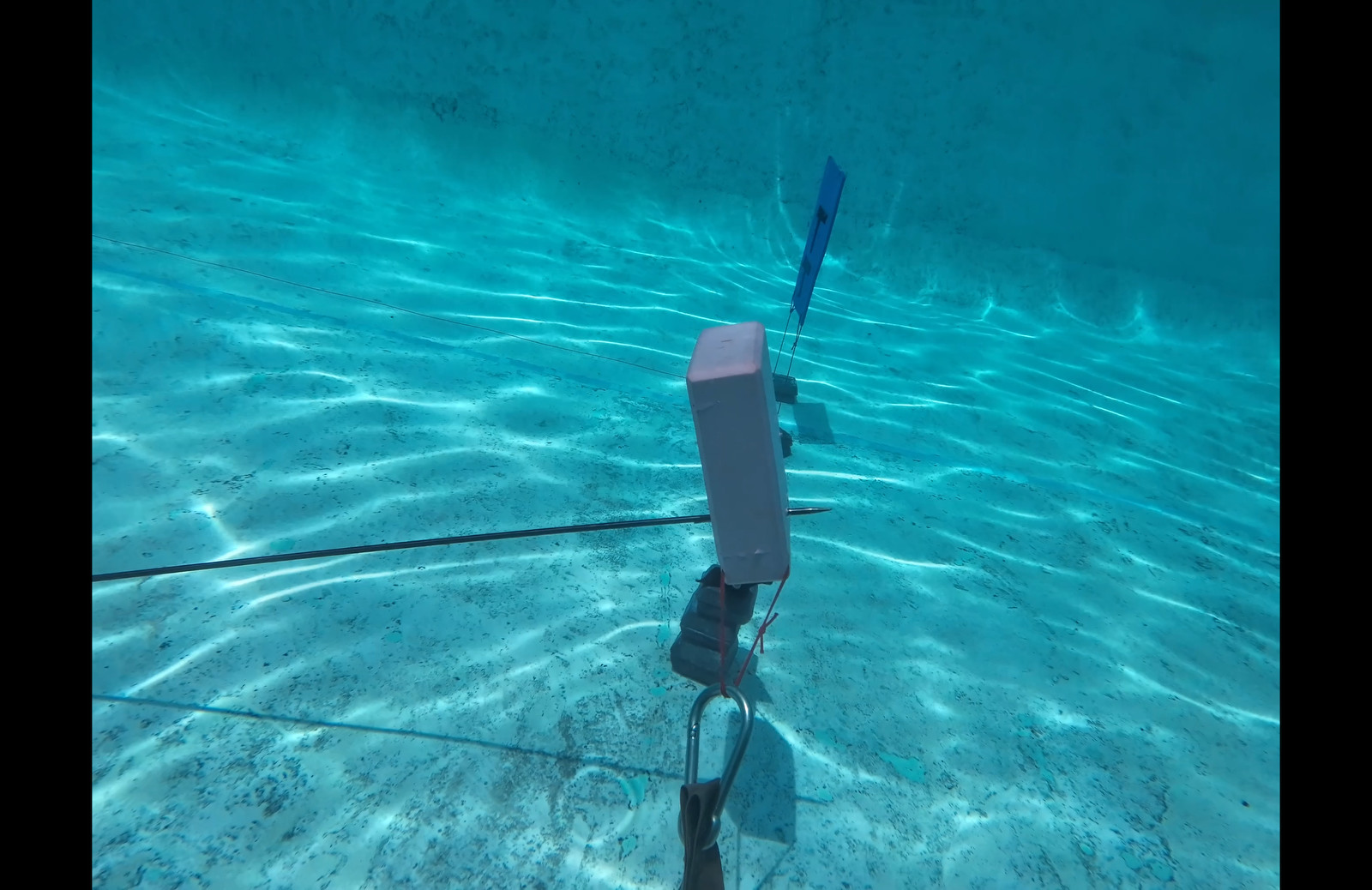
Maybe around half a hand width. BUT there's a chance these rubbers are cooked/old. Somewhere on a storage drive, I have another video from when the rubbers were brand new, but can't recall the results.
Both guns have the same draggy 1.4mm dyneema shooting line on it. It's way overkill and I think it slows down the shaft a lot but I only have one set of slider and tang left in this size for the Mirage and don't want to lose them to a broken line.
But there's more potential still in this Mirage. It was only pressurized to 26-27bar. I have taken them to 38 bar in the past, but mostly to around 33-35 bar.
I am not sure what the penetration test proved between the two. I don't think we can say one gun is X amount more powerful. I guess to non-airgun people it would still be impressive that the shorter and lighter airgun shaft punched this much deeper into the target.
Also, I found that at this pressure, 5 pre-pumping strokes were enough that the final loading was still quite comfortable. I settled on 7 however.
The Mirage manual states to do max 5 strokes. I forgot why though. Maybe because they didn't trust their internal bulkhead parts would stand up to the almost full 40 bar pressure differential if you moved "all" the air. But that feels unlikely - I mean, if it can do 35, it can do 40 bar as they wouldn't have operated with such small safety factors. Maybe it's to do with what's happening when you open the power regulator after the pre-loading? The larger the pressure differential, the faster and with more energy the pressure regulator will come flying back when it's opened. On my gun, it's even worse as the bushing is larger than it was on the original so it has more force on it and it really opens quite violently...
Which reminds me that months ago, I almost finished an alternative bulkhead with a new type of valve to combat this issue. I got stalled, I think I was missing some small drills, but I should be able to finish it now.
@rollerGR
BTW, I think it was you and I and @tromic who talked about measuring speed in pool tests a while back.
And I mentioned there is a way to measure the moment the trigger would let go and when the impact happens. Now, all this recent talk about the Velair finally made me look back at some of Pete's old posts about that gun and then go visit their facebook from where I grabbed these frames from a low res video:
Notice the add-on to the left of the trigger and the electrical wires going down from there.
Now, look to the right of the target, also wires going to the surface
And a closer view:
There are a few ways to collect this data. If it's only for time, then this is one way: They could be using either a switch or a simple piezo element on the handle to sense the shaft leaving the trigger. I am actually guessing it's a switch since it looks a bit bulky, but a piezo should be able to do the same but its signal may need amplifying.
On the target, I am not sure how they are sensing the impact. I have always thought a piezo could do the job, but not sure what they are using.
You would then run these cable to some small analog to digital converter circuitry(?) and into a laptop to time the delta between them and you have the average speed. Or if you used piezos, you could even "just" run them straight into the mic jack of a small audio recorder or a laptop and do an audio recording (in e.g. the free Audacity software) and then measure the time between the peaks. Maybe a small amplifier before the recording would be needed.
There is a chance they may even have some sort of sensor on the target to measure impact energy, maybe some sort of accelerometer, but my guess is it's "just" for speed.
Either way, it was nice to see this. I think I was off the forums when they posted this so may not have seen it at the time but I feel like somewhere else, long time ago, someone presented a similar idea. I am not smart enough to have come up with the piezo and audio idea on my own
.Speaking of pool testing, I was finally back in the pool today:
On the plus side the gun works, the Mirage pumping system was fine through a bunch of shots and loading cycles but it was a bit humbling overall as my aim was super off. I got it dialed in a bit better towards the end. And at least, I was always off in the same direction. Up and left. I think the high shots is me compensating for a shaft drop that isn't there. You really have to aim super flat along the top or side of the tube on an airgun, at least until you get your instinctive aiming sorted but I am starting from scratch again, haha.
But the left shooting is interesting. I think the gun shifts in my hand during the shot. The muzzle swings right which drags the tail of the shaft - which hasn't yet left the gun - with it and thus the shaft leaves the gun at an angle pointing a bit left. And maybe having a bit of a side profile presented to the water can make the shaft drift left?
It sounds counter-intuitive: The muzzle turns right during recoil but the shaft ends up shooting left... But if the muzzle nudges the tail, I think it can explain this behaviour.
Isn't it the same phenomenon with muzzle flip leading to low shots or how some rollers supposedly lift the end of the shaft by the wishbones leading to low shots (the end of the shaft gets lifted up before it has left the gun)?
Also, when I shot with two hands and gripped harder, the issue almost went away.
Here are three frames in a row, if you look really carefully, you may be able to see the muzzle dragging the shaft tail to the right just before the shaft has left the muzzle.
Anyhow, it was good getting to shoot a gun again.
And yes, my friend's pool looks dirty but that's just the paint getting old and supposedly it's not easy painting under water... The viz is the best I have seen for a long, long time. Made it really easy to see the targets. I shot everything at 4m from the tip today except a few shots at 5m to check for penetration. I generally try to check for both. The penetration target is the quite sturdy yoga brick:
I didn't shoot anything else than the Mirage 100 today but since I knew I had some older video of shooting the Pathos 100 on the exact same target, I wanted to compare the two a bit.
Here's the Mirage 100, shooting a 7mm x 105cm shaft:
That's almost six-and-a-half hand widths of penetration on the backside of the brick.
And from the archives, the Pathos 100 shooting a 7mm x 130cm shaft had this much penetration, also at 5m:
Maybe around half a hand width. BUT there's a chance these rubbers are cooked/old. Somewhere on a storage drive, I have another video from when the rubbers were brand new, but can't recall the results.
Both guns have the same draggy 1.4mm dyneema shooting line on it. It's way overkill and I think it slows down the shaft a lot but I only have one set of slider and tang left in this size for the Mirage and don't want to lose them to a broken line.
But there's more potential still in this Mirage. It was only pressurized to 26-27bar. I have taken them to 38 bar in the past, but mostly to around 33-35 bar.
I am not sure what the penetration test proved between the two. I don't think we can say one gun is X amount more powerful. I guess to non-airgun people it would still be impressive that the shorter and lighter airgun shaft punched this much deeper into the target.
Also, I found that at this pressure, 5 pre-pumping strokes were enough that the final loading was still quite comfortable. I settled on 7 however.
The Mirage manual states to do max 5 strokes. I forgot why though. Maybe because they didn't trust their internal bulkhead parts would stand up to the almost full 40 bar pressure differential if you moved "all" the air. But that feels unlikely - I mean, if it can do 35, it can do 40 bar as they wouldn't have operated with such small safety factors. Maybe it's to do with what's happening when you open the power regulator after the pre-loading? The larger the pressure differential, the faster and with more energy the pressure regulator will come flying back when it's opened. On my gun, it's even worse as the bushing is larger than it was on the original so it has more force on it and it really opens quite violently...
Which reminds me that months ago, I almost finished an alternative bulkhead with a new type of valve to combat this issue. I got stalled, I think I was missing some small drills, but I should be able to finish it now.
Last edited:
For a 7mm 105cm shaft (which has decent mass but not super high mass) this is insanely impressive, it means that it can retain its velocity, regardless of whether it's super high/high/moderate for a much longer duration with far fewer losses and thus have better momentum = penetration. Which means its kinetic energy remained high and was very high to begin with
We're talking about fewer energy losses than a roller and WAY fewer losses than a classic band gun
Regarding what I said earlier
In the Mirage, lets assume you have 2x the power without the pump. So one load only, let's say at 30 bar, but the output is 60 bar if that's how pneumatic power is calculated (bar translating to work translating to KE)
Would you prefer this over having
a) a pump that allows you to load 60bar like it's 20bar after 5-6 loads/"pumps"
b) two pumps that allow you to load 90bar like it's 20bar after 5-6 loads in each (so 10-12)
for what I have in mind for a hybrid, the output would be this:
one would be having 120bar output like loading a single 17,5mm rubber, a) would be having 120bar output like loading a single 14,5mm rubber (5-6 loads), b) would be having 180bar like loading a single 14,5mm rubber (10-12 loads)
if there's enough space in the gun's body you can theoretically get 200-240bar like loading a single 17,5mm rubber
I'm trying to get an opinion from someone who uses airguns. For bandguns we can set up a 6-band invert roller and it would shoot extremely well but almost nobody would choose it because it's overkill for everything except marlin and some beefy tunas and takes forever to sort out and load. So most people would pick 3-4 bands for their needs
We're talking about fewer energy losses than a roller and WAY fewer losses than a classic band gun
Regarding what I said earlier
In the Mirage, lets assume you have 2x the power without the pump. So one load only, let's say at 30 bar, but the output is 60 bar if that's how pneumatic power is calculated (bar translating to work translating to KE)
Would you prefer this over having
a) a pump that allows you to load 60bar like it's 20bar after 5-6 loads/"pumps"
b) two pumps that allow you to load 90bar like it's 20bar after 5-6 loads in each (so 10-12)
for what I have in mind for a hybrid, the output would be this:
one would be having 120bar output like loading a single 17,5mm rubber, a) would be having 120bar output like loading a single 14,5mm rubber (5-6 loads), b) would be having 180bar like loading a single 14,5mm rubber (10-12 loads)
if there's enough space in the gun's body you can theoretically get 200-240bar like loading a single 17,5mm rubber
I'm trying to get an opinion from someone who uses airguns. For bandguns we can set up a 6-band invert roller and it would shoot extremely well but almost nobody would choose it because it's overkill for everything except marlin and some beefy tunas and takes forever to sort out and load. So most people would pick 3-4 bands for their needs
Technically if we can get the m/s of a shaft at a few given distances we can compare how % better a gun is at delivering power than another one, assuming shaft mass is the same. Often power comes not from loading it up too much but from minimized energy losses. and the superior performance of airguns compared to classic bandguns confirms that ramping up work does indeed work and can fix bad shots when we thought there's some other reason or when we thought that the shaft can't go faster (because it can. It can go insanely fast as long as it's not a classic gun haha)But there's more potential still in this Mirage. It was only pressurized to 26-27bar. I have taken them to 38 bar in the past, but mostly to around 33-35 bar. I am not sure what the penetration test proved between the two. I don't think we can say one gun is X amount more powerful. I guess to non-airgun people it would still be impressive that the much shorter and lighter airgun shaft punched this much deeper into the target.
Ha just saw this, no pun intended. Or should it be no pump intendedramping up work does indeed work

This is very anectodal but could be tested a bit more in depth. But I do feel like I had very little shaft drop. Early on in the session, most of my shots were high. I specualate that I was anticipating more shaft drop over the distance and had almost none. Whilst I haven't freedive trained nor speared much in 2025, the spearing I did do was with bandguns so that might have been why I kept shooting high.For a 7mm 105cm shaft (which has decent mass but not super high mass) this is insanely impressive, it means that it can retain its velocity, regardless of whether it's super high/high/moderate for a much longer duration with far fewer losses and thus have better momentum = penetration. Which means its kinetic energy remained high and was very high to begin with
We're talking about fewer energy losses than a roller and WAY fewer losses than a classic band gun
I did see some drop when I went from 4m to 5m. (assuming my aim was not to blame). But the way to better test this is just to shoot more distances. Anyhow, even with the drop we had plenty of energy left for the penetration.
OK, I may almost be getting it now, haha. The "x2 the power" refers to the guesstimate of the increased efficiency over a classic bandgun, right? And since you say "one load only" we are talking a classic airgun without the secondary pumping varrel vs a bandgun(Or a Mirage at more normal pressures).Regarding what I said earlier
In the Mirage, lets assume you have 2x the power without the pump. So one load only, let's say at 30 bar, but the output is 60 bar if that's how pneumatic power is calculated (bar translating to work translating to KE)
BTW, I can't load a non-Mirage gun at 30bar. Only at ~23bar which does result in a force on the piston of ~30kgf.
But then this confuses me: "let's say at 30 bar, but the output is 60 bar"...
In a classic, one barrel airgun, 30 bar is 30 bar (which pretty much no one can load). 30kgf, yep, but not 30bar (not on 13mm pistons which is the most common standard).
So, 30 bar turning into 60 bar would be the Mirage again where you can double the output vs. the input. But yes, if we substitute bar for kgf that's true for a x2 Mirage system. My max peak loading ability is 30kgf. If I put that on the loading piston, then I get ~60kgf on the shooting piston. Or in pressure, it would mean, I can put twice as high a pressure into the gun as I could in a non-Mirage.
In reality, I have found that I like to split the difference a bit. So, whilst I could max it out fully, these days I like to actually not have to even use my peak loading force. So, I may run pressures that will give me something like a 26-28kgf peak or even a bit less. It makes loading nicer than on a classic airgun but still gives me more than a x1.5 increase in shot power. But I could of course get all the way to the x2 full power if I wanted to load at max peak force. (Max "force multiplier" is x1.7 on a stock Mirage).
That said, the loading force on the gun yesterday was as little as ~18kgf (helped by the smaller than normal loading piston) but I would have gotten around 36kgf on the shooting piston (not counting the compression ratio effect at the end of the stroke).
We are talking a hybrid, now right ? Because I can't build a Mirage with a x3 surcompressor (Pete's terminology but so very likely the best and most correct one for different pump types doing the same thing). I could get x3 with a lever type surcompressor but not if using a shaft in a secondary barrel.Would you prefer this over having
a) a pump that allows you to load 60bar like it's 20bar after 5-6 loads/"pumps"
Also, the "20bar after 5-6 loads" confuses me. I am daft, I know. But I can only think in starting force because as you know it decreases fast after that. So, only peak force on the very first loading stroke should matter, right? Because that will always be our limitation.
b) two pumps that allow you to load 90bar like it's 20bar after 5-6 loads in each (so 10-12)
for what I have in mind for a hybrid, the output would be this:
one would be having 120bar output like loading a single 17,5mm rubber, a) would be having 120bar output like loading a single 14,5mm rubber (5-6 loads), b) would be having 180bar like loading a single 14,5mm rubber (10-12 loads)
if there's enough space in the gun's body you can theoretically get 200-240bar like loading a single 17,5mm rubber
I will have to simplify it a bit, hope that's OK.
A). would be a x3 surcompressor taking just 5-6 loading pump strokes.
B). would be a x4.5 surcompressor where you have two different pumps and end up with a total of 10-12 pumps.
Here's the thing, I don't think I can give you a clear answer. I think it would depend on the type of hunting. So, e.g. if you're bluewater hunting for huge, thick bodied pelagics, I would say B. I wouldn't mind the loading taking longer.
But if you are on the reef, having x2 - x3 more power should already be plenty so I would think having faster/easier loading would be a worthy trade off.
And then add that thing I mentioned above about splitting the difference. So, I may not even want to have to tire myself out loading at peak force. So, I could take either A) or B) and drop the pressure a bit and not have to load at peak force and I would still have the best of both worlds - Super power and easy loading.
It's actually one of the nice things about airguns. You can tailor the gun to different modes by playing with the pressure. Easier than cutting new bands and having to figure out preload, stretch, thickness, etc.
Here's a thing I may never have mentioned, but of thes reasons I would want a built-in lever type pump is because I could then do all the loading on the boat in between drops. And because when loading in the water, using a shaft to do the pre-pumping becomes unwieldy on longer guns. Also, as I mentioned elsewhere, not having a full length secondary barrel would allow me to slim down the front of the gun substantially.I'm trying to get an opinion from someone who uses airguns. For bandguns we can set up a 6-band invert roller and it would shoot extremely well but almost nobody would choose it because it's overkill for everything except marlin and some beefy tunas and takes forever to sort out and load. So most people would pick 3-4 bands for their needs
Why the boat loading? Well, when I go to Indonesia we do drift dives on a very small dogtooth tuna spot. Sometimes you barely have time to load and prepare before you get over the spot. Of course, we need to keep our guns loaded on the boat (only do this with people you fully trust). But imagine I could sit there between drops and just pump the gun and then the only thing I had to do once I got in the water was to slide in the shaft with minimal effort, wrap the shooting line and open the valve before diving... This is a niche use case, but it would be a really sweet feature.
That gun would have a thicker shaft, perhaps 9mm, but with all that power on tap, I could make it shorter, so I would end up with a BW gun that would still be much easier to maneuver in the water than any of the high powered rollers that are being favored now. Don't get me wrong, they are amazing. But I personally would prefer having a smaller gun with enough or the same power and those guns are getting really, really big.
All this said, the key is to make the small air chamber absolutely tiny. I have done a bit of thinking, math, CAD on this and if I can use about the same force on a small lever pump as on a Mirage "shaft pump", I am still not moving much air with the lever pump because the piston stroke travel will be much shorter. I can't recall the exact numbers, but where a shaft type pump may only need 5 strokes, a lever pump would have needed perhaps 20. Just spit balling here. But that's the only downside - and then packaging it all inside the gun. But as you can tell, it's an idea I can't let go off.
Last edited:
It might be possible if you mark increments on the pool wall and set up a "high speed camera" shooting from the side showing the full length of the shot. But it would likely have to be in an outside pool on a very sunny day (high frame rates mean shorter exposures = less time to "gather" light. And actioncams don't like high ISOs on top of that).Technically if we can get the m/s of a shaft at a few given distances we can compare how % better a gun is at delivering power than another one, assuming shaft mass is the same.
But it might be possible to freeze the motion by shooting 240fps which newer actioncams can do and then it might be possible to count frames between each interval marked on the wall and thus get a few different speeds.
I could hang lines down from the pool edge at 1m intervals. Would be fairly easy to set up.
I will put it on the list of the many things that would be nice to try if time allows
.Yes, I think you/we/the oleo aficionados must be correct about how it's the minimal losses that make these guns stand up so well in comparison to rubber guns. You have made that even more clear to me in highlighting how much more energy the rubber platforms actually store and yet, we can easily compete.Often power comes not from loading it up too much but from minimized energy losses. and the superior performance of airguns compared to classic bandguns confirms that ramping up work does indeed work and can fix bad shots when we thought there's some other reason or when we thought that the shaft can't go faster (because it can. It can go insanely fast as long as it's not a classic gun haha)
As for the belief in "loading up" guns here's me going on another tangent, but I first got into spearing around the time when things seemed to be taking a step forward on bandguns. And it seems to me that until about 10 years or so ago, many builders thought more power was the solution to most problems - especially in the US.
Amongst one of Majd's (SpearQ8) first controversial findings was the one that enclosed tracks did nothing else than rob the shaft of speed. People liked to think it prevented whip which was why they could add more rubber. But it was the opposite - the track was so inefficient they had to add rubber.
I recall in one of his projects, he even ground whe whole enclosed track off of a Pathos roller (?) and showed that that alone was a huge improvement. Next, he got rid of the non-optimal roller system and converted to a classic setup and that made it better, too (that said, I do think he was always OK with more recoil). He probably did his whole grip modification too and then finally tuned it with Small ID rubbers and a well matched shaft. He did this pretty much step by step and pool tested each incremental change.
He did that to a Euro brand but I think he had already stated that none of his enclosed wooden guns shot that well and of course many US builder and manufacturers were selling enclosed wooden guns to the masses and they did not like his findings.
Same with the advent of Small ID, I recall a few builders specifically saying they wouldn't work. Yet, a few years later that's all they put on their own guns. (Small ID was probably already the bee's knees in certain places in Europe).
Of course, some other things I think helped push things along around that time was nice high Euro handles (like Pathos) and good reverse triggers and then in terms of high powered guns, Abellan putting out a well tuned classic gun might have helped a bunch, too.
One that always made me giggle was seeing big wooden wings on BW guns to prevent muzzle lift when all the time those guns had super lower handles. But Americans are historically guilty of thinking more power and bulk is the solution to problems that need finesse more than anything
People may or may not agree with all of Majd's work, but he did do more controlled testing than pretty much anyone at the time. Speaking of shaft speeds and limits, he liked to talk about a terminal velocity for shafts. I can't recall but he may have meant where the shaft really starts wobbling so much that it hurt penetration. I did notice that you mentioned that a shaft can wobble a whole lot in flight and still be precise which I found really interesting. The only thing I notice when seeing airgun shafts fly is what looks to be a whole lot of cavitation...
Last edited:
Placing the flopper on the underside and not having a double flopper helps a lot with reducing shaft drop as well as increasing energy retention due to lower drag. So it makes sense.This is very anectodal but could be tested a bit more in depth. But I do feel like I had very little shaft drop. Early on in the session, most of my shots were high. I specualate that I was anticipating more shaft drop over the distance and had almost none. Whilst I haven't freedive trained nor speared much in 2025, the spearing I did do was with bandguns so that might have been why I kept shooting high.
I did see some drop when I went from 4m to 5m. (assuming my aim was not to blame). But the way to better test this is just to shoot more distances. Anyhow, even with the drop we had plenty of energy left for the penetration.
x2 the power just means doubled the power of what you had before, in the same airgun. Let's say there is a magic spell that allows you to shoot with double the power, but the same loading effort.OK, I may almost be getting it now, haha. The "x2 the power" refers to the guesstimate of the increased efficiency over a classic bandgun, right? And since you say "one load only" we are talking a classic airgun without the secondary pumping varrel vs a bandgun(Or a Mirage at more normal pressures).
BTW, I can't load a non-Mirage gun at 30bar. Only at ~23bar which does result in a force on the piston of ~30kgf.
But then this confuses me: "let's say at 30 bar, but the output is 60 bar"...
In a classic, one barrel airgun, 30 bar is 30 bar (which pretty much no one can load). 30kgf, yep, but not 30bar (not on 13mm pistons which is the most common standard).
So, 30 bar turning into 60 bar would be the Mirage again where you can double the output vs. the input. But yes, if we substitute bar for kgf that's true for a x2 Mirage system. My max peak loading ability is 30kgf. If I put that on the loading piston, then I get ~60kgf on the shooting piston. Or in pressure, it would mean, I can put twice as high a pressure into the gun as I could in a non-Mirage.
In reality, I have found that I like to split the difference a bit. So, whilst I could max it out fully, these days I like to actually not have to even use my peak loading force. So, I may run pressures that will give me something like a 26-28kgf peak or even a bit less. It makes loading nicer than on a classic airgun but still gives me more than a x1.5 increase in shot power. But I could of course get all the way to the x2 full power if I wanted to load at max peak force. (Max "force multiplier" is x1.7 on a stock Mirage).
That said, the loading force on the gun yesterday was as little as ~18kgf (helped by the smaller than normal loading piston) but I would have gotten around 36kgf on the shooting piston (not counting the compression ratio effect at the end of the stroke).
We are talking a hybrid, now right ? Because I can't build a Mirage with a x3 surcompressor (Pete's terminology but so very likely the best and most correct one for different pump types doing the same thing). I could get x3 with a lever type surcompressor but not if using a shaft in a secondary barrel.
Also, the "20bar after 5-6 loads" confuses me. I am daft, I know. But I can only think in starting force because as you know it decreases fast after that. So, only peak force on the very first loading stroke should matter, right? Because that will always be our limitation.
Yes you are right I forgot about the piston diameter haha. I'm still thinking in bandgun terms. By "bar" i was translating to 1:1 kgf in my head. So for any of these numbers just assume it's kgf and that it results from a 13mm piston so around 23-24 bar, or more bar for a smaller piston.
The 30kgf turned into 60 isn't using a Mirage system with pump-style loadings, there is a specific configuration that this can be set up. It might not make sense when I write it ("how does 30kgf turn into 60 all of the sudden??") but if you see it you can understand immediately what I mean.
For the sake of simplicity let's say that there's a double barrel. in a pneumatic this isn't feasible (it would need two shafts) but in a hybrid it is, for example early designs of the Dreamair were double roller style
20"bar"(kgf) after 5-6 loads refers to the shooting barrel which is now easier to load. The full description would be "The shaft is inserted into the main barrel after 5-6 pumps in the pumping barrel"
Yes all the examples I mention are possible with a hybrid but I am giving them in the Mirage so you can compare it to it (since the mirage exists and the hybrid does not). I'll try to give a rundown again because I think I mentioned four examples when I detailed only three. I will be using the Mirage as an example again, assuming we have a magic spell that can make it do these
1) 2x the kgf of the shot with no need for any pumping. Loading effort is not doubled however, if you have a max shot of 56kgf then loading effort would be 28kgf.
2) 4x the kgf with no need for any pumping. Loading effort is not doubled here either, it's still 28kgf. There is a trick for that (impossible on any airgun but let's assume that it is)
3) 4x the kgf with pumping so around 20kgf loading effort
4) 6x the kgf with two pumps so around 20kgf loading effort again but requires more pumps
that being said an option 5) is theoretically possible with 8x the kgf and flat loading effort (significant pumping required)
so, which one of these 4 would you find more appealing to hunt with on reef and BW? I'm trying to weigh pros and cons with input from someone who uses airguns
Two different answers is ok, in fact I prefer it. Since there are 4 options that's fine. So I'm assuming reef = more compact handling with less or no pumps (if possible) and no need for huge power. BW = more time to prepare so can sacrifice some handling time for more power. But which of the two do you think suit these scenarios best?Here's the thing, I don't think I can give you a clear answer. I think it would depend on the type of hunting. So, e.g. if you're bluewater hunting for huge, thick bodied pelagics, I would say B. I wouldn't mind the loading taking longer.
But if you are on the reef, having x2 - x3 more power should already be plenty so I would think having faster/easier loading would be a worthy trade off.
And then add that thing I mentioned above about splitting the difference. So, I may not even want to have to tire myself out loading at peak force. So, I could take either A) or B) and drop the pressure a bit and not have to load at peak force and I would still have the best of both worlds - Super power and easy loading.
It's actually one of the nice things about airguns. You can tailor the gun to different modes by playing with the pressure. Easier than cutting new bands and having to figure out preload, stretch, thickness, etc.
And yeah big rollerguns are really an issue because they have very bad tracking, just like a 5-band classic gun. Invert rollers are better but need 4-5 bands minimum for BW, if 4 bands then they have to be thick and not load effortlessly, and all the dyneema and roller axis and stuff have to be very heavy duty. Still an airgun beats them all in maneuverability, even a hybrid like Dreamair
I'm picturing a vehicle tire valve connected to an air tank that pumps air inside a pumping barrel that then transfers it to the back chamber. Terminology might be off, I just mean that the pumping barrel does not draw its air from the loading barrel, so the pressure in the loading barrel can be kept low to begin withAll this said, the key is to make the small air chamber absolutely tiny. I have done a bit of thinking, math, CAD on this and if I can use about the same force on a small lever pump as on a Mirage "shaft pump", I am still not moving much air with the lever pump because the piston stroke travel will be much shorter. I can't recall the exact numbers, but where a shaft type pump may only need 5 strokes, a lever pump would have needed perhaps 20. Just spit balling here. But that's the only downside - and then packaging it all inside the gun. But as you can tell, it's an idea I can't let go off.
Does this sound feasible?
I train combat sports for over a decade and, just like in swimming, one of the best ways to get more power is to optimize energy efficiency. Not necessarily put more power to a punch (not even spamming hooks) or kick (strike or fin) but to do it with good technique. Because bad technique means tensing up and wasting energy so you just tire yourself out faster for the same energy output as before. So just adding more bands or cutting existing ones very very short has diminishing returns if recoil goes up, jerk goes up, if the flopper(s) is inefficiently set up and all that. There's a kind of "holistic approach" to setting up spearguns for optimal results given the load we put on themYes, I think you/we/the oleo aficionados must be correct about how it's the minimal losses that make these guns stand up so well in comparison to rubber guns. You have made that even more clear to me in highlighting how much more energy the rubber platforms actually store and yet, we can easily compete.
As for the belief in "loading up" guns here's me going on another tangent, but I first got into spearing around the time when things seemed to be taking a step forward on bandguns. And it seems to me that until about 10 years or so ago, many builders thought more power was the solution to most problems - especially in the US.
Amongst one of Majd's (SpearQ8) first controversial findings was the one that enclosed tracks did nothing else than rob the shaft of speed. People liked to think it prevented whip which was why they could add more rubber. But it was the opposite - the track was so inefficient they had to add rubber.
I recall in one of his projects, he even ground whe whole enclosed track off of a Pathos roller (?) and showed that that alone was a huge improvement. Next, he got rid of the non-optimal roller system and converted to a classic setup and that made it better, too (that said, I do think he was always OK with more recoil). He probably did his whole grip modification too and then finally tuned it with Small ID rubbers and a well matched shaft. He did this pretty much step by step and pool tested each incremental change.
He did that to a Euro brand but I think he had already stated that none of his enclosed wooden guns shot that well and of course many US builder and manufacturers were selling enclosed wooden guns to the masses and they did not like his findings.
Same with the advent of Small ID, I recall a few builders specifically saying they wouldn't work. Yet, a few years later that's all they put on their own guns. (Small ID was probably already the bee's knees in certain places in Europe).
Of course, some other things I think helped push things along around that time was nice high Euro handles (like Pathos) and good reverse triggers and then in terms of high powered guns, Abellan putting out a well tuned classic gun might have helped a bunch, too.
One that always made me giggle was seeing big wooden wings on BW guns to prevent muzzle lift when all the time those guns had super lower handles. But Americans are historically guilty of thinking more power and bulk is the solution to problems that need finesse more than anything
People may or may not agree with all of Majd's work, but he did do more controlled testing than pretty much anyone at the time. Speaking of shaft speeds and limits, he liked to talk about a terminal velocity for shafts. I can't recall but he may have meant where the shaft really starts wobbling so much that it hurt penetration. I did notice that you mentioned that a shaft can wobble a whole lot in flight and still be precise which I found really interesting. The only thing I notice when seeing airgun shafts fly is what looks to be a whole lot of cavitation...
classic bands + enclosed tracks = big energy loss, this is correct. Due to jerk/vibrations the shaft is literally banging against the ET which increases its "bleeding" of kinetic energy. At the same time it doesn't do anything for shaft whip because virtually 100% of shafts don't experience shaft whip, there are no guns that are THAT loaded up while using a very thin shafts. What most spearos claim is shaft whip that "hurts accuracy" in reality is
-bad aim
-recoil
-massive losses (for various reasons)
-all of the above
If a shaft is aimed well and does not have significant energy losses, it can wobble like spaghetti and it will still hit dead center, same as arrows. In fact most shafts do wobble during flight and this doesn't affect their accuracy. Even 8mm shafts
that being said the pathos roller used/uses a booster which is one of the best ways to sabotage a roller setup. It doesn't add much work on the shaft while dramatically increasing losses and recoil WHILE making the acceleration curve sharper which also hurts efficient energy charging (ramping)
Small ID bands don't make a huge difference from what I recall, it's more about the rubber itself. Sigal extreme are very good and would be very good with normal (NOT large) ID but having small ID on a mostly latex band like Cetma's allows for thicker coating that makes the rubber far stiffer and, even if less efficient, allows for bigger energy storing. Small IDs work better if you cut the rubbers short so let's say ~3,6-3,8 because their small % increase is amplified by the non-linear stored energy increase. Still, this is not a better solution but just a different one as short rubbers do lose significant part of their energy after 30-60 mins (measured) and revert to ~3,1 all while they do have high recoil (as you noticed too) and therefore energy losses. What helps a lot with shorter bands is that the gun has a longer active barrel length so it becomes closer to a roller. Shaving off centimeters from the bands means the shaft is pushed during those extra centimeters
Yeah the wooden wing addons do look goofy too. Adding a horizontal grip at the stock to grip with the left hand while shooting (exactly like the Stem SMG's magazine) would help much more with recoil. Not that these guns aren't powerful, they are, but what's the point of using 5-6 bands when you can use 3 or 4, or a double roller or something like that for the same performance and a far better shooting experience
"Terminal velocity" is something I've heard a few times but it's always someone underpowering a gun or having a moderate setup with a heavy shaft, reaching let's say 35m/s and thinking that that's as far as it can go. In reality it can go up to 42m/s+ with some overkill setups but shaft wobble (whip) was never an issue. I don't know who came up with it but for the way it's used, it's a myth and there are no physics constraints that say a shaft can't reach far higher speeds as long as it doesn't have big losses as the only limit is the speed with which bands contract (or the piston moves). All these guns are BW guns by the way because their shafts do reach far and with good penetration but only due to shaft mass. Shaft speed suffers and is the reason nobody uses such setups here in Greece or Italy or Turkey or Croatia. They can't catch small fast fish hovering at 5m distance because the shaft takes a while to get there. They absolutely do not get to the 140-150milisec mark at 4 meters required for dentex, for example. There are no measurements to back up their claims and Spiller's paper showed far higher numbers so I think it's just a canon to the people using it and they think they have some "special insight" while beefing with spearos from the Americas who use guns a bit more similar to Med standards like 3x16 + 7mm shaft (this works great by the way) for faster shots on faster moving prey sitting at a longer distance without wanting the recoil of an 8mm.
At the end of the day it's mostly a market thing, if a best-selling speargun has setup A then setup A will be assumed to be optimal as long as it catches fish. 90% of spearos shoot fish at close range (and aren't hunting tunas) so they'll never have an issue.
An emerging meta I've seen is deep spearfishing with pneumatics because they have fewer losses than bands in increased depths
I think I know how this originally came up as an intuitive (but inaccurate) explanation: placing heavy 7,5m and 8mm shafts on guns that are a must for penetration on big game, and then building the setup from there. Because using 3x16mm or more on such a shaft gives very bad recoil they just settled for fewer bands. Using thinner small ID bands with big stretch coefficient (~3,6+) gives similar power (energy) to slightly thicker bands but with less recoil. Thinner shafts weren't performing as well for penetration (lost a lot of energy) so the explanation was that it was the rubbers that are too "powerful" for the shaftthere are no physics constraints that say a shaft can't reach far higher speeds as long as it doesn't have big losses as the only limit is the speed with which bands contract (or the piston moves).
What I observe here is that these heavy shafts can sustain their trajectory and energy better even when they are used with a slip tip or double flopper since these amplify energy losses due to increasing drag
Basically it's the same way very thin shafts don't work very well on pneumatics, it's not that they aren't powerful but they just lose energy very quickly and most that I've seen have a double flopper
In terms of pure efficiency pneumatics are best, but loading is the main limiting factor. A 30kgf on the shaft seems enough to deliver similar power to a classic gun loaded up 4 times more (taking losses into account), so something like 2x17,5mm
I have a very well developed flopper OCD so I always place the flopper on the underside - the thing about oleos, is that shafts can turn. A small downside yet a little win for the hybrids.Placing the flopper on the underside and not having a double flopper helps a lot with reducing shaft drop as well as increasing energy retention due to lower drag. So it makes sense.
In general, the advice is to never turn the shaft after it has latched into the trigger sear. Some spearos have experienced misfires due to the turning.
Two small challenges remain in me being able to give you an answer, haha. I realized, probably through Pete's many educational posts over the years, myself getting into CAD that I often need visual aids in understandining mechanical concepts. And yet, I still also find I like/need to understand the details. A bit of a dilemmaYes all the examples I mention are possible with a hybrid but I am giving them in the Mirage so you can compare it to it (since the mirage exists and the hybrid does not). I'll try to give a rundown again because I think I mentioned four examples when I detailed only three. I will be using the Mirage as an example again, assuming we have a magic spell that can make it do these
1) 2x the kgf of the shot with no need for any pumping. Loading effort is not doubled however, if you have a max shot of 56kgf then loading effort would be 28kgf.
2) 4x the kgf with no need for any pumping. Loading effort is not doubled here either, it's still 28kgf. There is a trick for that (impossible on any airgun but let's assume that it is)
3) 4x the kgf with pumping so around 20kgf loading effort
4) 6x the kgf with two pumps so around 20kgf loading effort again but requires more pumps
that being said an option 5) is theoretically possible with 8x the kgf and flat loading effort (significant pumping required)
so, which one of these 4 would you find more appealing to hunt with on reef and BW? I'm trying to weigh pros and cons with input from someone who uses airguns
Not urging you to spend time with pen and paper, just saying some of this still escapes me. But your scenarios are OK now (I just have to fight my urge to understand how you can have your cake and eat it, too, haha).Second part of the challenge is the same as before; I think it depends a lot. On the hunting type and on personal preference.
Oh, there's a third. We don't yet know how efficient a hybrid is vs. an oleo. But let's be nice and assume it's close and then perhaps later, we will need to adjust our preferences in case the losses have enough of an impact.
But let me give it a go
If the hybrid is close to an oleo in terms of efficiency, I think this setup sounds amazing. It sounds like it would be simple, fast and with plenty of power for most cases. Also, if no need for pumping, perhaps this gun can be built more simple, perhaps even slimmer?1) 2x the kgf of the shot with no need for any pumping. Loading effort is not doubled however, if you have a max shot of 56kgf then loading effort would be 28kgf.
I have been talking quite a bit away from the forum with our new member @dentex_cas and we both agree that an oleo loaded at around 29-30kgf is a very powerful weapon on the reef and for, let's call it, light bluewater. So, amberjacks and such. I think we can basically say it can power up a 7mm shaft incredibly well and a 6.5/6.75mm would be many Med spearos choice. Not so sure about 7.5mm though for sure an 8mm shaft would need more to really start feeling fast enough.
Anyhow, if 29-30kgf is enough for the vast majority of hunting on the reef, then having double that means you would already have a jack-of-all-trades gun that could shoot heavier shafts if needed. Or again, split the difference and use a shorter gun of this type for those benefits.
Both sounds incredibly powerful. I think, no math done, but we could be looking at powering up 9mm shafts for bluewater hunting here, perhaps even thicker. Or given your taken on how all shafts wobble and still retain speed and accuracy you could have a thinner, more "normal" size hypersonic missile of a shaft. All those scared fish in the Med would now never have stand a chance of running away before the shaft gets to them.2) 4x the kgf with no need for any pumping. Loading effort is not doubled here either, it's still 28kgf. There is a trick for that (impossible on any airgun but let's assume that it is)
3) 4x the kgf with pumping so around 20kgf loading effort
As for 2). vs 3). that one must be personal preference and depend on how fast and cumbersome the pumping is. Also, but a small part of the market, 3). could be for people who for one reason or another are limited in their max. peak. Like age, injuries or other physical limitations. Over the years, we have had a few people ask about what gun to use after, say, rotator cuff issues and such. People who used to be able to load strong bands but now can't but don't wanna give up spearing.
If, a fairly big if, the hybrid has minimal losses, my gut feeling right now is that only very few would need this gun. But it might very well be the best (dogtooth) tuna gun ever made. I mention that specifically because like I explained in a roundabout way earlier, that type of hunting is often done in deep in waters with strong currents and the norm has always been big wooden guns. But I'd rather dive with a much smaller platform, one that not only swings easier and fast enough to track the fish, but also one that takes less energy to simply dive with and handle.4) 6x the kgf with two pumps so around 20kgf loading effort again but requires more pumps
that being said an option 5) is theoretically possible with 8x the kgf and flat loading effort (significant pumping required)
so, which one of these 4 would you find more appealing to hunt with on reef and BW? I'm trying to weigh pros and cons with input from someone who uses airguns
So, while I think this platform will likely have more power than we actually need, it would allow us to make the gun shorter. Thicker, but shorter shaft to keep mass up but on a much smaller than BW-normal gun. That's likely how I would make use of a platform like this.
Also, this gun must surely start getting into the territory where it can reach targets further away than is practical to shoot at? With the Abellan 135, that was already being talked about. How many spearos will take a shot at 6m in real life? With moving targets, less than ideal conditions, a racing heart, etc, etc. But hey, maybe if guns like these happen, 7m will become the new 4m.
So, on one hand, part of me wants to say that 4). and 5). aren't even needed. But just maybe we haven't really pushed the limits enough to see how things start behaving once we get there.
Last edited:
Perfect example of my inability to picture mechanical concepts with visualout aids, haha. That's on me. I will try to find time to read it a few more times and see if the images form in my head, but they haven't yet. But my mind is also already in the workshop on something I want to machine todayI'm picturing a vehicle tire valve connected to an air tank that pumps air inside a pumping barrel that then transfers it to the back chamber. Terminology might be off, I just mean that the pumping barrel does not draw its air from the loading barrel, so the pressure in the loading barrel can be kept low to begin with
Does this sound feasible?
.
Last edited:
I agree with all this and also the previous post where you covered the need for faster shots, especially in the Med.I think I know how this originally came up as an intuitive (but inaccurate) explanation: placing heavy 7,5m and 8mm shafts on guns that are a must for penetration on big game, and then building the setup from there. Because using 3x16mm or more on such a shaft gives very bad recoil they just settled for fewer bands. Using thinner small ID bands with big stretch coefficient (~3,6+) gives similar power (energy) to slightly thicker bands but with less recoil. Thinner shafts weren't performing as well for penetration (lost a lot of energy) so the explanation was that it was the rubbers that are too "powerful" for the shaft
What I observe here is that these heavy shafts can sustain their trajectory and energy better even when they are used with a slip tip or double flopper since these amplify energy losses due to increasing drag
Basically it's the same way very thin shafts don't work very well on pneumatics, it's not that they aren't powerful but they just lose energy very quickly and most that I've seen have a double flopper
In terms of pure efficiency pneumatics are best, but loading is the main limiting factor. A 30kgf on the shaft seems enough to deliver similar power to a classic gun loaded up 4 times more (taking losses into account), so something like 2x17,5mm
I just wanted to add one little thing in terms of the thicker shafts. Again, this is mostly related to doggies which are known to head straight for a rock and thrash shafts and shooting line (same with GT) but not so with pure tunas. But the former two need really heavy "rigging". People shoot either cable or dyneema shooting line. And my feeling is that it really slows down the shaft. So, not only do we need more penetration power for these thick bodied, tough fish we also need more power to carry that extra rigging through the water.
And I would think this drag penalty can be considered a constant, so it would have relatively more impact on a lighter shaft than on a thicker one. If I knew a doggie would just head straight for the horizon, I would still just use mono and a small surface skimming float as you can with e.g. wahoo and spanish macks and you could get away with a lot less mass in the shaft and a less powerful gun.
But it's one of the things I do want to pool test. Dyneema vs. equal thickness mono vs. a "Med thin" mono. Just some penetration tests should be enough.
E.g. the 7mm x 105cm Mirage shaft had 1.4mm dyneema on it, but I would be ok with shooting it on the reef with 1.2mm mono which can still take a small knick or two. But I will only change over once I have extra sliders and tangs as I am on my only 7mm set.
@rollerGR
Low Power Shot
Forgot to say that if you can somehow make the valve between the two chambers also work as a power regulator to enable Low Power shots then that's a nice feature to have - depending on the length of the gun. I know some oleo shooters in the med pull the bulkhead from their guns to save weight and because they feel it may still throttle the high power shots. Also, on longer airguns, you likely wont be sticking them into holes. But on a smaller one, long enough for free swimming fish on the reef but short enough to poke into holes, a low power shot is a really nice feature.
My first Mirages were the original 80 size shooting a meager 84cm shaft and my very first gun was a 90 Seac oleo shooting a 98cm shaft. I could shoot free swimming fish just fine on the reef. And these guns would still be fine to poke into holes which makes sense as overall, they would be as short as a 55-70 bandgun. So, perhaps for the shortest hybrid, a low power shot option could be a welcome feature.
Low Power Shot
Forgot to say that if you can somehow make the valve between the two chambers also work as a power regulator to enable Low Power shots then that's a nice feature to have - depending on the length of the gun. I know some oleo shooters in the med pull the bulkhead from their guns to save weight and because they feel it may still throttle the high power shots. Also, on longer airguns, you likely wont be sticking them into holes. But on a smaller one, long enough for free swimming fish on the reef but short enough to poke into holes, a low power shot is a really nice feature.
My first Mirages were the original 80 size shooting a meager 84cm shaft and my very first gun was a 90 Seac oleo shooting a 98cm shaft. I could shoot free swimming fish just fine on the reef. And these guns would still be fine to poke into holes which makes sense as overall, they would be as short as a 55-70 bandgun. So, perhaps for the shortest hybrid, a low power shot option could be a welcome feature.
Last edited:
Getting Back To The Non-Violent Mirage Valve
Some months back I was working on a new type of power regulator/partitioning valve for the Mirage system and got as far as making the bulkhead and part of the valve before progress stalled. But now, I am back at it.
But why a new type of valve? Well, having a normal Mares style power regulator valve - the simple kind with an o-ring bushing that gets pushed forward into a bore to close off the air transfer passage - is a rough experience on a Mirage. Why? Because after the pre-pumping when you go to open the valve, you have a huge power differential pushing back on the bushing so once you open it, it comes flying back. It really can be quite violent. This is even worse on my particular handle/bulkhead since it has a 9mm bushing where the original Mirage had a smaller one. (Can't recall how small, maybe 7mm - it's in the thread somewhere).
Right now, at the lower pressure I am running the gun at, there's ~15kgf on the valve but if I take the gun up to proper Mirage pressures there would be ~23kgf of initial force on the valve. That wouldn't be fun.
That's why I am making a completely new type of valve. It takes inspiration from the old Scubapro/Predathor type valve where you have a sort of cap with a flat gasket that rests on a lip on the bulkhead. But inside that cap, I am adding a bushing valve.
It looks like this in an older screenshot I probably shared when I was last working on this:
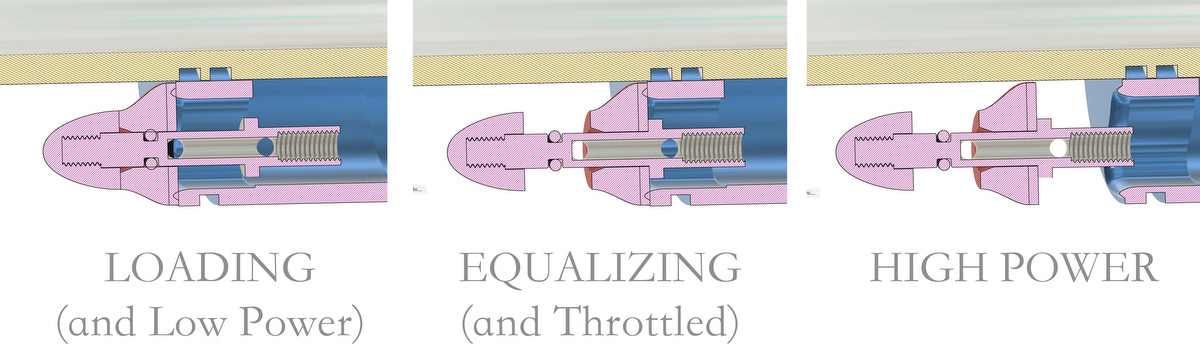
The cap is quite large and the air transfer passage larger than on any classic oleo but since the cap is so large, there's no way I can open it under pressure - since the mechanism is now a "push to open" valve. This is where the smaller bushing inside the valve comes into play - I can indeed push that open even against a big pressure differential and once open, it will expose an internal air channel in the rod that will let the pressure equalize between the front and rear chamber. And once that's happened, I can push the much bigger cap all the way forward for a quite unrestricted shot.
Now, I don't know how long it will take to equalize, we will see. The internal bore in that rod is only 2mm in diameter. This is because the thinner I can make the outside of the rod, the easier it will be to push forward to open and it's only 3.5mm in OD.
Btw, the force required to push the smaller part of the valve open would be around 2.5-3kgf at 25-30bar of pressure differential which might still feel like a lot. Not sure, yet, will know once all the parts are in the gun.
But writing all this makes me wonder if I ever tried drawing up a version where you let the inner valve open backwards to equalize before you then push the whole assembly forward to open the main "gate". This would mean I wouldn't ever need to push against any pressure. Granted, I would now be back to having pressure trying to shoot that valve backwards when opening it but having only 3kgf instead of +20kgf acting on it would probably be a really nice improvement and may feel gentle enough. Actually, at 3kgf, I would proably be able to let it push slowly against my thumb as I let it slide backwards.
Anyhow, time for some pics. Today I managed to get this far:
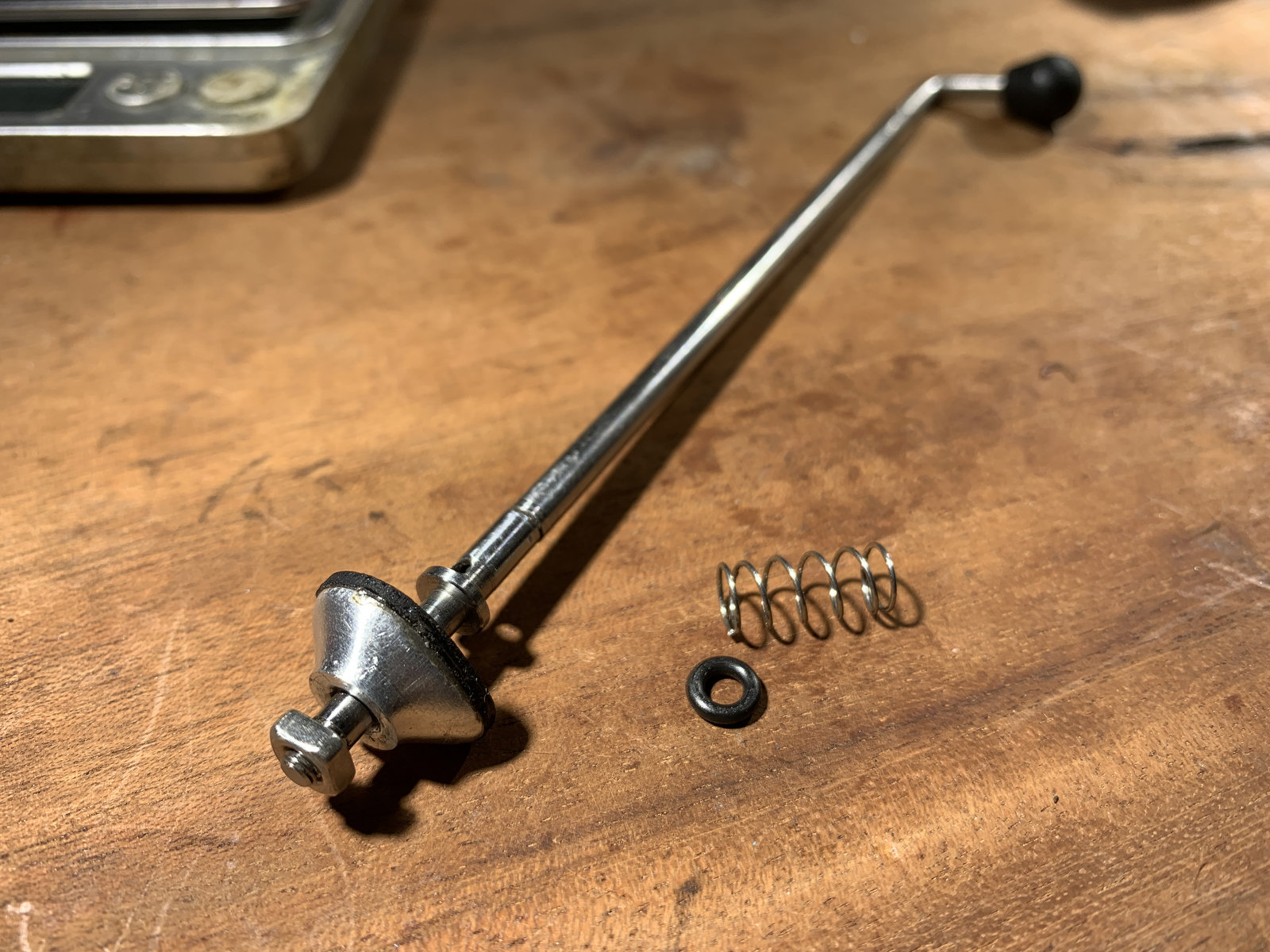
So far, I finished the front part of the power rod, the one with all the features, internal channel, cross bores, etc. And then I had to make a new middle rod. Cutting the internal M3 thread in the gummy stainless used to be a chore but I have gotten pretty good at it. The knob at the end may be from a Predathor or a Mares. Can't recall.
It's all rather small, too:
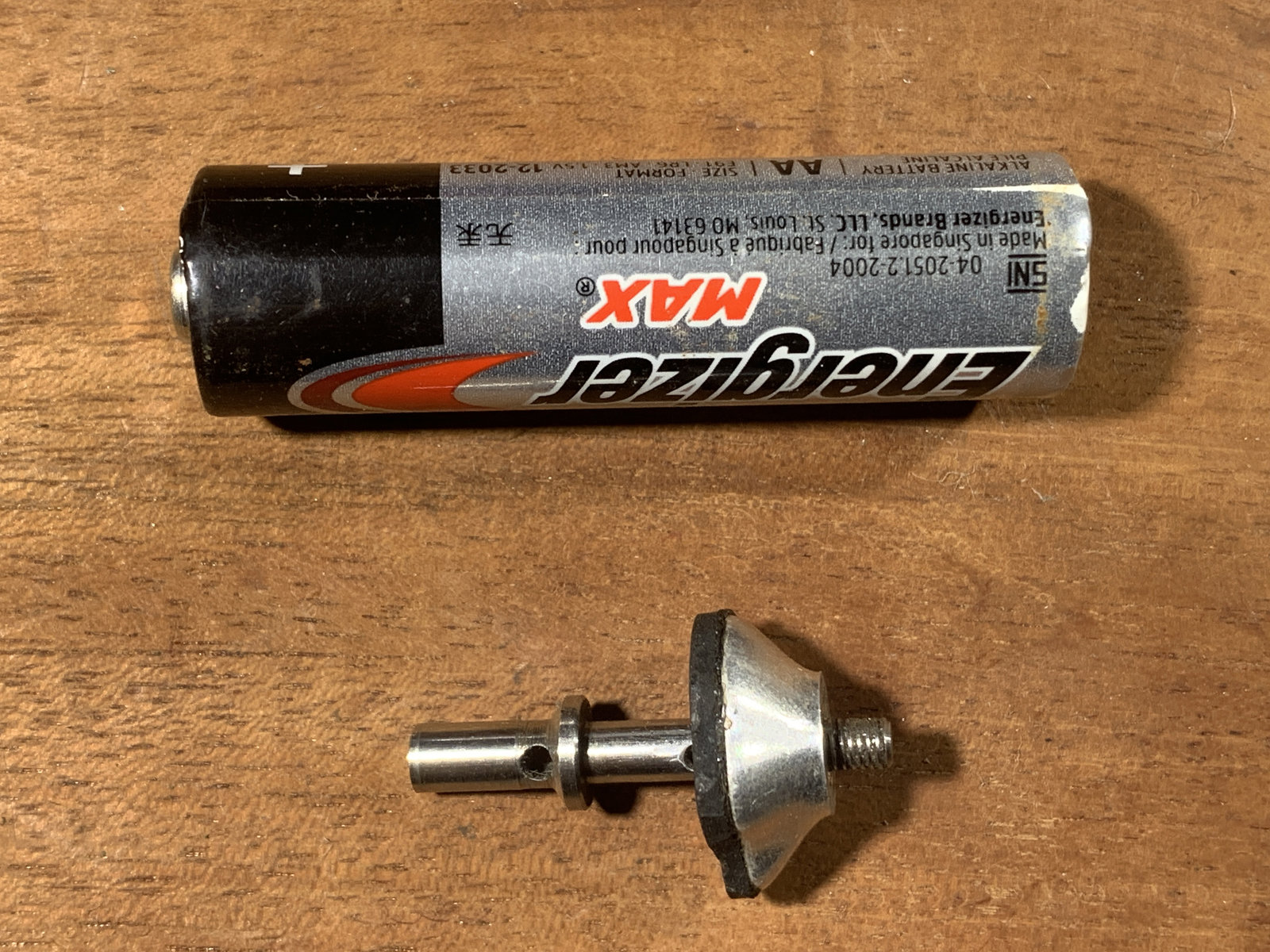
Here you can see the transverse holes - and there's a 2mm internal bore connecting them:
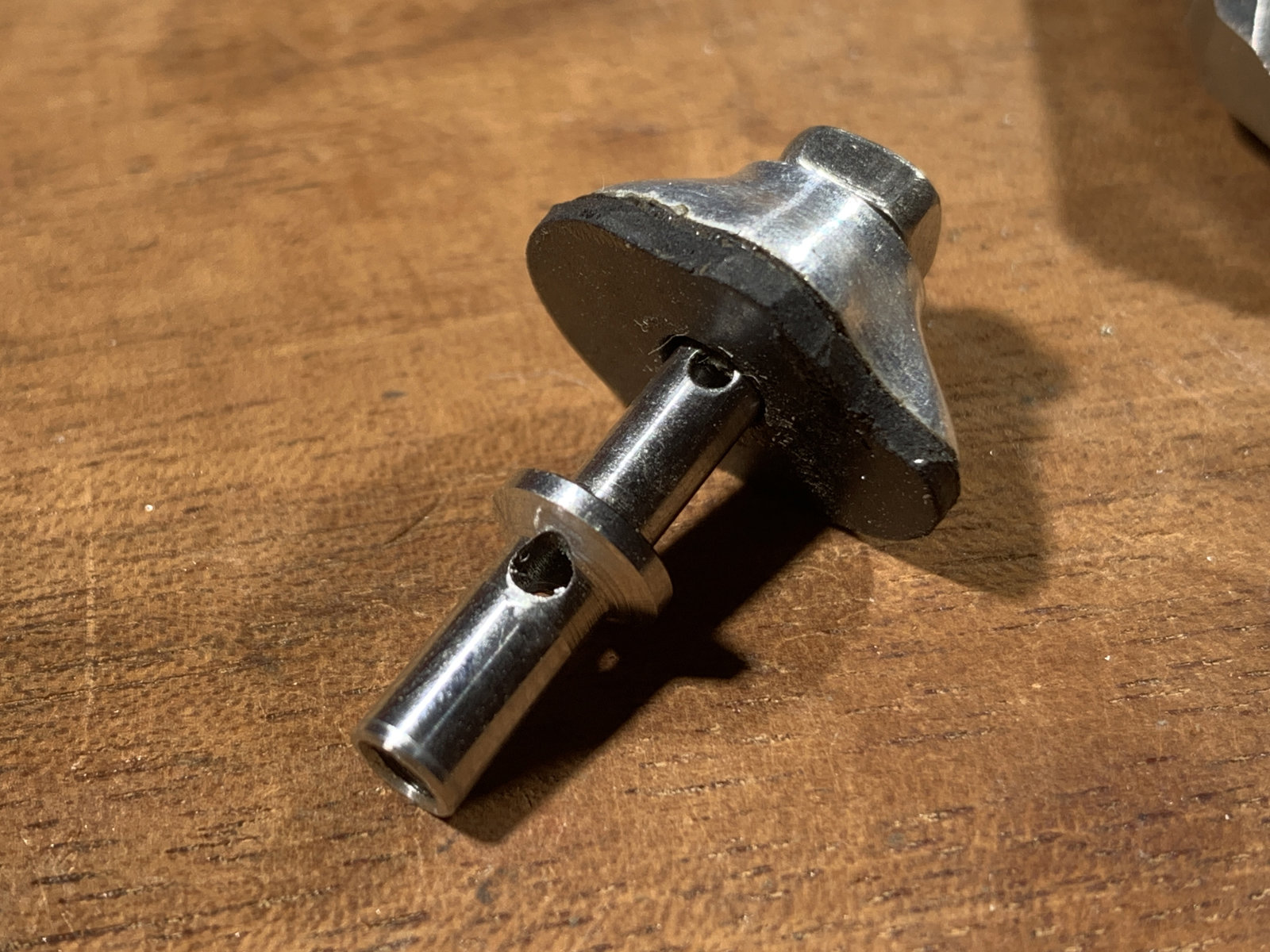
Even though this little rod looks like a part I turned in the lathe, it's actually all done on the CNC.
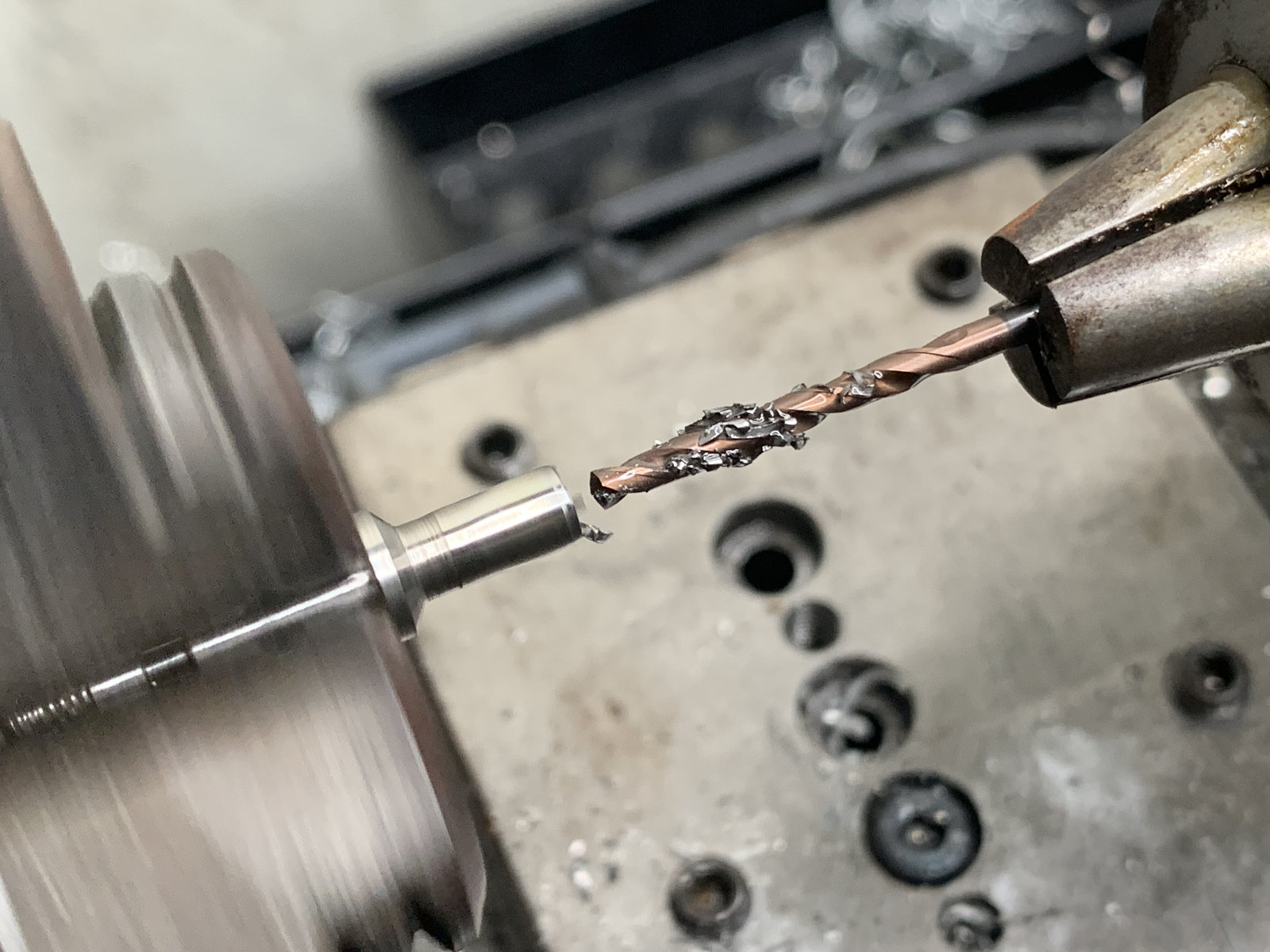
I think I did the chamfer under the flange on the lathe though. I made most of it some months back, just did the internal and transverse bores today. Here's the internal 2mm being done on the lathe (actually the hold up was due to not having a long enough 2mm drill back then):
And the transverse holes were done on the CNC:
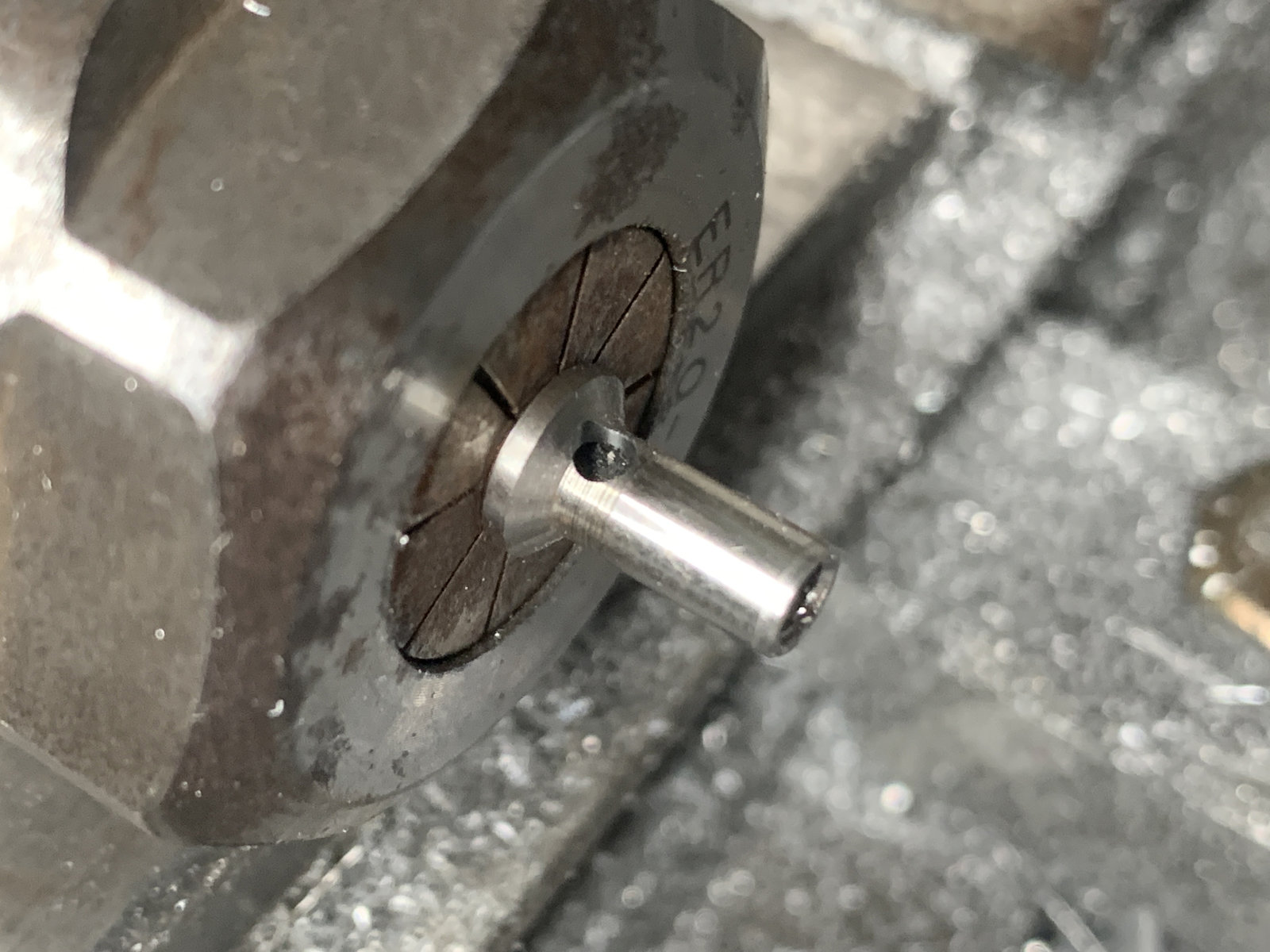 The pic above shows the rear-most holes. They are 2mm whereas the front holes are 1.5mm:
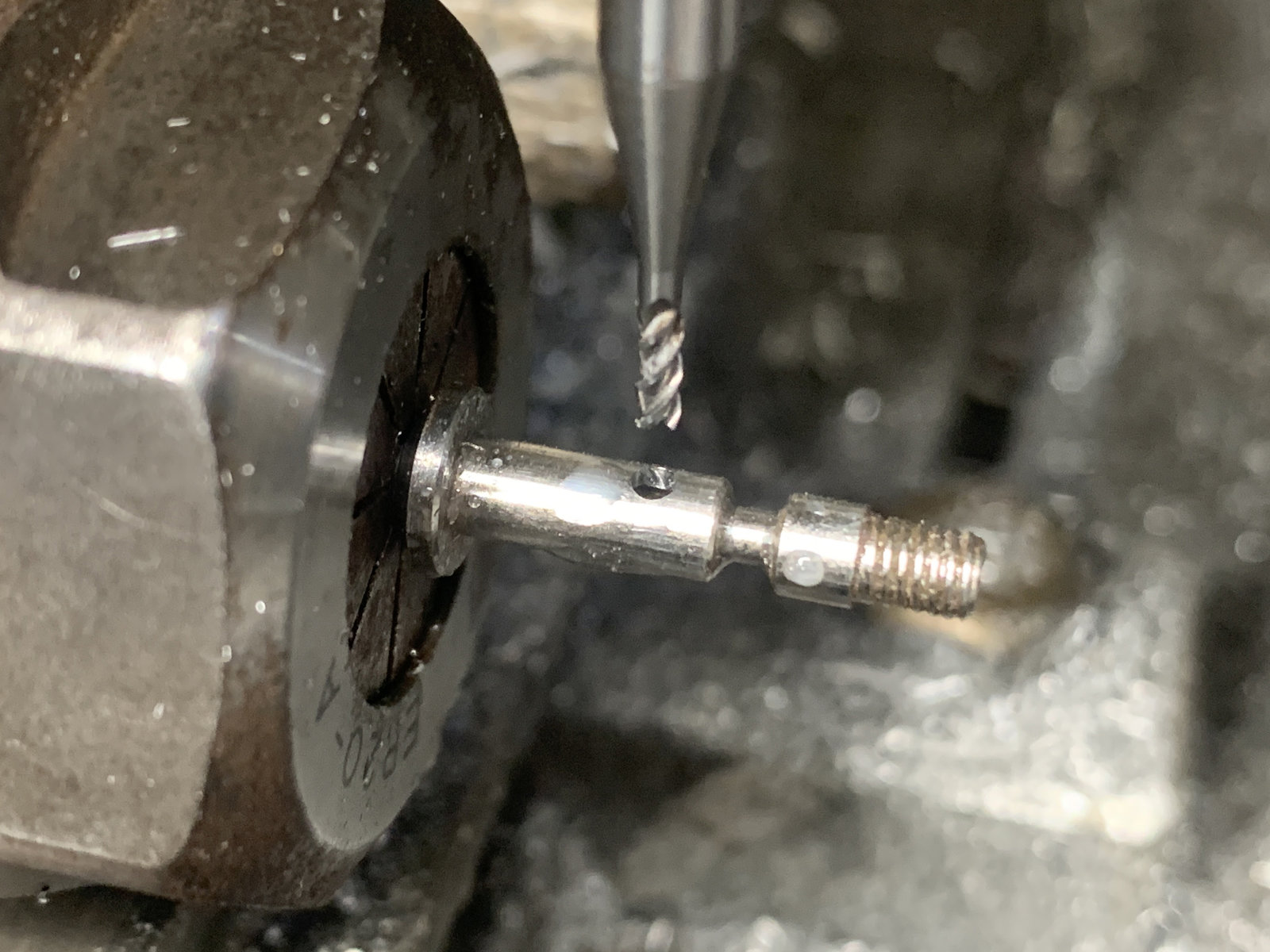
As often before, when making cross holes in small rods or tube I used endmills instead of drill bits - zero risk of the drill wandering off and breaking this way.
I went a bit smaller with the transverse holes at the front because the OD of the rod is 3.5mm in this area whilst it's 4mm behind the flange. Going to 3.5mm means about 25% less force on the valve when opening it.
Also, I reckon that 2mm internal transfer bore is where the flow bottleneck will be as the combined cross area of the two 1.5mm cross holes is still larger than that of a 2mm bore.
And then I spent some time doing a bit of test assembling and confirmed that I will need some help in closing the valve properly - in getting the gasket squished into the bulkhead lip... As it is now, it would rely on the power regulator knob being pulled back into the most rearward gate in the handle and the various parts all having the perfect length to add just enough compression to the gasket so once the pumping starts, the valve wont leak. But getting all that correct is naive... So, I played around with some springs and o-rings for adding extra compression onto the cap when then valve is in the closed position. It's also how the Scubapro Magnum valve does it (same as the Predathor).
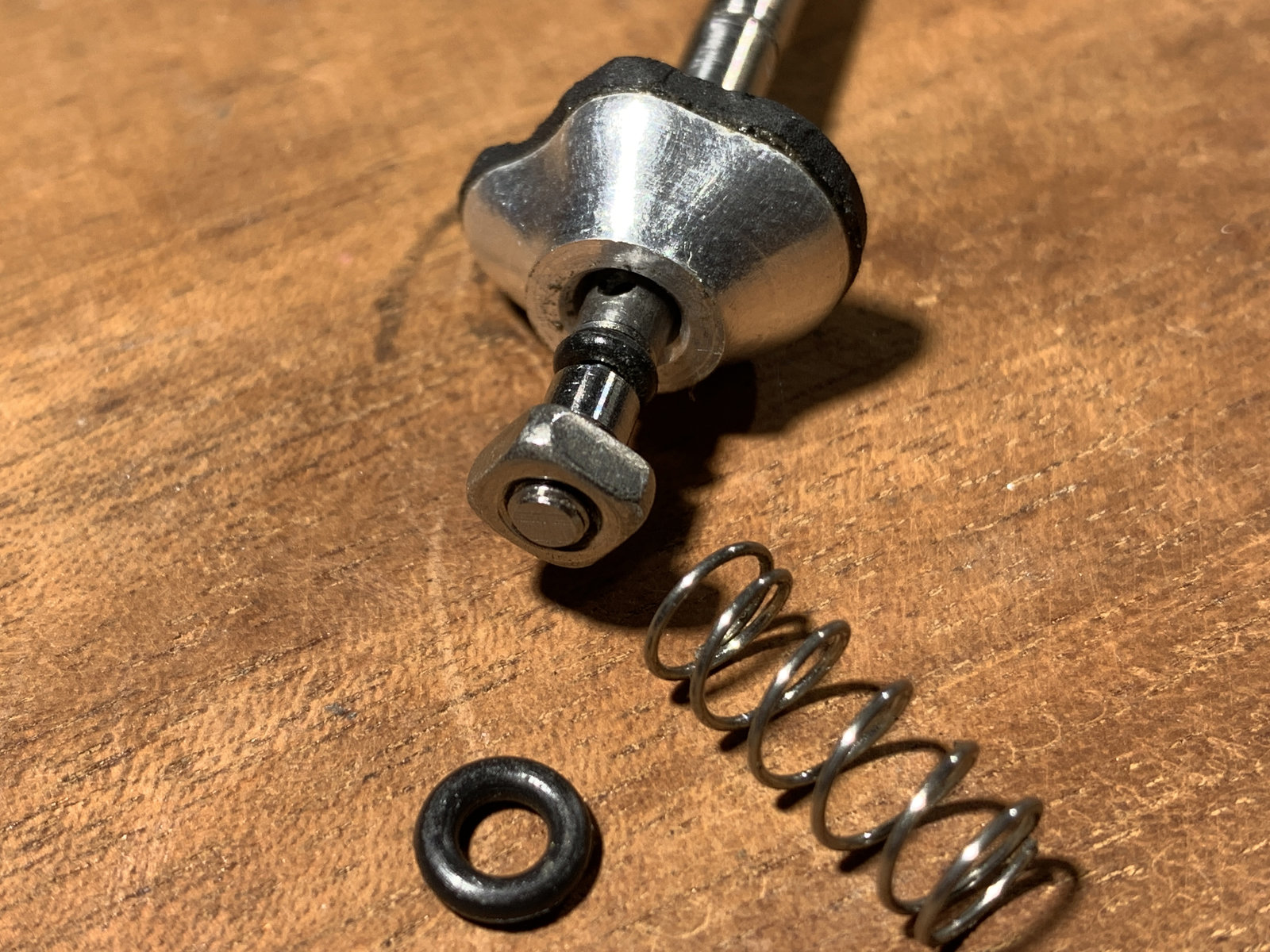
So, instead of that M3 square nut at the front, I will make a custom fasterner with an internal groove to hold a spring. It will look like the one in the first screenshot in this post, but be a bit longer and have a spring.
But that's for tomorow.
And since - for reasons I forgot - I didn't make the bulkhead that goes with this new power regulator have a built-in check valve for the pumping barrel, I will have to make a separate check valve, too. I have the dimensions pretty well sorted for these by now, so that should be pretty easy. The bulkhead I am using now has the check valve built in and it's worked without an issue.
Some months back I was working on a new type of power regulator/partitioning valve for the Mirage system and got as far as making the bulkhead and part of the valve before progress stalled. But now, I am back at it.
But why a new type of valve? Well, having a normal Mares style power regulator valve - the simple kind with an o-ring bushing that gets pushed forward into a bore to close off the air transfer passage - is a rough experience on a Mirage. Why? Because after the pre-pumping when you go to open the valve, you have a huge power differential pushing back on the bushing so once you open it, it comes flying back. It really can be quite violent. This is even worse on my particular handle/bulkhead since it has a 9mm bushing where the original Mirage had a smaller one. (Can't recall how small, maybe 7mm - it's in the thread somewhere).
Right now, at the lower pressure I am running the gun at, there's ~15kgf on the valve but if I take the gun up to proper Mirage pressures there would be ~23kgf of initial force on the valve. That wouldn't be fun.
That's why I am making a completely new type of valve. It takes inspiration from the old Scubapro/Predathor type valve where you have a sort of cap with a flat gasket that rests on a lip on the bulkhead. But inside that cap, I am adding a bushing valve.
It looks like this in an older screenshot I probably shared when I was last working on this:
The cap is quite large and the air transfer passage larger than on any classic oleo but since the cap is so large, there's no way I can open it under pressure - since the mechanism is now a "push to open" valve. This is where the smaller bushing inside the valve comes into play - I can indeed push that open even against a big pressure differential and once open, it will expose an internal air channel in the rod that will let the pressure equalize between the front and rear chamber. And once that's happened, I can push the much bigger cap all the way forward for a quite unrestricted shot.
Now, I don't know how long it will take to equalize, we will see. The internal bore in that rod is only 2mm in diameter. This is because the thinner I can make the outside of the rod, the easier it will be to push forward to open and it's only 3.5mm in OD.
Btw, the force required to push the smaller part of the valve open would be around 2.5-3kgf at 25-30bar of pressure differential which might still feel like a lot. Not sure, yet, will know once all the parts are in the gun.
But writing all this makes me wonder if I ever tried drawing up a version where you let the inner valve open backwards to equalize before you then push the whole assembly forward to open the main "gate". This would mean I wouldn't ever need to push against any pressure. Granted, I would now be back to having pressure trying to shoot that valve backwards when opening it but having only 3kgf instead of +20kgf acting on it would probably be a really nice improvement and may feel gentle enough. Actually, at 3kgf, I would proably be able to let it push slowly against my thumb as I let it slide backwards.
Anyhow, time for some pics. Today I managed to get this far:
So far, I finished the front part of the power rod, the one with all the features, internal channel, cross bores, etc. And then I had to make a new middle rod. Cutting the internal M3 thread in the gummy stainless used to be a chore but I have gotten pretty good at it. The knob at the end may be from a Predathor or a Mares. Can't recall.
It's all rather small, too:
Here you can see the transverse holes - and there's a 2mm internal bore connecting them:
Even though this little rod looks like a part I turned in the lathe, it's actually all done on the CNC.
I think I did the chamfer under the flange on the lathe though. I made most of it some months back, just did the internal and transverse bores today. Here's the internal 2mm being done on the lathe (actually the hold up was due to not having a long enough 2mm drill back then):
And the transverse holes were done on the CNC:
As often before, when making cross holes in small rods or tube I used endmills instead of drill bits - zero risk of the drill wandering off and breaking this way.
I went a bit smaller with the transverse holes at the front because the OD of the rod is 3.5mm in this area whilst it's 4mm behind the flange. Going to 3.5mm means about 25% less force on the valve when opening it.
Also, I reckon that 2mm internal transfer bore is where the flow bottleneck will be as the combined cross area of the two 1.5mm cross holes is still larger than that of a 2mm bore.
And then I spent some time doing a bit of test assembling and confirmed that I will need some help in closing the valve properly - in getting the gasket squished into the bulkhead lip... As it is now, it would rely on the power regulator knob being pulled back into the most rearward gate in the handle and the various parts all having the perfect length to add just enough compression to the gasket so once the pumping starts, the valve wont leak. But getting all that correct is naive... So, I played around with some springs and o-rings for adding extra compression onto the cap when then valve is in the closed position. It's also how the Scubapro Magnum valve does it (same as the Predathor).
So, instead of that M3 square nut at the front, I will make a custom fasterner with an internal groove to hold a spring. It will look like the one in the first screenshot in this post, but be a bit longer and have a spring.
But that's for tomorow.
And since - for reasons I forgot - I didn't make the bulkhead that goes with this new power regulator have a built-in check valve for the pumping barrel, I will have to make a separate check valve, too. I have the dimensions pretty well sorted for these by now, so that should be pretty easy. The bulkhead I am using now has the check valve built in and it's worked without an issue.
Last edited:
A note here, wobbling can reduce energy but leave accuracy unaffected (it still shoots straight even if it nosedives sooner). But I have seen 8mm double roller shafts bend like bananas during firing and the shot was still fine. So either the losses are small to begin with for all types of shafts, or they are amplified on lighter/thinner shafts due to increased drag due to the anti-hydrodynamic bending. But 6,25mm shafts have been tried on rollers and invert rollers and they had very good results given their low mass, including in penetration which means they didn't bleed KE. So I'm inclined to believe that there aren't significant energy losses to begin with. Yes shafts wobble during flight but it's only the initial plastic deformation and particularly the acceleration curve due to jerk and recoil that bleeds the shaft's energy. The wobbling we see during flight seems to be much smaller than the initial one... which also bands the shaft against the guide. So this makes sense (ETs already guilty of this). If these factors are removed then the initial wobbling isn't that big and has negligible energy losses on shafts of 6,75mm+ diameters. However it is a very visible effect on camera, just like in bow/crossbow arrows. So it is expected to get blamed for factors far less visible or intuitive to the eyeI have a very well developed flopper OCD so I always place the flopper on the underside - the thing about oleos, is that shafts can turn. A small downside yet a little win for the hybrids.
In general, the advice is to never turn the shaft after it has latched into the trigger sear. Some spearos have experienced misfires due to the turning.
Two small challenges remain in me being able to give you an answer, haha. I realized, probably through Pete's many educational posts over the years, myself getting into CAD that I often need visual aids in understandining mechanical concepts. And yet, I still also find I like/need to understand the details. A bit of a dilemma
Second part of the challenge is the same as before; I think it depends a lot. On the hunting type and on personal preference.
Oh, there's a third. We don't yet know how efficient a hybrid is vs. an oleo. But let's be nice and assume it's close and then perhaps later, we will need to adjust our preferences in case the losses have enough of an impact.
But let me give it a go
If the hybrid is close to an oleo in terms of efficiency, I think this setup sounds amazing. It sounds like it would be simple, fast and with plenty of power for most cases. Also, if no need for pumping, perhaps this gun can be built more simple, perhaps even slimmer?
I have been talking quite a bit away from the forum with our new member @dentex_cas and we both agree that an oleo loaded at around 29-30kgf is a very powerful weapon on the reef and for, let's call it, light bluewater. So, amberjacks and such. I think we can basically say it can power up a 7mm shaft incredibly well and a 6.5/6.75mm would be many Med spearos choice. Not so sure about 7.5mm though for sure an 8mm shaft would need more to really start feeling fast enough.
Anyhow, if 29-30kgf is enough for the vast majority of hunting on the reef, then having double that means you would already have a jack-of-all-trades gun that could shoot heavier shafts if needed. Or again, split the difference and use a shorter gun of this type for those benefits.
Both sounds incredibly powerful. I think, no math done, but we could be looking at powering up 9mm shafts for bluewater hunting here, perhaps even thicker. Or given your taken on how all shafts wobble and still retain speed and accuracy you could have a thinner, more "normal" size hypersonic missile of a shaft. All those scared fish in the Med would now never have stand a chance of running away before the shaft gets to them.
As for 2). vs 3). that one must be personal preference and depend on how fast and cumbersome the pumping is. Also, but a small part of the market, 3). could be for people who for one reason or another are limited in their max. peak. Like age, injuries or other physical limitations. Over the years, we have had a few people ask about what gun to use after, say, rotator cuff issues and such. People who used to be able to load strong bands but now can't but don't wanna give up spearing.
If, a fairly big if, the hybrid has minimal losses, my gut feeling right now is that only very few would need this gun. But it might very well be the best (dogtooth) tuna gun ever made. I mention that specifically because like I explained in a roundabout way earlier, that type of hunting is often done in deep in waters with strong currents and the norm has always been big wooden guns. But I'd rather dive with a much smaller platform, one that not only swings easier and fast enough to track the fish, but also one that takes less energy to simply dive with and handle.
So, while I think this platform will likely have more power than we actually need, it would allow us to make the gun shorter. Thicker, but shorter shaft to keep mass up but on a much smaller than BW-normal gun. That's likely how I would make use of a platform like this.
Also, this gun must surely start getting into the territory where it can reach targets further away than is practical to shoot at? With the Abellan 135, that was already being talked about. How many spearos will take a shot at 6m in real life? With moving targets, less than ideal conditions, a racing heart, etc, etc. But hey, maybe if guns like these happen, 7m will become the new 4m.
So, on one hand, part of me wants to say that 4). and 5). aren't even needed. But just maybe we haven't really pushed the limits enough to see how things start behaving once we get there.
Any initial stage vibration on pneumatics happens inside the chamber and thus meets much lower resistance. So there are reduced energy losses even there no matter how tiny. Energy conservation at the beginning of the shot is exponential to preserved energy at the distance we want to hit
Now, to the rest:
2x kgf of the Mirage would be around 56kgf but the load effort isn't technically 28kgf, to give you a clue. It just feels like as if it was 28kgf on the Mirage due to both hands being used as well as back muscles
From what you say I take that this is a very powerful all-around so maybe even 50kg would be feasible for even easier loading on a single chamber without pump. So this is an option I am keeping.
This same setup can produce a version with halved loading effort either using a pump or a very nice trick (very sparsely used from what I've seen since it can't be utilized well with rubber bands) that is like having a pump, without a pump. It produces a similar effect. Because it would be possible to just lighten up the initial version (2x Mirage) without a pump and operate with lower atm, I think this would be useful in the version with double kgf (4x Mirage) which can be done either using a pump or the same trick as before.
From your examples, both of these options (2x Mirage and 4x Mirage) sound like they'd have their respective audience. Both load much faster than an invert roller also
Any gun with a single pump would be bulkier and less maneuverable. The 6x Mirage version I thought of therefore seems pointless I think. It's better to try and beef it up, initially I thought of two shooting barrels and two pumps to get to that 8x. But 25 bar on two 25mm pistons placed side by side is a bit bulky for an airgun so maybe 25 bar on a single 35mm piston would be better assuming 2 pumps - one on each side. I prefer having two smaller pumps here that can be engaged in a single pull instead of a single larger one. 6x is the "weaker" version of this with a smaller kgf capacity. But this can be achieved in the previous 8x gun as well, with a lighter setup anyway
For reference Pete said that Velair has a 32mm piston and its body is a mostly compact cuttlefish
Some more good news is that because pumping is done by hand (both hands) you can do all of it on the boat and when jumping in the water all you'll have to load is the equivalent of a single 16mm band pair, maybe lower. So maybe this can work as an alternative to what you were thinking of earlier plus the line would be already wrapped since the shaft would be like in bandguns before they're loaded.
But that's enough analysis for now. I'm keeping the 2x (no pump), 4x (no pump for the sake of simplicity) and 6/8x (double pumps engaged simultaneously) and I'll try to make some designs that hopefully lead to a prototype if I can get the right people interested in it
Fun fact: just a week ago I had no idea that I'd ever get such an interest in pneumatics. And I've already known of Dreamair and Velair for years, yet the spark was because of this thread and the Mirage. So if this actually materializes to something functional, all the doggies will have you to blame
Last edited:
Yes this is correct. The energy losses are exponential if the shaft is too light and a small % loss on a heavy shaft becomes a much higher % loss on a significantly lighter shaft.I agree with all this and also the previous post where you covered the need for faster shots, especially in the Med.
I just wanted to add one little thing in terms of the thicker shafts. Again, this is mostly related to doggies which are known to head straight for a rock and thrash shafts and shooting line (same with GT) but not so with pure tunas. But the former two need really heavy "rigging". People shoot either cable or dyneema shooting line. And my feeling is that it really slows down the shaft. So, not only do we need more penetration power for these thick bodied, tough fish we also need more power to carry that extra rigging through the water.
And I would think this drag penalty can be considered a constant, so it would have relatively more impact on a lighter shaft than on a thicker one. If I knew a doggie would just head straight for the horizon, I would still just use mono and a small surface skimming float as you can with e.g. wahoo and spanish macks and you could get away with a lot less mass in the shaft and a less powerful gun.
But it's one of the things I do want to pool test. Dyneema vs. equal thickness mono vs. a "Med thin" mono. Just some penetration tests should be enough.
E.g. the 7mm x 105cm Mirage shaft had 1.4mm dyneema on it, but I would be ok with shooting it on the reef with 1.2mm mono which can still take a small knick or two. But I will only change over once I have extra sliders and tangs as I am on my only 7mm set.
But are you really using 1,2mm mono line? Here we don't use dyneema not even for AJs of 30+kg but we do use 1,5-1,8mm monofilament on every gun depending on its purpose (1,5 on lighter guns and 1,8 on more heavy duty ones). If the gun is long enough, dyneema is many times heavier than simple mono especially if a double wrap is used
I gave this thought a go and it is probably the one place where a roller/invert-style arbalete is lacking. Chamber fishing is a no-no unless you want to destroy your shaft hahaLow Power Shot
Forgot to say that if you can somehow make the valve between the two chambers also work as a power regulator to enable Low Power shots then that's a nice feature to have - depending on the length of the gun. I know some oleo shooters in the med pull the bulkhead from their guns to save weight and because they feel it may still throttle the high power shots. Also, on longer airguns, you likely wont be sticking them into holes. But on a smaller one, long enough for free swimming fish on the reef but short enough to poke into holes, a low power shot is a really nice feature.
My first Mirages were the original 80 size shooting a meager 84cm shaft and my very first gun was a 90 Seac oleo shooting a 98cm shaft. I could shoot free swimming fish just fine on the reef. And these guns would still be fine to poke into holes which makes sense as overall, they would be as short as a 55-70 bandgun. So, perhaps for the shortest hybrid, a low power shot option could be a welcome feature.
Power regulation is still possible by loading an intermediate sharkfin like the "loading tab" sharkfin some rollers use halfway on their shafts but the kgf loaded on the shaft would still be 2x of the Mirage which I think kind of defeats the purpose. A possible solution would be a limited edition very short hybrid, something like a 40cm in bandgun length terms so overall maybe 60cm from stock to muzzle. Fully loaded this would still work like a pneumatic with ~55-60 kgf on it and shots up to 2,5m can be feasible I hope, which is more than a classic bandgun double its barrel size with two pairs of rubber. But to have a 40cm shoot that far would be rather special. So that's another project put into the list haha, thanks for that
Not for a long time, but when I first got into spearing and forums, 1.19mm I think it was, or 1.17mm Asso Triple Something was considered the next best thing after chocolate amongst some Italian oleo shooters. It was quite stretchy and may (or may not) have a had a bit less memory, so less severe kinks at the bends in the wrap, too?But are you really using 1,2mm mono line? Here we don't use dyneema not even for AJs of 30+kg but we do use 1,5-1,8mm monofilament on every gun depending on its purpose (1,5 on lighter guns and 1,8 on more heavy duty ones). If the gun is long enough, dyneema is many times heavier than simple mono especially if a double wrap is used
So, for sure on my Mirage 80 and Seac 90 I had mono that thin. I never broke a line but I also didn't shoot monsters. I did shoot some groupers in holes though - or rather some that went into holes - and with line that thin you do end up having to change it out more often. From memory, some Italians even shot 0.9-1.05mm mono. I guess all in the pursuit of faster shots.
The island I am on now is quite overfished and thus our catches tend to be on the small side. So, I could likely go to 1.2mm just fine or 1.4mm for a bit more peace of mind and longer "service intervals". In all likelihood, the only bigger fish that we might get lucky to see would be a spanish mack (kingfish), a barracuda or a decent trevally. The first two would tend to just zip for the horizon and not trash the bottom, whereas the travally might do either.
Peace of mind is nice though as evidenced by the fact that I still haven't bothered to change out the dyneema on my Pathos. I will however do it on the Mirage as soon as I have gotten - or made - some spare sliders and tangs in this size.
Generally, dyneema/cable really comes into its own when going for dogtooth that like to hang around structure and will almost always head straight for a rock after a shot. And even small ones are often too powerful to pull away from structure by hand. The way I try to stop this from happening is to set the floatline as short as possible so the fish don't have long to run before it has to fight the float(s). I used to have some nice homemade floatline (PU tube with dyneema inside) but on the latest trip I just resorted to cheap polypropylene rope. It's just about thin enough to not be too draggy and it can be spliced. So, I spliced in some small eye loops to be able to set the line for various depths. Worked well for the one spot that we tend to go to the most which is mere meters away from a pinnacle.
As for how many wraps... Airguns are short, but as we know shoot as a longer bandgun so I think a lot of us do three wraps. I have had four on some guns. I have likely been guilty of putting too many wraps. Often it's not needed and just gives reef fish that like to hole up more time to do so.
Last edited: