Found it - here it is unedited and without the pictures.
Fondueset's Guide to Sphera Ressurection
You're diving. Someplace cool..maybe someplace you almost never get to, say; Dean's Blue Hole.
You are coming up from a deep dive – past 40 meters anyway – and luxuriating in the kinesthetic bliss of a monofin ascent. Body extended in liquid space, feeling the long wave down your spine and the solid authority of the fin as it drives you toward the light. Lungs expanding, mask filling with air to be inhaled. But wait, what's this?! Water is filling the mask; horrible burning saltwater fills your sinuses, mixing with sunscreen until your eyes can't stand themselves.
Your Sphera has collapsed. One of the lenses, whimsically teetering on the brink of dislocation, has been sucked in by your inhale. At the surface your safety diver is wide-eyed; sure you'd lost it in that explosion of bubbles. You suppress an urge to hurl the cursed mask into the depths only because it could become a choking hazard for the Tarpon.
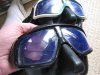
Eric Fattah and Pete Scott turned me on to the Sphera. In a post on Deeperblue Eric explained how the Sphera has a -1.5 to – 1.75 diopter correction. Up until then I didn't see the sense of a fragile, plastic lensed mask; but when I put one on and found my vision corrected perfectly underwater, I was sold.
There are a couple things that happen to these masks. One is sand. When your mask starts leaking its perfectly reasonable to think this is caused by sand. Having taken apart your Sphera, seen the sand, and meticulously cleaned it out of the lens seats, one may then suppose that, upon carefully reassembling the mask (a process that, in and of itself, might drive the uninitiated to ..oh say; want to stuff the thing in a blender filled with vomit, gasoline and feces, osterize the living crap out of it, set it on fire and throw it off a cliff) it will not leak. Ha!
Sometimes you can just pop the lens back in and it works, other times you can take the goddamn thing apart and clean it with a magnifying glass, put it back together, and it leaks like a screen door on a submarine.
So, knowing all this, and having been through that particular ringer numerous times, and having a passel of Spheras. I will now switch from this tediously verbose anecdotal mode to a refreshingly concise and technical process-oriented narrative, with pictures and everything!
What you need:
A small – screwdriver: About 2mm across.
Loctite clear silicone aquarium caulk
Maybe some alcohol or white vinegar
Q-tips or something of the sort
Taking it apart: This part is easy. You can just pop the lenses right out by wiggling them a little – then you can pull the body of the mask right out of the frame. Then you can wash the frame out and run a Q-tip or something along the lens area to remove the various crud that builds up in there.
I've found soaking the lenses in hot water and white vinegar makes it easy to get the crud off of them – some of which is mineral deposits that the vinegar works well on.
Once you've got it cleaned up you are ready for the hard part. First you'll want to separate the frame a little. If you look on the inside of the corners you'll see a sort of triangular opening. Theres a nefarious little clip dealy in there that holds the bottom of the frame to the top. When reassembling the mask it's helpful if you undo that clip.
Take your small screwdriver (a big one will gaff up the frame – which I did quite a bit before I figured out I just needed a small one) and insert it above the top of the clip. Once it's jammed in there nicely rotate it so that the edge of the driver nearest the seam with the frame goes up. The logic here is to have the screwdriver's rotation simultaneously depress the little clip AND push it out of the frame. It does not take much and with the small driver you can do it with very little deformation of the clip area.
I've found that its enough just to leave the clip unseated – no need to pull it all the way out; which makes putting it back together kind of a nightmare.
Theres a few ways to do the rest of this, but this is what I've been doing lately.
Put the frame back on the mask body but leave the aforementioned clips undone. Get the lens insert area nicely seated in the frame.
Take your Silicone Caulk – the nozzle of which you've trimmed to a pretty small diameter – and run a bead all along the inside of the lens insert area. Don't worry about making a mess – just makes sure you don't leave any gaps.
Now you've gotta put the lenses in. Do them one at a time. It'll be messy and you'll probably get calk all over them; no worries, it cleans up easily. Work the lens in and make sure the rubber seal is not folded under anywhere and that it is well seated in the frame. Once you've got one lens in – go ahead a push the clip back in until it locks.
You might still need to wrangle the lens some – just make sure it is well seated then do the other one.
The caulk is still liquid at this point – so now is the time to work those lenses in and make sure everythings lined up right.
One problem area is the outside corner of the lenses – if the rubber seal seems to be unusually wide across the outside of the lens it may be it is not seated in the frame – be sure and check it. You should see rubber seal all around the lens. At varying thicknesses – but visible and not folded under.
You can clean off the lenses with alcohol and a paper towel before the caulk cures. Or just rub it off after it cures. If you want to you can carefully trim the extra around the edges – I usually only remove what interferes with vision.
This repair is very durable, and the silicone really doesn't leave much room for sand or dirt to get in. I decided to test it with my pool mask – which now has several thousand dives on it – both pool and open water – with zero problems.
Sphera Fun Facts:
Theres a fair amount of variation in the correction of these lenses – or lack thereof. The ones that correct have more of a bubble-like curve when viewed from the side. This is generally around -1.5 diopter but even within correcting masks there is variation. It may also be that the newer masks have less to none and those that do only correct underwater.
Scratches on the plastic lenses don't seem to matter much. Most of the ones on the outside vanish when the lens is wet.
You can use the frame and lenses from the Aquasphere Seal swim mask to replace same on the Sphera.
Older Spheras seem to have a different grade of Silicone. Its a little grayer looking and feels a bit waxier. It seems to seal just a bit better – nothing radical – just a subtle difference in feel.