• Welcome to the DeeperBlue.com Forums, the largest online community dedicated to Freediving, Scuba Diving and Spearfishing. To gain full access to the DeeperBlue.com Forums you must register for a free account. As a registered member you will be able to:

    • Join over 47,943+ fellow diving enthusiasts from around the world on this forum
    • Participate in and browse from over 531,990+ posts.
    • Communicate privately with other divers from around the world.
    • Post your own photos or view from 7,455+ user submitted images.
    • All this and much more...

    You can gain access to all this absolutely free when you register for an account, so sign up today!

mask, goggles or nothing?

Thread Status: Hello , There was no answer in this thread for more than 90 days.
It can take a long time to get an up-to-date response or contact with relevant users.
Well, Fabrice, I am perhaps indeed overgeneralizing, but am afraid there is a grain of truth in it anyway. With the huge base of freedivers France has, with all the natural resources and conditions available, and with the support of the state, the performance of the top athletes should be quite far above the countries who have just a dozen or two of freedivers, with no access to the sea, and/or frozen waters most of the time. I do not know what better aquacity at French freedivers you exactly speak about, but it looks like the French aquacity does not work well in water. And the aesthetic duck-dive does not seem to help a lot either.

Otherwise I agree with you that French do not feel the need to search information outside - as in many other domains they think they know it all better. They are persuaded diving and freediving was invented by the French, so some ignorant foreigners won't teach them how to do it correctly :)

As for Italian and Spanish, I cannot comment, because I do not know those nations and their freediving communities as well as I know the French. Besides it, I do not feel like critizing other nations than mine. And although being Czech, after the years spent in France I feel it like my own partially too, hence the critics :)
 
Last edited:
Back to the topic, I really think this is just a matter of personal preference. There are some great freedivers that are putting out some huge performances in dynamic with masks. Molchanov,Mullins for example. There are as many that use goggles and nose clip as well as some that use no goggles. Ask any of them and I'm sure they will swear that their method is the best.
 
Yes, I think there are indeed freedivers with excellent and quick diving reflex, at whom the mask won't make a big difference. But at many others, removing the mask will improve the DR significantly.
 
Well maybe I'll get a little bit out of topic, but I think it's related. I just switch to noseclip and goggles few months ago. I don't train static at the pool, so no idea. I didn't feel any difference between mask and googles in my dynamic performances, but in the pool I use the "no warm up" approach, and I think that's the reason. When I arrived to Dean's blue hole, my focus was to switch from mask to goggles (and that was the only reason for the change in the pool, just to get used). The first day of training the lens of my goggles popout (now is part of the bottom of the blue hole) so I did that training just with the noseclip. It was a revelation. I felt so relaxed with no mask, and the feeling of the water in all my face was incredible. So all my trainings where without goggles. I didn't increase depth with the change, but my recovery was faster and I felt more fresh at the end. I think that no-mask diving will help you with your diving reflex, and your body reduces oxygen consumption.
One morning I was telling that to Herbert Nitsch, and he agree with me, but he said that the main problem is the tag recovery on bad visibility conditions. On that days the viz at the blue hole was really poor (3 meters maximum), that's why I started to use my goggles again. But on SP they are a pain in the a.. So, what i think is: if you have a strong diving reflex, use what you like more. But if you have a weak one. No mask is the way to go.
Just my opinion
 
  • Like
Reactions: jay cluskey
...at many others, removing the mask will improve the DR significantly.
Most (maybe 90 %) use goggles and noseclips in pool competitions. Would DR be a little better without googles, really?
(So, why competitors use goggles? Just for comfort?)
And would DR be a little better without a cap or hood?
Where are exactly the receptors in our faces effecting to DR?

fpernett: So, what i think is: if you have a strong diving reflex, use what you like more. But if you have a weak one. No mask is the way to go.
Sounds somehow logical to me. But still wondering that so rarely anybody dives without goggles or mask even in competitions...
 
Last edited:
Well, I tried to find out why people use goggles, asking couple of them. Some of them are probably still under some kind of trauma from childhood and think that water will make them blind :cool:. Others claim they would not see the wall.:head Some are telling it would stress them too much, or that they really cannot stand chlorine (or salt) in their eyes, not even for that short single swim.
The cap and hood have impact too. Generally it is better keeping the brain in warmth, but you should keep your front and ears exposed. Well the ears may cause some drag (at some more than at others), so it is up to your decision :D

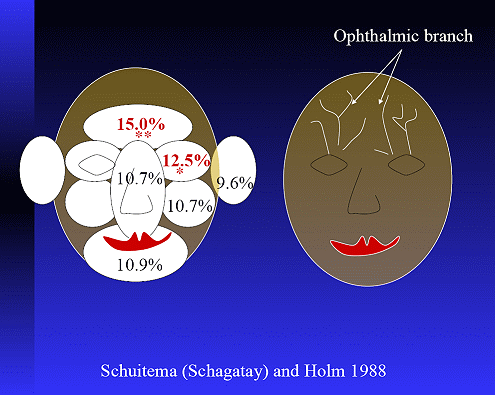
I have a diagram of the DR receptors, with percentual repartition. Let me try finding it - I'll edit this post and add it here in a moment (hopefully).

OK, I found it - here you go:
DR-face.gif

 
Last edited:
So an eye or area just near an eye is 12,5%. To get 100%, it means that is only one eye?
So for both eyes it's 25%, and that is much. So no goggles anymore...
And ears about 20% .... so no hood or cap anymore...

Sounds like striptease...
Maybe it's best for DR to go naked and feel water everywhere ;)
 
Last edited:
I agree with Trux completely about the french divers. A couple of years ago I spoke with Aurore Asso, one of the better french female freedivers. Concerning equalizing, she had never even heard of the frenzel technique (let alone mouthfill!) She knew only valsalva or BTV.

Concerning goggles vs. mask vs. nothing, I have tried them all, in fact I have done more than most people. At Vertical Blue 2008, I did all my frc dives with no goggles and no nose clip either. I think I might be the only one to try diving without the nose clip in competition.

Certainly ascending without a nose clip dramatically increases the dive reflex for me. So even if I have a nose clip I take it off on the bottom.

But pinching the nose on the descent, instead of using a nose clip, also seemed to increase the dive reflex for some strange reason. There was some fear of letting go of the nose, one slip and the dive is over... maybe this fear amplified the reflex.

In Vancouver where the salinity is close to human tears, I do something even better. I flood the mask or take off the nose clip during the descent, after the last equalization. This floods my sinuses (inverted) right before the turn around. Then, I grab the rope, and wait for 5 seconds (hang). This allows the flooding reflex to slow my heart and suck more blood out of my legs before the ascent. The effect is huge.
 
So it's seems to be something we must really think about in this No mask, No goggles, and even No nose clip approach. We already have that No warm up approach. Freediving is going back to basics: no extra things, just do it in the natural way!

It is something so natural when you think about DR and your face, but maybe most freedivers are just used to using masks and goggles and nose-clips. But some testing will start soon in many trainings...

Thanks trux and eric for this information!
 
Last edited:
Just look at dolphins, whales or seals! Do they have some equipments or suits, or do they pack or take warm-ups? No, all are NO. So lets get natural!

In fact, they had in Dahab Bizzy Blue Hole this kind of deep diving comp: just swimming trunks/bikinis, nose clips and weights were allowed. But next time UFC comp will be ALL natural, I hope ;).
http://www.freediving.biz/Bizzybluehole/ufc1.html
 
Last edited:
I flood the mask or take off the nose clip during the descent, after the last equalization. This floods my sinuses (inverted) right before the turn around. Then, I grab the rope, and wait for 5 seconds (hang). This allows the flooding reflex to slow my heart and suck more blood out of my legs before the ascent. The effect is huge.


mate..... hard core!
 
In Vancouver where the salinity is close to human tears, I do something even better. I flood the mask or take off the nose clip during the descent, after the last equalization. This floods my sinuses (inverted) right before the turn around. Then, I grab the rope, and wait for 5 seconds (hang). This allows the flooding reflex to slow my heart and suck more blood out of my legs before the ascent. The effect is huge.

Yes, really hard core. Almost everybody else would have major difficulties to stay relaxed there in deep water when doing something like that...
 
thing about seeing with no googles, my eldest son, now 8, spent 4 years in the pool and ocean without googles or mask, i would dive alongside him (with mask) and swear he could see as much detail as I could. He could pick up the smallest shell or coin. Fast forward, and now he always uses a mask and gets red eyes if he does not.

Can the eyes adapt to better vision after a certain period without mask?
Herberts solution, lenses held in front of eyes by strange fibreglass arms (they are not goggles) seems to be a great compromise.
 
'Can the eyes adapt to better vision after a certain period without mask?'

It's apparently not the eyes that adapt but the computer that they
are connected to.
 
Can the eyes adapt to better vision after a certain period without mask?

I definitely think that one can adapt to seeing underwater. When I first experimented with no mask diving about 2 years ago, my eyes would sting and become all red. I also felt very dizzy when trying to sort out images underwater and everything looked hexagonal and crystallized - the whole experience was very disconcerting.

With steady practice, I can now dive without anything and just pinch my nose on the descent and let go on the ascent without experiencing my previous problems. My vision has improved to the point where I can dive down and retrieve dropped items mixed in with the coral - like a snorkel - without a mask. No way I could have done that when I first started.

The only thing holding me back now when using a noseclip is that I still get funny swallowing urges and some type of contraction when water flows quickly over my bare eyes, to the point of making me abort a constant weight dive. I still need to use a mask over the eyes and flood it with water to avoid this uncomfortable feeling. Yes, goggles are still too small and don't cover enough of my eyes! I have a feeling this will dissipate over time with enough practice.

I remember seeing a documentary on TV a while back about the Moken Sea Gypsies who hunt underwater without masks and their vision adapted over time. According to this article I found about the Moken, their eyes actually improve. The article also mentions something about DR and sea nomads in the Philippines diving to 70m for pearls. Somehow I doubt the nomads are using monofins, noseclips, and yamamoto wetsuits. :)

CDNN :: Moken Sea Gypsies: Seeing Underwater
 
Last edited:
I'd tell that it is just a psychological barrier, refusing to look underwater. Well, sure you do not see perfectly, but the vision quality is fully sufficient. And yes, young kids may have more flexible cornea or lenses, so can perhaps focus better underwater, but I remember a scuba trip some years ago, but when I was already over 40 (hence no youngster) - since I did no scuba during a year or two, the monitor wanted to check our abilities, and asked us at the depth to flood our masks and clear them again. When I flooded my mask, the strap slid out of the buckle. The monitor wanted to take my mask, but I did not understand why, because I saw no inconvenience in putting the strap back into the buckle alone even with no mask on face. And I also did not want that some moron touches my mask and screws it up :) I did it myself, and it was pretty quick. Hence you can see that the vision under water is not too bad if you really want and go over the psychological barrier. And you do not need to be an 8 years old Moken Sea Gypsy :)
 
Last edited:
As far as I can tell Ant, there is a very slight advantage to wearing goggles and noseclip. But it would be hard to prove in real performance terms and might just be a placebo effect.

I find CWT with just a noseclip to be nice and simple, and largely functional except for when I'm at the baseplate trying to find a tag. With minimal light and severe narcosis I've had a couple of bad experiences, spending ages at the bottom. I changed to fluid goggles since and I still have cold/wet eyes, but enough vision to see a tag properly and remember what I'm supposed to be doing with it :blackeye

Also I couldn't see the line in the near-darkness of Deans, which meant I had to run one hand down it in order to stay in contact. Not good streamlining.

Fabrice: yeah many competition divers have ugly duck-dives. This is probably because they're going very deep with high lung volume, so have to be very buoyant at the surface.
 
DeeperBlue.com - The Worlds Largest Community Dedicated To Freediving, Scuba Diving and Spearfishing

ABOUT US

ISSN 1469-865X | Copyright © 1996 - 2026 DeeperBlue Global Media Limited.

DeeperBlue.com is an independent digital media platform dedicated to Scuba Diving, Freediving, Ocean Advocacy, and Dive Travel.

Since 1996, we’ve been informing, educating, and inspiring the global diving community through trusted news, features, and shared community experience.

ADVERT