• Welcome to the DeeperBlue.com Forums, the largest online community dedicated to Freediving, Scuba Diving and Spearfishing. To gain full access to the DeeperBlue.com Forums you must register for a free account. As a registered member you will be able to:

    • Join over 47,943+ fellow diving enthusiasts from around the world on this forum
    • Participate in and browse from over 531,990+ posts.
    • Communicate privately with other divers from around the world.
    • Post your own photos or view from 7,455+ user submitted images.
    • All this and much more...

    You can gain access to all this absolutely free when you register for an account, so sign up today!

Max pessure limitation

Thread Status: Hello , There was no answer in this thread for more than 90 days.
It can take a long time to get an up-to-date response or contact with relevant users.

tromic

Well-Known Member
Aug 13, 2007
1,855
299
173
What do you think, is the major reason for the pressure limitation to about 30 bars at mares, cressi, and 20 bars at asso, the preasure itself or the speed of the piston? I suppose the reason is the speed of the piston. How could this affect pneumatics with vacuum barrel? Maori sub Mamba max pressure limit is 27 bars.
 
Last edited:
I believe the pressure limitation is mainly a safety precaution due to sometimes inappropriate handling of the pneumatics, like people dropping them to the floor or leaving them uncovered in the boat, where they heat excessively and may burst.
The second is very likely longevity of the gun.
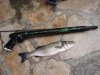
As mentioned before, this year I hunted with my spark 70 equipped with a vacuum system at 30 bar and shock absorber protected by ~7mm of ordinary flat rubber seal. I shot the gun at least 300 times and did not observe any gun damage.
 

Attachments

  • 6219.JPG
    6219.JPG
    87.8 KB · Views: 330
I think the pressure limitation is just the manufacturers being conservative in the interests of long term durability of their guns. The main working stress is the piston slamming into the muzzle shock absorber with every shot, so by nominating a pressure that they know the gun can take they can be reasonably confident of avoiding any warranty problems in that area. I doubt that the various brands of current mass produced pneumatic guns are different enough in their basic construction or fabrication materials that the nominated maximum air pressure is a reflection of the inherent mechanical strength of that particular model as far as its pressure containment capability is concerned.

The Asso is rated at 20 kg/cm2 maximum, yet the very similar Mares Reef (a revamp of the original Sten which was in turn replaced by the Competition Line or Sten 87) was rated at 30 kg/cm2. The guns do not look much different in their construction judging by the component diagrams and their external appearance.

Operating pneumatic spearguns at lower pressure presents less risks during gun loading as far as the user is concerned, which is particularly important with muzzle loaded guns where your head is not far away from the business end of the gun! This consideration may be an important factor in determining the manufacturer's recommendation as to the pressure to be used in their gun, accidents are not good for repeat business even if they had nothing to do with the manufacturing quality or design of the gun.
 
... and shock absorber protected by ~7mm of ordinary flat rubber seal. I shot the gun at least 300 times and did not observe any gun damage.
petar_dj, I am just preparing to make something similar to my shock absorber. It seems to be very like your solution. I am going to make new plastic part of the shock absorber with central boring of 7 mm (for 6,5 mm shaft only) and I would put flat rubber seal for water tap of 4 mm as a aditional protection. I would also use a piece of plastic tubing between the barrel and the shock absorber to support the piston. Have you any picture of your solution?
 
Sorry Tromic, no picture, and until christmas will be highly unlikely as I am currently on a long bussiness trip.

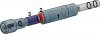
2 piece of advice: the hole in the tap water seal (drawn red in the picture) should be around 9-10 mm, as it is compressed when you will tighten the vacuum barrel kit and the hole will shrink to around 7-8 mm. If you make the original hole smaller you will get a lot of additional friction between the seal and shaft.
When assembling the kit, which will probably look similar to this, make sure to have the shaft inserted to act as a guide and the seals do not move from the desired position when you tighten everything. After tightening, you will probably observe that the shaft movement is somewhat harder, compared with no seals installed, as a result of their rubbing, but its influence under water will be greatly reduced as a result of smaller friction between both components when wet. On the other hand, dont make the hole in the seal too big, as you will loose the protected impact surface area and make little improvement in absorption/softening of impact.
my 2 euro cents=)
 

Attachments

  • kit3.jpg
    kit3.jpg
    34.3 KB · Views: 348
Last edited:
Thank you, petar_dj for advices and for schematic. Is it tovarich muzzle? Had you use glue for the washer and O-rings?
 
Last edited:
DeeperBlue.com - The Worlds Largest Community Dedicated To Freediving, Scuba Diving and Spearfishing

ABOUT US

ISSN 1469-865X | Copyright © 1996 - 2026 DeeperBlue Global Media Limited.

DeeperBlue.com is an independent digital media platform dedicated to Scuba Diving, Freediving, Ocean Advocacy, and Dive Travel.

Since 1996, we’ve been informing, educating, and inspiring the global diving community through trusted news, features, and shared community experience.

ADVERT