• Welcome to the DeeperBlue.com Forums, the largest online community dedicated to Freediving, Scuba Diving and Spearfishing. To gain full access to the DeeperBlue.com Forums you must register for a free account. As a registered member you will be able to:

    • Join over 47,943+ fellow diving enthusiasts from around the world on this forum
    • Participate in and browse from over 531,990+ posts.
    • Communicate privately with other divers from around the world.
    • Post your own photos or view from 7,455+ user submitted images.
    • All this and much more...

    You can gain access to all this absolutely free when you register for an account, so sign up today!

Murat exhale video interviews

Thread Status: Hello , There was no answer in this thread for more than 90 days.
It can take a long time to get an up-to-date response or contact with relevant users.
So the stuff makes the water feel colder on your face and fools the body into thinking its in colder water. Presto, stronger DR.

What a cool idea. I want some.

Connor

Freedivinmike: check your pms, so we don't hijack the thread.

Stronger DR = delayed hypoxia, enhanced hypoxia tolerance, better perfs, reduced risk of DCI, etc.
 
Now subject is changing away from exhale, but I'll ask here, instead of making a new thread:


There's something I don't understand well, even though I have read a very scientific explanation before (perhaps too difficult for me).

Is it easier to BO when doing less-than-full/exhale/FRC breathholds???

Some say it is safer, fx Sebastion Murat in this video because of stronger DR as I understands it.

Others say it is easier to BO along the lines that less CO2 is building up, and therefore it is easier to reach blackout.

Now I know Sebastion is very much into benefits of exhaling in depth-diving. So just for a second, to try separate different contributing factors, how about just a regular static? It seems it comes down to STRONG DR vs. CO2 BUILDUP.

Are there different believes and experiences about wich is "safer"?

Or is there perhaps like someone mentioned a "sweetspot" in exhaling, an optimal degree/amount of both DR and CO2?

can get pretty complicated pretty quickly if you're looking to break things down for analysis, especially if one doesn't have a really solid physiological grasp. Having said that, you don't need to have that to use this strategy. But its very easy to abuse and screw-up if you think its a magic bullet. Like I've mentioned elsewhere, empties should not involve swimming from the outset. The CO2 stuff has been explained before and in detail in other threads. This whole thing about sweetspots is also not a very robust approach. Best to keep it simple.
 
Last edited:
If someone wears a hood and a mask there wouldn't be much skin showing to benefit from the lotion would there as the major receptor areas eyes and nose are covered?
 
Hi Nathan,
There's a couple of things going for it:
- once the skin is wetted, e.g., at the surface, the cooling lasts for as long as the skin remains wet; there's a lag time of about 30" - 1'. Any condensation that forms in the mask also helps; highly likely considering that air compression within the mask will raise the vapor pressure to above the dew point. Coupled with the increased thermal conductivity of the rubber as its compresses, the loss in effect isn't noticeable.

Certainly if you flush every now, then there's no issue. The effect also lasts for over an hour.
 
Last edited:
A lot of people have commented, in various threads, that BO in exhale/FRC comes more suddenly and unexpectedly. Anyone know of any evidence or basis for this claim?

Empties should not involve swimming from the outset.

Sebastien, does this apply to FRC as well as to empty?

Start with something like 60 percent of a lungful and no deeper than 60 ft, maybe less. Adjust from there.

How would you say this relates to neutral bouyancy, at the surfcae (I mean without suit, weights etc.)?

I didn't realise that there would be less CO2 in the core on FRC. Interesting! Does the body only sense CO2 in the core? i.e. less urge to breathe on FRC?
 
The CO2 stuff has been explained before and in detail in other threads. This whole thing about sweetspots is also not a very robust approach. Best to keep it simple.

Yes, I would like to keep it simple. But still I would like to understand the process.

I have spend litterally hundreds of hours reading on deeperblue the past year, and this is one thing that stil puzzles me (what's going on during exhaledives). Also apparently I can't search on FRV, BO and CO2, perhaps words are too short. I've tried for a few hours now reading many, many threads on "exhale", but no result/explanation, only claims about safety, feelings, higher this, higher that.

So, if anyone remembers a thread or post where it is explained, please do not hesitate to drop a link, og PM, or visit this thread, since subject is changing here:

http://forums.deeperblue.com/genera...oing-exhale-frc-bo-co2-safety.html#post894330

Thanks
 
" How would you say this relates to neutral bouyancy, at the surfcae (I mean without suit, weights etc.)?

I didn't realise that there would be less CO2 in the core on FRC. Interesting! Does the body only sense CO2 in the core? i.e. less urge to breathe on FRC?
Reply With Quote"

Diving at 60 percent, no suit, I like to wear 1 lb. neutral about 12 ft. No weight, neutral for me is around 15-20 ft. Those numbers are approximate, haven't measured in a long time. For sure neutral is much shallower than full lung.

C02 levels in the core: Oh boy, I'm getting out of my area of real knowledge. Yes, the body's c02 sensors are in the core. What seems to me is that diving exhale with a very minimal breathup starts the body with a higher c02 level (relative to full lung). This, in combination with small lung size and depth, kicks in blood shift much faster than full lung. As a result, you find co2 levels in the core climbing much more slowly than on full lung. I get my looong comfortable dives.

Connor
 
So why am I not getting longer, more comfortable dives training dynamics in the pool on FRC?

(Nearly all my training is FRC because I don't wear weights and don't want to float like a cork. But for longer swims I find it easier with a neck weight and full lung).

Perhaps DR isn't kicking in?
 
Are you sitting still until the urge to breathe comes? very roughly a minute+

Are you using a minimal breathup approach? no long deep and slow breathup?

What volume is your FRC? 1/2 lung, 1/4 lung, almost empty?

Connor
 
Ok, ok, let's roll it back a little, for everyone's sake

I'll try to give my take on it and it may take a couple of days to do an adequate job of it. Let's start with part I, the basics, and let's get rid of some myths.

Here goes:

- It is not possible to swim (horizontally) as far on empty, semi-empty, FRC (or whatever you want to call it) compared to full or supra full lungs. Firstly, to cover distance you actually have to swim, so you have to go into work mode. Therefore, it clearly makes more sense to maximize your body O2 stores. Your lungs offer a considerable store for this. Having said that, the problem is that you are pitting the O2-conserving DR against the O2-burining work response, i.e., one vasoconstricts the other dilates. One involves lowering metabolic rate, and at extremes (based on some tests I've done, probably well below basal rates, i.., well below sleep O2-burn rates. The other involves increasing metabolic rate to match the work output. Also, it should be clear that if you burn O2 quickly, you'll likely produce CO2 quickly too, and conversely. Should be no confusion here. There's a trade-off and depending on how hard you go from the outset, you may be more on one side then the other; genetics plays a part also.

-Having said that, my prediction, is that if you want to break a pb, you should start really slow and give the DR a chance to develop and establish itself. Reason being, very few divers suffer muscle failure before they BO. Usually, its the other way around and, indeed, many indicate no extensive muscle fatigue. I'll go out on a limb and go so far as to say, go nowhere for the first 20-30" (depending how long it takes for the DR to reach its first plateau, as indicated by your HR value), then swim.

.....to be continued

Feel free to shoot me down if you disagree...my glass is actually still half empty!
 
Last edited:
Having said that, my prediction, is that if you want to break a pb, you should start really slow and give the DR a chance to develop and establish itself. Reason being, very few divers suffer muscle failure before they BO. Usually, its the other way around and, indeed, many indicate no extensive muscle fatigue. I'll go out on a limb and go so far as to say, go nowhere for the first 20-30" (depending how long it takes for the DR to reach its first plateau, as indicated by your HR value), then swim.

I will get a spotter and do some max dyns this week but I suspect I am sitting on the spectrum where I might have muscle failure before BO... On a full lung SLOW swim I typically experience 'The Clamp' as I am nearing 75M--really strong, sudden vasoconstriction that makes my muscles feel like lead and produces serious lactic acid. This may be 90 secs; dry tests with an O2 sat meter I can be pedaling at a sprint pace for close to 90 secs before I begin to see a drop in O2 so I am not even remotely hypoxic when this is happening during a slow swim, plus I've tested with an O2 sat meter after swimming 50M DYNs. Doing a full exhale+reverse packs, then swimming, The Clamp begins at about 35M, and I almost definitely growing hypoxic; on dry tests I've done with an O2 sat meter I typically start seeing a drop in O2 seconds after those reverse packs. Worth mentioning that if I begin a full lung swim at a sprint pace, I experience lactic burn faster but no drop in HR. In a pool DR seems to come on stronger when I am slow dolphin kicking as opposed to slow flutter kicking; my rate of perceived exertion is also much lower on dolphin kicks vs flutter. Full lung DR only happens for me if I start the dive very, very slow. I suppose I could start at a sprint but would need to stop in apnea for a bit to let DR kick in... My breathe-up is nearly always very minimal, and if I pack (rarely do this, mostly just experimented a few times) the clamp seems to happen at about the same place. Perhaps a softer fin would make it easier to swim in The Clamp...?
 
continuing:

-If you do exhale swims and swim from the outset, especially in the pool, you're asking for trouble, especially if either you or the water is warm. Exhale dives were never, I repeat, never intended to be a means to allow you to swim further horizontally. Exhale dives serve the purpose of minimizing the cost-of-transport when diving vertically. Even here, however, several there are several considerations, largely related to lung volumes, buoyancy, depth, etc. But they can be used to build fitness and simulate deep dives (to a limited extent).

- If you have a large O2 store you should, all things being equal, be able to produce a concurrently large amount of CO2. Two things can happen here: it can increase your tolerance of hypoxia (this is good), but it can also make you severely hypercapnic (not so good, for several reasons, one of which involves poor judgement due to narcosis). If your response largely involves a patent peripheral circulation, which it could well be if you've a poor DR and/or strong work response, then you may not have a strong urge to breathe before the lights go out. You can do a simple test with a O2 meter: raise your metabolic rate to progressively higher levels whilst holding breath; you'll have to do several trials over several days to get no carry-over effects. You should find that you hypoxic reserve margin decreases as your metabolic rate increases. Clearly your not burning less O2, which means you must be storing your CO2 somewhere besides the blood, most likely your working muscles, and bones. At the other extreme, if you've reduced you O2 stores (by exhaling) and your circulation is clamped things can go in a totally different direction. In this case, your CO2 build-up has nowhere to go, except in the blood and vital organs. But the build-up isn't as severe as when diving on full lungs. This is good if you're want to limit narcosis, but maybe not so good if you want to really push back hypoxia tolerance. But that's only have the story. Your brain cools, and cooled tissue can store a whole lot of CO2 (Henry's law); cooled tissue also enhances hypoxia tolerance on its own merits and signigficantly lowers the oxygen consumption rate (1 degree drop is about 8 % decrease in brain burn rate). Consequently, you may have less O2, but you also burn it at a much lower rate and your tolerance is enhanced. This falls in line about what we know of hypoxia tolerance and metabolic rate. Of course, I'm really simplifying things somewhat here, but hopefully you get the gist.

- Above all else, what matters is your metabolic or burn rate. The lower the better. If you can modulate your metabolic rate below a certain value you're probably immune from BOs, that's because hypoxia develops very slowly providing you with a sufficient reserve margin, but your muscles may not be. Furthermore, no good having all this O2 if it screws you in the end. On the other hand, if you can't keep your burn rate down from dive to dive, because your pushing and depriving your muscles (which have to recover if you burnt them) then you're sadly misunderstanding and misappropriating what exhale dives can and cannot do. Indeed, there are such things like adaptation that are also important, as well as limitations (we are clearly not seals). Its a complicated landscape and to understand it is like reading a map: you not only have to know what the symbols mean but what path you should take. You start out close-by, master the area and only then move further on ... I guess. Without getting all philosophical or metaphysical, most people are in a hurry to get to some goal so that's an improbable proposition. In the end, however, I'll always take the guy who can navigate the landscape without the need for a map, as you simply cannot substitute a map with experience.
 
Last edited:
Are you sitting still until the urge to breathe comes? very roughly a minute+

Are you using a minimal breathup approach? no long deep and slow breathup?

What volume is your FRC? 1/2 lung, 1/4 lung, almost empty?

No I normally swim from the outset.

No breath up at all, just full ex, partial in. HR, relaxation, CO2 etc all variable depending on what exercises we've been doing.

Not sure on lung volume but for me neutral buoyancy is slightly more than passive exhale - so RV + 1/4 of VC I'd guess.

From Sebs posts above I guess without depth and without waiting for DR to kick in this style of diving is just kinda full lung with a half empty tank?! So worst of both worlds! Lol!
 
A lot of people have commented, in various threads, that BO in exhale/FRC comes more suddenly and unexpectedly. Anyone know of any evidence or basis for this claim?
I have had some pretty big and unexpected wobbles doing full exhale dives. Dives were on a line, were long, with very few noticeable contractions and sudden big shake at surface. I think in my case the feeling of ease of the dives just made me hang around too long.
 
have you tried a pull down and hang on empty? at about 7m contractions are non-existent (for me at least). the dives always feel dreamy
 
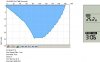
Siku, its been a while since I did FRC and Exhale dives, I just looked at my notes from Vertical Blue 2011. The only two sambas I had during the 3 weeks there were doing a <FRC dive and a Full exhale. They were both surprisingly long and my notes say how easy they were. The notes also say NOT to mix EQ training and pressure adaptation (head down empty and <FRC) dives with hangs, as they tricked me every time. YMMV. This dive produced a samba:
 

Attachments

  • Clipboard01.jpg
    Clipboard01.jpg
    46.5 KB · Views: 285
Azapa, what was your approximate lung volume on that dive, 1/4, 1/2, less, more? Any idea what your max lung volume is, not counting residual volume or packing?

Was this dive a pull down or a swim down?

Connor
 
Capn. Pull down working EQ and then sink when negative.I would say about 1/4. 2mm full suit no lead and sinking from about 12m. When i blow though one of those lung test machines (no pack) it says 6.5l vc, add 20% residual or thereabouts for TLC.
 
Last edited:
DeeperBlue.com - The Worlds Largest Community Dedicated To Freediving, Scuba Diving and Spearfishing

ABOUT US

ISSN 1469-865X | Copyright © 1996 - 2026 DeeperBlue Global Media Limited.

DeeperBlue.com is an independent digital media platform dedicated to Scuba Diving, Freediving, Ocean Advocacy, and Dive Travel.

Since 1996, we’ve been informing, educating, and inspiring the global diving community through trusted news, features, and shared community experience.

ADVERT