


The barrel sliding piston in a pneumatic speargun has to hold the spear shaft securely in the gun when the gun is cocked and ready to shoot, unless the gun is of the forward latching type, in which case the sear tooth holds the spear in directly by acting on an annular shaft notch located just behind the spear tip. Then when the gun shoots the piston has to allow the spear tail to release from its grasp without losing too much of the forward momentum which will carry the spear shaft and shooting line to the target.
On Mares pneumatic guns, and many others of a similar type, "conic friction" is used to jam the spear tail into the face of the barrel sliding piston. This involves a slightly tapered section on the extreme rear spear tail where a small part of that taper wedges against the cylindrical bore hole in the nose of the piston. In the old metal pistons this bore hole was about 5.7 mm diameter and in the plastic pistons it is the same, although entrance wear can make this hard to measure accurately. Where the spear tail jams into them both is about 6.1 mm in diameter, the spear tails tend to insert further into the plastic pistons than the metal ones, but only by a few millimetres. The idea behind this simple friction coupling design is that the spear tail can press slightly further into the piston as the hole in the piston or the spear tail's tapered section gradually wears. The latter will not occur with plastic pistons, but I have had it happen with metal pistons where the spear tail has gradually worn a small step or band into its tapered section and that spear will eventually not jam in the piston and will fall out very easily. Spears are usually lost or bent well before this happens, but this particular spear had an easy life as it was always used on smaller prey and was secured to the gun with a heavy shooting line (there were no escapees). By the time it wore out the spear had lost all of its cadmium plating and was a smooth "browned" finish just as firearms have a "blued" finish on some of their carbon steel parts. The metal pistons seem to last forever unless the mushroom head wears down, however free-moving oil lubrication inside the gun is intended to prevent that happening, or the mushroom tail shank is bent by using excessive force on the component.
Pneumatic spearguns shot when out of the water, or the muzzle lifted clear of the water's surface, with or without spears will soon damage pistons and shock absorbers and guns shot underwater without spears will also risk damaging the piston, especially plastic pistons, as the piston accelerates rapidly without having a heavy projectile to propel sitting in front of it. With all of the gun's propulsion energy then at its disposal the piston will use that energy to destroy both itself and the shock absorber, so do not be tempted to try it or you may be buying another pneumatic gun to replace the one that you have just ruined. If the shaft is tethered by a short shooting line then it may take you out on its return journey through the air as the line sends the spear back in your direction after hitting the limits of forward travel, another good reason not to shoot any spearguns in the air.
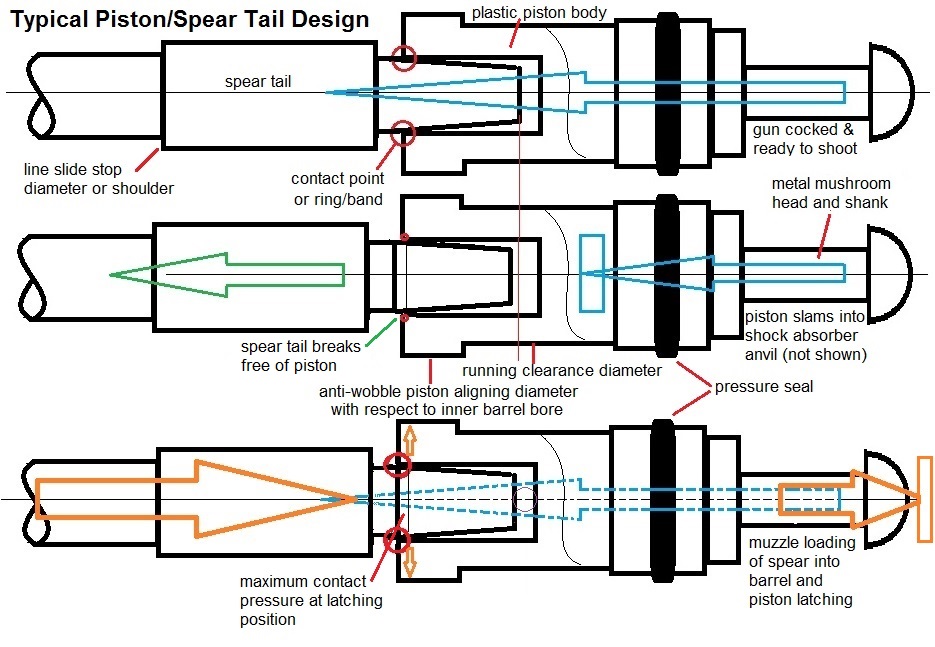
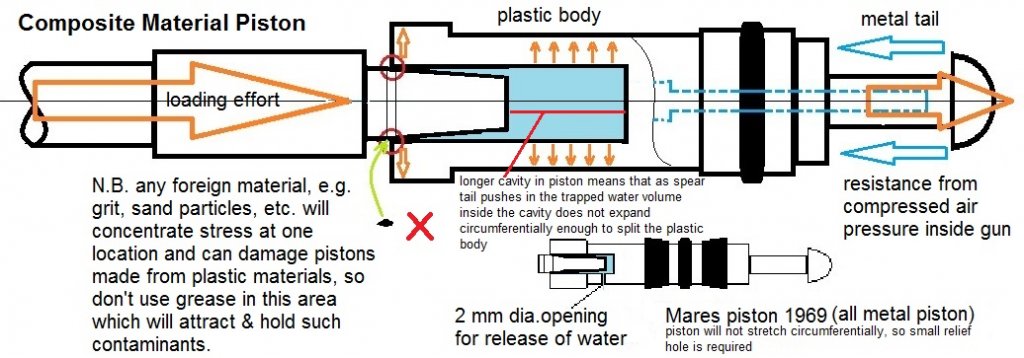
On Mares pneumatic guns, and many others of a similar type, "conic friction" is used to jam the spear tail into the face of the barrel sliding piston. This involves a slightly tapered section on the extreme rear spear tail where a small part of that taper wedges against the cylindrical bore hole in the nose of the piston. In the old metal pistons this bore hole was about 5.7 mm diameter and in the plastic pistons it is the same, although entrance wear can make this hard to measure accurately. Where the spear tail jams into them both is about 6.1 mm in diameter, the spear tails tend to insert further into the plastic pistons than the metal ones, but only by a few millimetres. The idea behind this simple friction coupling design is that the spear tail can press slightly further into the piston as the hole in the piston or the spear tail's tapered section gradually wears. The latter will not occur with plastic pistons, but I have had it happen with metal pistons where the spear tail has gradually worn a small step or band into its tapered section and that spear will eventually not jam in the piston and will fall out very easily. Spears are usually lost or bent well before this happens, but this particular spear had an easy life as it was always used on smaller prey and was secured to the gun with a heavy shooting line (there were no escapees). By the time it wore out the spear had lost all of its cadmium plating and was a smooth "browned" finish just as firearms have a "blued" finish on some of their carbon steel parts. The metal pistons seem to last forever unless the mushroom head wears down, however free-moving oil lubrication inside the gun is intended to prevent that happening, or the mushroom tail shank is bent by using excessive force on the component.
Pneumatic spearguns shot when out of the water, or the muzzle lifted clear of the water's surface, with or without spears will soon damage pistons and shock absorbers and guns shot underwater without spears will also risk damaging the piston, especially plastic pistons, as the piston accelerates rapidly without having a heavy projectile to propel sitting in front of it. With all of the gun's propulsion energy then at its disposal the piston will use that energy to destroy both itself and the shock absorber, so do not be tempted to try it or you may be buying another pneumatic gun to replace the one that you have just ruined. If the shaft is tethered by a short shooting line then it may take you out on its return journey through the air as the line sends the spear back in your direction after hitting the limits of forward travel, another good reason not to shoot any spearguns in the air.