• Welcome to the DeeperBlue.com Forums, the largest online community dedicated to Freediving, Scuba Diving and Spearfishing. To gain full access to the DeeperBlue.com Forums you must register for a free account. As a registered member you will be able to:

    • Join over 47,943+ fellow diving enthusiasts from around the world on this forum
    • Participate in and browse from over 531,990+ posts.
    • Communicate privately with other divers from around the world.
    • Post your own photos or view from 7,455+ user submitted images.
    • All this and much more...

    You can gain access to all this absolutely free when you register for an account, so sign up today!

Question about intense ventilation before dive

Thread Status: Hello , There was no answer in this thread for more than 90 days.
It can take a long time to get an up-to-date response or contact with relevant users.
And if you would take your last breath (before apnea) from a joint, how much O2 would there be in your lungs?

Having personally dived with these guys, I think I have the answer. The ganja instantly lowers your heart rate which compensates for the lower O2. Your muscles are far more relaxed thus reducing consumption of O2. Also, contractions are mistaken for hunger pains (commonly referred to as 'the munchies') thus making the discomfort of high CO2 much easier to handle and as a result you burn less O2.

The only drawbacks of this type of diving is the urge to break out in spasmodic coughing and the over use of words like 'dude' and 'man'.
 
Sounds great, can't wait to try it ! :)
Just wondering if I can still pass a SP with it, If I come up and say "I'm ok dude" I would be fine, but if it was like " dude! I'm ok" it would be a red card......

Hi Simos, I'm not a beginner I do know the theory on HV, no need for me to look it up. Just wondering more at a comp level, people still dive after significant breathe ups (not everyone). If it really made you blackout quicker they wouldn't be doing it. Again I'm talking about a controlled environment with safety divers, it's not something I would ever teach beginners to do.

Cheers,
Wal
 
Hi Wal - it sounds to me that while you know the theory, you don't believe it's true :-) the theory explains why you black out quicker. The fact that people do it in competition does not mean the theory is wrong - i am pretty sure in fact that if I hyperventilated before an attempt, I would do better than what I am doing now. But that's just because I am still mainly limited by co2 and I am ending my attempts much before I am anywhere near BO..

Out of curiosity, if you don't think that it does make a difference in BO why wouldn't you teach beginners to do it? Why would it be appropriate for a more advanced diver to hyperventilate - surely if anything beginners are safer because even with hyperventilation they are still a lot less tolerant to CO2 levels...

Just to reiterate - I am not saying that hyperventilation can't lead to a better performance; depends on the diver's limitstions and how much HV they do. But I do still think that while it might make longer holds easier (delayed contractions etc) it does limit performance if a diver can push to the limits of BO

Ps I am not an expert by no means so I would be really interested to know why you think that it doesn't bring BO closer (other than that people do it)
Posted via Mobile Device
 
Forgot to ask Wal: what exactly did you mean by 'significant breathups'? Surely not all kinds of breathups result to hyperventilation...

E.g. as far as i know (and I stand to be corrected of course) one popular type of breathup involves a 2:1 ratio of exhale:inhale time. The idea is that by doing this slowly the heart slows down too and as I understand it, the reason for the 2:1 ratio is so that it doesn't lead to hyperventilation despite the deep inhales....

Posted via Mobile Device
 
Last edited:
E.g. as far as i know (and I stand to be corrected of course) one popular type of breathup involves a 2:1 ratio of exhale:inhale time. The idea is that by doing this slowly the heart slows down too and as I understand it, the reason for the 2:1 ratio is so that it doesn't lead to hyperventilation despite the deep inhales....
Most "breath-ups" lead to lesser or bigger hyperventilation. The ratio is little important. What is important is the number and the volume of the breaths. In relaxed state you breath flatly (~0.5 liter) around 12 times per minute. If you breath up slowly (say 4 times per minute), but deeply (say 4 liters), you hyperventilate (in our case 16 liters instead of 6).

Also reducing the heart-rate prior the dive is questionable. In fact you need your heart running fast before the dive - that helps keeping the venous blood oxygenated. You want it low during the dive (and even that is not always necessarily true).

There is a certain trade off between the advantages and disadvantages of hyperventilation. Moderate hyperventilation helps keeping more oxygen especially in the venous blood, but decreases the hypoxia tolerance. Hence the ideal preparation would keep maximal possible level of CO2, while keeping the oxygen supply higher than consumption to increase the O2 saturation in venous blood.

However that's a bit contradictory. With hyperventilation it happens thanks to the high heart rate and the blood alkalosis (limiting the O2 discharging from hemoglobin). We do not want the later, since it means less protection against hypoxia, and because it can lead to depleting O2 stores in the tissue (namely in myoglobin) before the breath-hold starts. The maximal muscular and cerebral relaxation, while maintaining relatively high heart-rate seems to be the way. Certain level of moderate hyperventilation may be helpful too, but 100% of freedivers hyperventilate more than needed already without admiting it, so it should really never be tiught to beginners, and never use when perfect safeguards are not in place.
 
Last edited:
EtpLe
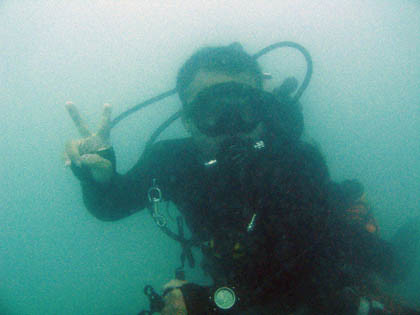
Haha, Wal that'd be a red card, this is your ok:
435374809


435374809
 
Last edited:
Hi Lars,
Hyper-ventilating they call it, & yes it works, flooding the system with extra oxygen & giving you a longer dive. But only if you're in good cardio-vascular condition. In other words...pretty fit.

In any case, if you're diving with a buddy you should always watch each other, just in case. My mate & I in Mozambique tried to never be both underwater at the same time, ensuring that 1 of us was always on the surface, watching the other ones back, & ready to help if the other one got into difficulty. (fortunately we never did) Also, when shooting a lot of fish in one area, a fast moving shark can come in looking for an easy meal, so that's another reason for having a buddy on the surface to watch out for you.
Jeff
 
Hi Lars,
Hyper-ventilating they call it, & yes it works, flooding the system with extra oxygen & giving you a longer dive. But only if you're in good cardio-vascular condition. In other words...pretty fit.
That's a relatively common but still wrong interpretation. In contrary to what you think, hyperventilation does not add all that much of oxygen to your body, while it does reduce your hypoxic tolerance. The amount of CO2 in lungs that can be replaced with O2 is very low, the arterial blood is in relaxed state already saturated close to 100%, and it cannot take much more O2. So only the venous blood (the one that comes back from the body to lungs) is more charged when hyperventilating. At prolonged hyperventilation, the tissue can start starving of O2, and create O2 debt. And there are other negative effects (listed many times in other more extensive threads here on DB).

Whether you are in good cardiovascular situation makes no difference. In contrary, a person with great cardio condition with excellent VO2max may blackout earlier than someone untrained.
 
Thanks Trux - very interesting. I know most freedivers hyperventilate to some extend (including myself hence my other thread a couple of days ago - thanks for tha calculator by the way!).

I thought the ratio is important as essentially it makes sure roughly that the deeper your inhalations, the less of them you do. I understand there is no magic in the ratio but in practice it must limit the hyperventilation...

One question about your explanation - doesn't make full sense to me to say that if you take more L of air in it necessarily leads to hyperventilation... Surely say you take on deep breath in of 7L and hold for a minute (instead of 12x0.5l) you wouldn't have hyperventilated? How would your CO2 level drop below normal in this scenario? Surely the number of exhalations must also be important?

I find your point on keeping the heart rate high before the dive very interesting. Assuming you can really drop it quickly during the dive and that it doesn't mean you start with excess co2 this makes sense, will have to give it some thought :-)
Posted via Mobile Device
 
Also just one point on the 2:1 breathup: I've seen a number of beginners doing this (and I had tried myself when I started) and nearly everyone finds it really hard to make really long inhalations. When I did it, it felt a bit like a breathhold almost and I had the urge to breath during the exhale so I am guessing my co2 levels might even have been rising a bit - certainly didn't feel like they were dropping and after a few cycles I was finding harder to keep the exhales so long (a bit like when you do holds almost back to back).
Posted via Mobile Device
 
Thanks Trux - very interesting. I know most freedivers hyperventilate to some extend

I don't think this is true at all. Amongst my circle of freediving acquaintances only the ones with informal training or those who have trained with instructors who are not up-to-date with freediving developments use hyperventilation. They are also the ones who samba and blackout all the time. HV is sooo 1994!
 
Just wondering more at a comp level, people still dive after significant breathe ups (not everyone). If it really made you blackout quicker they wouldn't be doing it.

I'm not too sure about that Wal, it's a hard habit to shake. Even if you're pretty careful about your dive strategy it's difficult to bring your breathing back in line when you know that a harder breathup will make a dive feel easier. Plus many of the deep divers are limited by EQ rather than hypoxia, so they can afford to HV and lose a few potential metres.
 
I thought the ratio is important as essentially it makes sure roughly that the deeper your inhalations, the less of them you do. I understand there is no magic in the ratio but in practice it must limit the hyperventilation...
Yes, you are partially right, the depth of the inhalation is important. But in the exact opposite direction than you think: the deeper you inhale, the harder you hyperventilate. When breathing, there is a dead volume in the mouth and sinus, the trachea, and the bronchi, with little or no gas exchange in them. At normal flat breath, the inhaled or exhaled volume (~0.5 l) is hardly (if at all) bigger than the dead space, At deep exhales and inhales, the dead space gets flushed entirely very quickly, and most of the inhaled air volume is new air. It means you remove CO2 much more efficiently than with flat breathing. The simplified calculation in my previous post did not take it in account, the real level of hyperventilation would be in fact worse than shown at the deep pattern.

One question about your explanation - doesn't make full sense to me to say that if you take more L of air in it necessarily leads to hyperventilation...
That's the very definition of hyperventilation - it is a higher than needed ventilation (exchange of air in given time unit). Even if we ignore the influence of the dead space as noted above, 4x4 liters at deep slow pattern = 16 liters are 10L above the normal 12x0.5 = 6 liters (or almost three times higher ventilation). Hence hyperventilation. At 1x7 l we would be already close to the normal of 6l, hence lesser hyperventilation.


I don't think this is true at all. Amongst my circle of freediving acquaintances only the ones with informal training or those who have trained with instructors who are not up-to-date with freediving developments use hyperventilation. They are also the ones who samba and blackout all the time. HV is sooo 1994!
No, it is true. Already a single purge represents hyperventilation. Practically any kind of "deep relaxed breath-up" represents a rather serious hyperventilation. And the body starts hyperventilating alone when in stress or in preparation for performance, even without you doing it consciously. There is difference between moderate and excessive hyperventilation. At moderate hyperventilation, the advantages may overweight the reduced hypoxic tolerance, while not suppressing the contractions and the urge to breath beyond the safe zone. However, even at moderate hyperventilation the disadvantages are there, and especially it then happens easier that under stress or in a unusual situation you unconsciously over-hyperventilate, and find yourself beyond the safe zone.
 
For me this is very simple and no "articles" needed to be written.

1. Medical definition of Hyperventilation: any increased (volume) of breathing above what the body needs (which is controlled by the nervous system). This is called the tidal volume.
A body in rest breathes about 12 breaths per minute and a very low volume in every breath. An example: 3 dl of air x 12 breaths = less than 4 liters of air every minute.

Just a singled deep breath is thus HYPERVENTILATION.

2. But traditionally HV among freedivers is the kind of forced fast breathing that was as someone said "soo 1994".

3. Most competetive freedivers HV I would claim. BUT the professionals know exactly what CO2 levels they want.

4. And the already known fact that the more CO2 you have the more access you have to the O2 in the body.

5. There is no perfect standardized breathing. Not even for one individual. Every day, every dive, every stage of you freediving career asks for one specific breath up.

Sebastian
 
  • Like
Reactions: Johan Andersson
Based on that definition, then yes almost everyone hyperventilates because the last breath is usually a big deep inhale (+packing).
I agree that almost everyone hyperventilates. That's what I already wrote. There is still a huge difference in the level of hyperventilation.

However, the last breath is no hyperventilation, because since you do not exhale anymore, you do not remove any CO2.
 
Maybe we can appoint an international fact finding committee to establish a universally accepted definition for the term 'hyperventilate'?

I think for most people out there 'normal breathing' = 'slow relaxed breathing' and 'hyperventilation' = 'forced deep inhaling and exhaling for more than 1 breath'. So based on my own definitions, which I like quite a lot, I'd say that the majority of good (definition of 'good' to be decided at a later date) freedivers that I know DO NOT hyperventilate.

However, based on Dave and Sebastian's input it may be that the majority of bad freedivers and the small number of top record-breaking freedivers DO hyperventilate.
 
Maybe we can appoint an international fact finding committee to establish a universally accepted definition for the term 'hyperventilate'?

In physiology, hyperventilation is defined as:

"A pulmonary ventilation rate faster than is metabolically necessary for the exchange of gases. It is the result of an increased frequency of breathing, an increased tidal volume, or a combination of both. It causes an excess intake of oxygen and the blowing off of carbon dioxide."

/Johan

Edit: It is the "blowing off of carbon dioxide" that is the most important factor to consider when defining any ventilatory pattern as either hyperventilation, hypoventilation, or normal breathing.
 
Johan, you ruined my plan. I was going to appoint myself the committee chairperson and live off NGO funds for the rest of my life.

I'm tempted to delve into the metabollic necessity part of that definition, but I think I'll give it a rest and do some ganja freediving instead.
 
Hi Dave,
you seen (&heard) Herbert and or Sarah before they dive ? ;-)
Agree for some people, myself included HV can help relax you more in the glide phase and help you out with deep EQ. If there is a difference, ie making you blackout earlier I think it must be fairly small, ie a few %, or as you said a few m. Depends on a lot of variables of course. Like I said before Narcosis is a big factor as well. At least for me HV will definitely reduce the Narcosis.

Slow deep breathing for long periods ie 5 minutes plus will also lower your CO2 levels. So it's not just about rapid/fast breathing, but your resting CO2 output vs how fast you are removing it from your blood. So even "correct" breathing can lower your CO2. Genetics plays a huge part, a good breathe up for one person could be over breathing for another.

Cheers,
Wal
 
DeeperBlue.com - The Worlds Largest Community Dedicated To Freediving, Scuba Diving and Spearfishing

ABOUT US

ISSN 1469-865X | Copyright © 1996 - 2026 DeeperBlue Global Media Limited.

DeeperBlue.com is an independent digital media platform dedicated to Scuba Diving, Freediving, Ocean Advocacy, and Dive Travel.

Since 1996, we’ve been informing, educating, and inspiring the global diving community through trusted news, features, and shared community experience.

ADVERT