


Guest viewing limit reached
- You have reached the maximum number of guest views allowed
- Please register below to remove this limitation
- Already a member? Click here to login
-
Welcome to the DeeperBlue.com Forums, the largest online community dedicated to Freediving, Scuba Diving and Spearfishing. To gain full access to the DeeperBlue.com Forums you must register for a free account. As a registered member you will be able to:
- Join over 47,943+ fellow diving enthusiasts from around the world on this forum
- Participate in and browse from over 531,990+ posts.
- Communicate privately with other divers from around the world.
- Post your own photos or view from 7,455+ user submitted images.
- All this and much more...
You can gain access to all this absolutely free when you register for an account, so sign up today!
You are using an out of date browser. It may not display this or other websites correctly.
You should upgrade or use an alternative browser.
You should upgrade or use an alternative browser.
Recordattempt William Trubridge
- Thread starter Jorg
- Start date
Thread Status: Hello
, There was no answer in this thread for more than 90 days.
It can take a long time to get an up-to-date response or contact with relevant users.
It can take a long time to get an up-to-date response or contact with relevant users.

sickbugs said:... i believe that the discipline you chose is the most pure form of freediving.
That's for sure and IMHO CNF will be the discipline of choice for competitions.
- safer for safety divers (shallower dives, greatly reduced Deco times)
- safer for freedivers (no dependency on fins)
- cheaper for competition organizers (safety divers)
- purer competition (look where finswimming is compared to swimming today)
- No fancy and expensive fins needed (it's all about the competitor - not the equipment)
greetings from Austria

Excellent post, Will. Congratulations for an almost perfect dive. Joy is both the secret and strength of freediving. Keep on pursuing that joy and success will inevitably follow. We look forward to hear about Your next WR-attempt soon.Will said:I found out today that there is a huge difference between doing 82m in a calm, serene Blue Hole and doing the same thing with an official top, judges and spectators. I feel like I gave it my best shot, but in these conditions 81m is still beyond me, so full credit to Martin, whose 80m dive remains the greatest acheivement in this discipline. ...
Gerald


Hi Tyler,
I still have some symptoms of the ciguatera even now (almost a month after the last poisoning). The lethargy and aching muscles have gone, but I still feel burning/tingling on hands and feet from the cold water, making it difficult to judge hypocapnia in the breathe-up.
If I had a severe case I would still be in bed (walking is physically impossible for a month).
Will
I still have some symptoms of the ciguatera even now (almost a month after the last poisoning). The lethargy and aching muscles have gone, but I still feel burning/tingling on hands and feet from the cold water, making it difficult to judge hypocapnia in the breathe-up.
If I had a severe case I would still be in bed (walking is physically impossible for a month).
Will
Hi Will,
Again- amazing dive, well done! Can you let us know more about the "shortening of the breathe-up to ensure high pre-dive CO2"?
Do you lower frequency of breathing, overall duration of breath-up or amplitude? Or combinations of these?
Thanks!
Pat
Again- amazing dive, well done! Can you let us know more about the "shortening of the breathe-up to ensure high pre-dive CO2"?
Do you lower frequency of breathing, overall duration of breath-up or amplitude? Or combinations of these?
Thanks!
Pat

Hi Pat,
No warm-up (other than stretching and lung stretching 1 hour before dive)
5-8' breatheup: very slow breathing to maintain high C02 (4-6 breaths/min). All breathing prior to the breatheup is normal relaxed breathing, whilst the breatheup is deeper diaphraghmatic. With this method:
Good dive: contractions (hypercapnic) on descent & CO2 narcosis, no contractions for ascent
Close dive: no contractions at all
Bad dive: no contractions on descent, contractions (hypoxic) during last part of ascent.
The WR attempt was funny, because it was a good dive for the descent, but I had hypoxic contractions from 20m on the ascent...
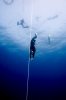
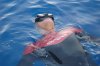
I have some photos from the comp, but can't resize them to DeeperBlue dimensions. Maybe I will e-mail them to Stephan, if he would do me the honour of posting...
Cheers, Will.
No warm-up (other than stretching and lung stretching 1 hour before dive)
5-8' breatheup: very slow breathing to maintain high C02 (4-6 breaths/min). All breathing prior to the breatheup is normal relaxed breathing, whilst the breatheup is deeper diaphraghmatic. With this method:
Good dive: contractions (hypercapnic) on descent & CO2 narcosis, no contractions for ascent
Close dive: no contractions at all
Bad dive: no contractions on descent, contractions (hypoxic) during last part of ascent.
The WR attempt was funny, because it was a good dive for the descent, but I had hypoxic contractions from 20m on the ascent...
I have some photos from the comp, but can't resize them to DeeperBlue dimensions. Maybe I will e-mail them to Stephan, if he would do me the honour of posting...
Cheers, Will.
Attachments
Last edited by a moderator:

Many thanks, Will, for explaining the breath-up, and also for the nice and frank report. Congrats and big respect to you even if there was no record!Will said:... very slow breathing to maintain high C02 (4-6 breaths/min)
I still do not understand though what is the purpose of having high CO2 prior the dive. Additionally you write, on a "good" dive you have contractions and CO2 narcosis on descent, but not on ascent. Why do they stop at the bottom? Is it the partial pressure? And why they do not appear again on the ascent? And I though that the exact purpose of the breath-up is to get saturated with O2, but keeping CO2 reasonably low (not too much though, to use the CO2 contraction as indicator of the comming end). Additionally, it was frequently discussed here on DB, that contractions on the descent or in the depth, can play a very important role in causing a lung squeeze, since they violently change the pressure in the lungs - which can have fatal effect if the lungs/rib cage/diaphragm are already stressed to the limits by the depth.
As for the CO2 narcosis - I do not really know if I know how it feels and what are its effects, but wonder why it is good to get it as soon as on the descent.
So, so far, I really do not understand what is the purpose and advantage of contractions and CO2 narcosis on the descent. If you could explain little bit more, I'd be very thankful.
Last edited:
Just quickly before I dash off to the sea...
CO2 regulates blood O2, so that the higher your CO2 the more O2 is conserved. This is why your longest static might involve very early breathing reflexes.
CO2 narcosis is due to partial pressure, and is pronounced on no warm-up dives. I normally start feeling it just before the turn, and it peaks at about 55m from the surface.
If your training focusses on hypercapnic resistance (and 'denying' contractions) then it is only in these extreme conditions (no warm-up, high partial pressure) that you will feel any hypercapnic contractions.
CO2 narcosis is characterised by somnolence (unnerving), but normally indicates that I haven't blown off too much CO2 in the breatheup.
Lung squeeze is an independent problem, that can be cured through non-cardio exercise and lung/ribcage stretches (see other threads).
Will
CO2 regulates blood O2, so that the higher your CO2 the more O2 is conserved. This is why your longest static might involve very early breathing reflexes.
CO2 narcosis is due to partial pressure, and is pronounced on no warm-up dives. I normally start feeling it just before the turn, and it peaks at about 55m from the surface.
If your training focusses on hypercapnic resistance (and 'denying' contractions) then it is only in these extreme conditions (no warm-up, high partial pressure) that you will feel any hypercapnic contractions.
CO2 narcosis is characterised by somnolence (unnerving), but normally indicates that I haven't blown off too much CO2 in the breatheup.
Lung squeeze is an independent problem, that can be cured through non-cardio exercise and lung/ribcage stretches (see other threads).
Will

Will said:Just quickly before I dash off to the sea...
Hmm, I keep "alive" reading this interesting thread in between writing office memos some 800km away from the nearest seaside and you are dashing off the blue hole :head! I guess i am heading off tomorrow the a lake nearby, to test a bit some of your very interesting points made here - really, thanks for sharing your experience and knowledge - it really helps the others stay safer and have more fun diving.
serge
BTW, if you want to resize the images - there are many programs (even free ones) that make it really easy, and mostly you get such program with your camera too, but you can do it also with the off-the-box Windows:
http://graphicssoft.about.com/cs/imageediting/tp/freephotoedw.htm
If you use a Mac or Linux, then you probably already have some good graphic editors in your system, or will find many free applications in Google too.
- Right-click the image in Explorer
- Select Open With >> Paint
- Hit Ctrl-W (or Image >> Stretch in menu)
- Enter reasobable percentage values both for horizontal and vertical stretch - for example if the original image has the width of over 2000 pizels, then you can enter 20%, getting a final image width of some 400 pixels which is already quite small (possibly even too much - 30% may be better).
- Click OK
- Select File >> Save as, and save the resized image under a new name to avoid overwriting the original
http://graphicssoft.about.com/cs/imageediting/tp/freephotoedw.htm
If you use a Mac or Linux, then you probably already have some good graphic editors in your system, or will find many free applications in Google too.
Last edited:
Thanks again, Will, for the detailed answer and for sharing your wisdom!

Yes, that sounds reasonably. On the other hand though - aren't the contractions a big O2 consumer? I am no big competitor, but I usually do my PB when my contraction come late - when they come too soon, I simply feel exhausted and O2 depleted through the muscle work much earlier.Will said:CO2 regulates blood O2, so that the higher your CO2 the more O2 is conserved. This is why your longest static might involve very early breathing reflexes.
How do you fight against that? Or is the somnolence/unnerving not too bad to make you abandon the dive?Will said:CO2 narcosis is due to partial pressure, and is pronounced on no warm-up dives. I normally start feeling it just before the turn, and it peaks at about 55m from the surface... <snip> CO2 narcosis is characterised by somnolence (unnerving), but normally indicates that I haven't blown off too much CO2 in the breatheup.
Yes, I know that. But I'd tell that with contraction starting soon on the descent, you have to have much bigger reserves in the lung/ribcage/diaphragm flexibility, because the contraction add a lot more to the top of the depth pressure. Well, but that's certainly why not everyone can do itWill said:Lung squeeze is an independent problem, that can be cured through non-cardio exercise and lung/ribcage stretches (see other threads).
Will
Will said:Hi Pat,
No warm-up (other than stretching and lung stretching 1 hour before dive)
5-8' breatheup: very slow breathing to maintain high C02 (4-6 breaths/min). All breathing prior to the breatheup is normal relaxed breathing, whilst the breatheup is deeper diaphraghmatic. With this method:
Good dive: contractions (hypercapnic) on descent & CO2 narcosis, no contractions for ascent
Close dive: no contractions at all
Bad dive: no contractions on descent, contractions (hypoxic) during last part of ascent.
The WR attempt was funny, because it was a good dive for the descent, but I had hypoxic contractions from 20m on the ascent...
I have some photos from the comp, but can't resize them to DeeperBlue dimensions. Maybe I will e-mail them to Stephan, if he would do me the honour of posting...
Cheers, Will.
Thank you Will!
I will go for the preparation of the Tripledepth competition in Dahab next thursday. I have never worked with the concept of no-warmup dives so far. But will definitely try it out this time. My CO2 tolerance is higher than last year, so good premises. So far I did warmup dives under the idea of peripheral vasoconstriction, something that might not even be needed in advance on very deep dives. Another thing is the mental aspect of overcoming the fears caused by contractions on the descent. Maybe something that can be overcome by more training. We'll see..
Pat
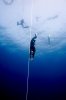
Here is a photo from the attempt on the 13th
The photographer is Adam Butler http://www.butlersweb.com and the images are copyrighted.
Before you ask, the white patch on my leg is velcro, to hold the 81m tag (worked very well).

The photographer is Adam Butler http://www.butlersweb.com and the images are copyrighted.
Before you ask, the white patch on my leg is velcro, to hold the 81m tag (worked very well).
Attachments
great image Will. I just checked verticalblue.net if you posted the video of the attempt, you mentioned it earlier, but could not find it. Any new about it?
One question, i cant figure out if you have a nose clip and goggles, or full mask, if the latter (as it looks like) i wonder how you do the equalisation while saving as much energy as possible.
Serge
One question, i cant figure out if you have a nose clip and goggles, or full mask, if the latter (as it looks like) i wonder how you do the equalisation while saving as much energy as possible.
Serge
As soon as someone tells me how to edit a DVD video file (*.VOB) and compress it down to a lower resolution (currently 620MB) then I can upload the video onto my site.:head
I used a Cressi Minima for the attempt, and don't have any trouble equalising this down to 81m handsfree.
I used a Cressi Minima for the attempt, and don't have any trouble equalising this down to 81m handsfree.