• Welcome to the DeeperBlue.com Forums, the largest online community dedicated to Freediving, Scuba Diving and Spearfishing. To gain full access to the DeeperBlue.com Forums you must register for a free account. As a registered member you will be able to:

    • Join over 47,943+ fellow diving enthusiasts from around the world on this forum
    • Participate in and browse from over 531,990+ posts.
    • Communicate privately with other divers from around the world.
    • Post your own photos or view from 7,455+ user submitted images.
    • All this and much more...

    You can gain access to all this absolutely free when you register for an account, so sign up today!

Runner calculations conventional guns bs inverters guns

Thread Status: Hello , There was no answer in this thread for more than 90 days.
It can take a long time to get an up-to-date response or contact with relevant users.

Adammoore

Well-Known Member
Jan 25, 2012
24
0
86
Hello ,
Am building an inverted roller gun I had experience building a 3*16 conventional gun I wonder if there is a change in rubber length calculation being conventional vs roller or inverted and if why there is a difference since it’s all about the rubber traveling distance and rubber stretch 300-350%.
 
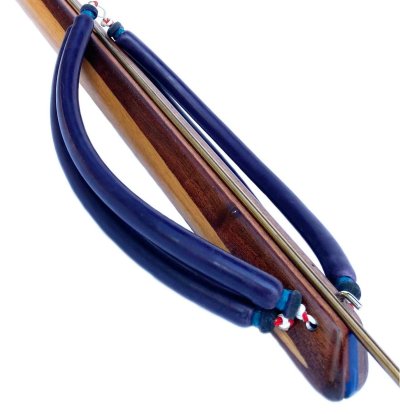
it's calculated in the same way we calculate conventional bands that are tied with dyneema to the muzzle, like image attached
you just measure from where the pulley stops at the muzzle down to the hook that the bands are going to anchor

the main different is that the power in invert rollers is halved by the pulley so a load of 3x16, around 150kg on the mech, is going to be 75kg in invert rollers which is less than 2x14,5 usually
so depending on shaft you just add more rubbers. 3 pairs is more or less the minimum unless you can find 21mm rubbers in which case you can have a pair of 21s and a second pair of 17,5s. for reference this is with a 6,5 or 6,75 shaft in mind
but usually it depends on the shaft and the type of hunting (bw vs reef)
 

Attachments

  • lastixa.jpg
    lastixa.jpg
    127.4 KB · Views: 47
Some gun makers do not recommend mixing rubbers diameters, as far as we got explained it's due to different loads and speeds provided which sounds counterintuitive. How much truth is in it I can't say, as I haven't seen any technical proof.
 
Thanks a lot gof
The advise
My plan is for 100 cm
Gun with 140 cm 7mm shaft

3 pairs of 16M

Wdyt about that ?

Also I wonder is it on to add a 14Mm rubber band on top as a booster like it was
Done in earlier roller guns ?
 
Thanks a lot gof
The advise
My plan is for 100 cm
Gun with 140 cm 7mm shaft

3 pairs of 16M

Wdyt about that ?

Also I wonder is it on to add a 14Mm rubber band on top as a booster like it was
Done in earlier roller guns ?
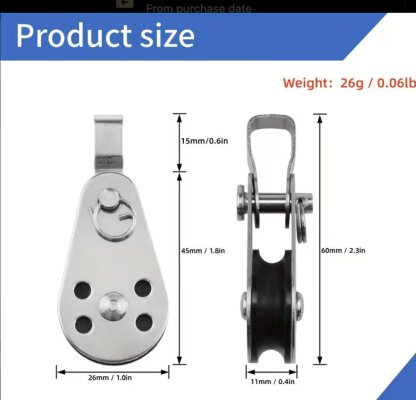
Also i would like to ask does the size of the pulley matters cuz the smallest I can find is like 6cm

Does the size matters. I will use the one attached in picture
 

Attachments

  • 11087140-2613-4E64-8C80-78A3B759D1F5_014D4770-F5D0-4912-8600-E08BBF1F75D9.jpeg
    11087140-2613-4E64-8C80-78A3B759D1F5_014D4770-F5D0-4912-8600-E08BBF1F75D9.jpeg
    54.6 KB · Views: 49
it's calculated in the same way we calculate conventional bands that are tied with dyneema to the muzzle, like image attached
you just measure from where the pulley stops at the muzzle down to the hook that the bands are going to anchor

the main different is that the power in invert rollers is halved by the pulley so a load of 3x16, around 150kg on the mech, is going to be 75kg in invert rollers which is less than 2x14,5 usually
so depending on shaft you just add more rubbers. 3 pairs is more or less the minimum unless you can find 21mm rubbers in which case you can have a pair of 21s and a second pair of 17,5s. for reference this is with a 6,5 or 6,75 shaft in mind
but usually it depends on the shaft and the type of hunting (bw vs reef)
I want to comment here about the half load on the trigger it makes sense but I wonder how when they sell trigger mechanism like bleutech that is specialized for roller they claim that it has more with standing power since it’s roller and more expensive with fully inside the trigger for smoother shot claiming that in roller guns the load on mechanism is higher which is against the idea of half the load wdyt ?
 
I want to comment here about the half load on the trigger it makes sense but I wonder how when they sell trigger mechanism like bleutech that is specialized for roller they claim that it has more with standing power since it’s roller and more expensive with fully inside the trigger for smoother shot claiming that in roller guns the load on mechanism is higher which is against the idea of half the load wdyt ?
Do they really say that? if so it's not true
trigger mechs with rollers in them are smoother and enjoyable even in single band conventional guns, this is accurate, they have less friction. but rollers and especially invert rollers do not have a larger load. Just consider a typical setup in bleutec oceanborn, 4x14,5 or 2x14,5+2x16, or 4x16
a double roller is usually 2x16 so half the load and an invert roller with 4x16 is also half the load (equivalent to 2x16 double roller)
we'd need a quad roller which doesn't exist (maybe double HEPA comes close), to get to the same load as the classic 4x16 setup. or an inver roller with 8 pairs of bands which also doesn't exist.
and that's not even an extreme setup, consider how there are 5x16 or 6x16 wooden guns with 9+kg mass

there are a lot of misconceptions due to speculation around rollers & invert rollers and the physics behind them, over the years i have seen a lot of nonsensical explanations. they do sound plausible and so they are adopted for explanatory power, but in practice they are not true
don't forget that most speargun makers don't know exactly why their guns shoot the way they shoot, especially those who switched to invert rollers. a lot of the innovation occurs through trial and error, not calculating math behind it, and that's good because otherwise it would be very boring
we do know for example that if the shaft is slow, then we just need to power up the gun more. this can work up to a certain point. the answer to recoil sapping away shaft energy was to just have heavier guns, and it worked
but with rollers and invert rollers and fusion and other guns, it's not so evident. it's not very evident with pneumatics either
i'd also say that most people including builders, don't really have interest in that. they know that they can make a gun catch fish, and that's enough. that's not bad either, it clearly works
but if you press on the "why is it so" then it doesn't hold up because there's no actual physics behind it

basically it's just speculation because there was never a big need to confirm why it works that way. same way we know that rollers have slower shaft acceleration (smoother curve), that's not a problem, but some brands speculated it is a problem so they added a booster band, which in practice dramatically reduces efficiency and fixes nothing
 
I'm totally with you on the mentality 'if it's working let's not get into it why and let's sell it... Which sux.

But yes, I don't wanna cite some popular gun makers but we got the do not mix rubber sizes in invert from 2 sources when asked. It's pretty reflected on their builds, but maybe it's too much work to customize a different thickness first band on invert...
 
I'm totally with you on the mentality 'if it's working let's not get into it why and let's sell it... Which sux.

But yes, I don't wanna cite some popular gun makers but we got the do not mix rubber sizes in invert from 2 sources when asked. It's pretty reflected on their builds, but maybe it's too much work to customize a different thickness first band on invert...
I have gotten that from a well known maker with decades under his belt as well, the logic behind it is solid. since bands will contract at similar speeds, one of the two bands will be basically nullified
In theory there is an answer to this: the bands always contract at a speed higher than their speed when pulling a heavy object like the shaft. the thicker band will do the heavy lifting (and rectract more slowly) while the thinner one will be able to have a lighter load than if the other band was thin as well, so it will contract faster
I have not tested any of this so it's just plausible, not guaranteed. But it seems that it works this way with invert rollers where having different band thickness is the go-to in most setups (1x19 + 2x16 etc). some will even have a booster band with a much smaller overall load compared to the one on the dyneema
There was also a guy here in greece taking measurements in a controlled environment with an auto-firing machine (idk how to call it lol), measuring speed, energy and things like that. he said somewhere that two different bands don't make a difference, and this was years before we saw it from invert rollers. obviously not hard proof, but i think that with invert rollers we do have confirmation of this now. whether it is because of the explanation i found, no idea. could be something else

i do set up my conventional guns with the same rubbers though, it just feels off to have two different ones and it looks a bit ugly hahaha. so to be honest it's definitely not an issue if it persists
 
Your logic regarding mixing the bands for inverted is identical to my thinking, but I am not engineer just some joe that probably understands the basics a little bit deeper than typical person.

Everyone convinces me to not mix so idk...

1 thing that stands out for me is something that I believe is the biggest misconception in the invert/rollers but I hope I am wrong.
'roller guns pull the shaft all the way to the muzzle'
How on earth is that living in most heads when rubbers when contracted STOP gaining more speed when the shaft speed and rubber stored energy gets into equilibrium at some point over the length of the barrel.

The equilibrium is NEVER at the muzzle I believe unless you do some weird gimmicks with bands %.

I liked the Greek guy shaft speed tests on YT and Rob allen's, but I wish someone extrapolated the first half of the barrel length speed or even 2/3 and it's correlation to full barrel length to get a nice and clean ∆ change between. It would end the discussion for ever.

If at let's say 1/3 or 1/2 barrel length we get Vmax the shaft isn't propelled any more. It's free flying.
That's would be the case to add thinner FASTER bands at higher stretch ratio.
Becouse manufacturers do not talk about bands VMAX based on bands specification, it's really hard to get more into topic unless you have resources and test platform to do it yourself.
 
that's probably related to Work done, which means there's load on the shaft increasing its KE for the additional 1/3 of the barrel
it's not a lot but the most valuable thing is that it prevents it from going into depletion like in classic setups
Spiller's paper from 2021 has diagrams on this
similar reason pneumatics are so powerful despite having a very light load on the shaft compared to even a single band
basically it's force over distance
W = F*d
rubber speed isn't as relevant
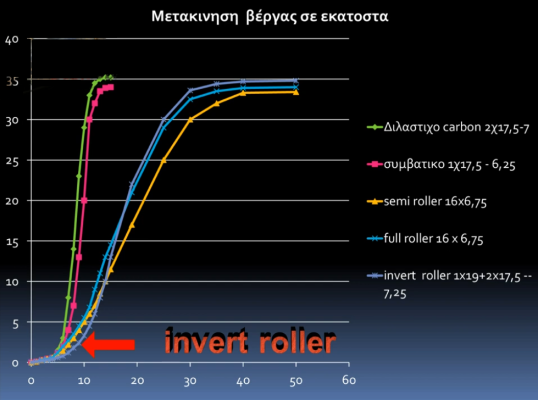
shaft speed does drop at the muzzle though, peak acceleration is usually either very early (classic setup) or as it approaches the middle (roller/invert)
that being said, the shaft never reaches a higher speed than the bands can when they aren't pulling the shaft
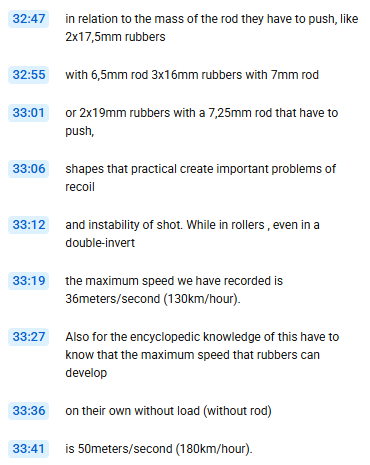
check second attachment from the same greek channel you mentioned
it's why preload is so powerful, it increased work and thus energy of the shaft allowing it to travel faster, retaining its speed better (slower decay)
otherwise if in the final cm of the barrel the bands were detached (like in a classic gun), this would actually solve a large part of the problem of rollers having shaft tail lift, even semirollers (with no preload). so although i don't think it has been measured

thinner bands would have a lower speed due to lower stored energy (lower load). like in the example with the different thickness bands, the thicker and faster would slow down more as it offsets a bit more weight, allowing the thinner one to catch up because it has a lighter load left to lift. so they end up meeting around the same speed (like with invert rollers at the pulleys)
if we cut thin bands short, they'd be comparable to their thicker version with a longer elongation coefficient (so ~3,6 of 14,5 would be ~3 of 16 or so)
generally for more speed we want thicker bands (or shorter) that can develop higher speed under load (pulling shaft) and thus propel the shaft with better speed and most importantly, better KE
but most of it will be lost in recoil/losses not to mention inaccuracy. unless we have very big gun mass, which ends up making the gun have bad tracking in a classic setup

so thankfully i don't think we have that against us, and there is propulsion during the entire length of the rubber elongation distance. maybe only at the last 1-2% of a classic setup which is very small
if we were to add more rubbers then the rubbers are able to contract at higher speeds than a single pair of the same rubbers, and catch up with the shaft's increased speed (or rather, the shaft would not be able to catch up with them despite its increased speed)

it does however look plausible to the eye so it's not weird to think that.
 

Attachments

  • 26-29.png
    26-29.png
    317.8 KB · Views: 41
  • shot1.png
    shot1.png
    24.4 KB · Views: 51
I've spoken with the guy that did the study for PhD and there doesn't seem to be a proper research about bands terminal velocity in the higher viscosity medium like water and from most study I think this was the most skipped topic.
Bands terminal velocity.

It doesn't matter how much stored energy band have once there is an equilibrium of forces on the shaft due to (drag), adding more stored energy will not increase if the bands are at their max contraction speed.
I know it's been said and understood that the biggest yield is in the very begining of the destretch period.
Since the biggest ∆v and ∆a is in very short distance, it's hard to make calculation without laboratory style research.
I'm not gonna crunch the numbers here couse I'd be speaking from pure ignorance, but what should have been the focus was first 1/5/10/20/50% of the distance where the band get all their elasticity power transfer with speed.
Knowing the delta change at each part of the flight, we could understand better where and what should be looked for and designed. It would help determine if band mixing has an affect.

There is a lot of IFs (I need to simplify)
If the Vmax and ∆v / ∆a is achieved by shaft only during the first let's say 10cm on a 100cm gun, the rest 90cm doesn't matter, be it roller or standard gun. (The rest 90cm is just acting on shaft trying to maintain equilibrium thus speed against the drag)

It's extremely short distance where potential energy calculation are only at the brief and we should look at ∆, thus we shouldn't interpolate it from total stored energy when we want to establish how can we increase the shaft velocity.
If the shaft gets to Rubber Vmax during that 5cm because there was enough energy to get it there, than adding more energy might be giving diminishing returns over finding the rubber that would contract faster with spare energy to get an extra ∆velocity.

I don't remeberr where I read, but higher stretch results in higher possible band V, but I also read something that smaller diameter tend to DeStretch faster comparer to thicker one, but I don't seem to find the source.

In theory I'd like to believe that for invert
1 thick rubber storying a lot of potential energy to kick the shaft close to it's equilibrium speed where a higher thinner stretch ratio rubbers would allow for it to increase its ∆v a little bit due to having still a bit acceleration in them compared to thick band at lower stretch.

Its a lot theory though.

Btw I will try to find the video of cavitation on the shaft and get proper 4k Fotos couse Instagram just cuts the image quality to the brim. I'm gonna add the foto from IG for now as I'm at work.
 
Cavitation following shaft is clearly seen on the left of the shaft trailing it.
It's less visible on straight flight shafts as the pressure change is less(?) drastic and since they calapse at the speed of sound (!!!)

Fyi cavitation bubbles calapse with the speed of sound, you can break the bottle by just taping it slightly and cavitation will break it. YT.
A lot of research is done into boat propellers to lower the drag, where it's main part is the cavitation issue and it's destructive force aswell.
 

Attachments

  • 70988.jpg
    70988.jpg
    7.5 KB · Views: 33
Interesting. yes it'd be definitely interesting to see this studied, it could possibly open new ways to how to tweak our setups for more efficiency

regarding
"If the Vmax and ∆v / ∆a is achieved by shaft only during the first let's say 10cm on a 100cm gun, the rest 90cm doesn't matter, be it roller or standard gun. (The rest 90cm is just acting on shaft trying to maintain equilibrium thus speed against the drag)"
For terminal velocity, it definitely does not matter imo. Terminal velocity is reached at one particular point (always at the first half of the barrel) and then drops. Muzzle velocity is always lower
however it is the rate of deceleration, affected primarily by losses early in the shot and then by the rubber energy (rubbers at ~3,8 stretch can yield more energy at the same amount of load than thicker bands at ~3,1 can) that will determine how the shot actually goes and whether the shaft will maintain a good speed to hit fish far enough
that's my main focus in terms of setups as well, as i tend to think maximum velocity as generally not a specific goal, rather a byproduct of a powerful setup. a smooth deceleration rate will also necessarily have a smoother (progressive, gradual) acceleration of the shaft to reach its maximum velocity, which will also usually be lower than the maximum velocity of the same load with a sharp acceleration rate and thus sharped deceleration rate
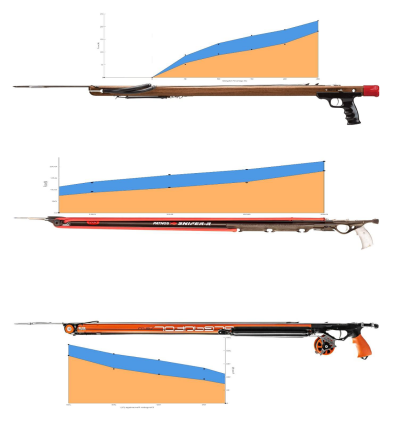
if i'm reading correctly what you say, it sounds related to the measurements of pic attached

theoretically we don't want super high shaft velocity! because then it means more drag. ideally we want decent velocity maintained over long distances

as for
"If the shaft gets to Rubber Vmax during that 5cm because there was enough energy to get it there, than adding more energy might be giving diminishing returns over finding the rubber that would contract faster with spare energy to get an extra ∆velocity."
i'm not 100% sure what this refers to
the spear doesn't have a way to propulse itself, so its speed is always the speed at which the bands contract at that given moment. adding more explosive bands would simply make the shaft mirror their contraction rate. the bands cannot contract if the spear does not move forward so the more the spear moves forward the more the bands contract. if the spear had higher velocity than the bands then the bands would be free to contract faster and thus catch up, at any point in the spear's trajectory. "The spring's contraction speed is dictated by the projectile's motion."
i had to use ai for the post-Vmax calculations, basically the rate of acceleration continues up until the muzzle but at a slower rate because the bands will still overtake and offset drag's deceleration but with less intensity than the peak acceleration moment
after the peak acceleration moment reaching max velocity, the bands have lower stored energy and the drag's effect is stronger
because the net force on the spear (work done by the bands minus drag) becomes slightly negative or balanced after maximum velocity has been reached, the spear either coasts and does not decelerate until muzzle exit (in roller/invert rollers) or it decelerates very slowly

in practice, with two guns, one classic one roller/invert, with the same load on the shaft/mech, the roller/invert will always have higher muzzle exist velocity due to higher work done (and fewer losses)
but at the same time we don't load up our spearguns that much. for example a typical BW setup for 8mm shafts would be 4x16 but we don't use quad rollers or 8-band pairs in invert rollers. so the load is always lower proportionally to the shaft's mass hence usually lower maximum speed, and often lower muzzle exist speed as well, but a much better deceleration rate (thus longer shots, because the spear retains speed better since its KE is both higher and not depleted as quickly)
 

Attachments

  • roller-classic acceleration curve comparison.png
    roller-classic acceleration curve comparison.png
    190.5 KB · Views: 52
I don't remeberr where I read, but higher stretch results in higher possible band V, but I also read something that smaller diameter tend to DeStretch faster comparer to thicker one, but I don't seem to find the source.

In theory I'd like to believe that for invert
1 thick rubber storying a lot of potential energy to kick the shaft close to it's equilibrium speed where a higher thinner stretch ratio rubbers would allow for it to increase its ∆v a little bit due to having still a bit acceleration in them compared to thick band at lower stretch.

Its a lot theory though.

Btw I will try to find the video of cavitation on the shaft and get proper 4k Fotos couse Instagram just cuts the image quality to the brim. I'm gonna add the foto from IG for now as I'm at work.
yes longer stretch = more force and more stored energy, so faster contraction velocity
maybe you were reading about internal diameter? there are a few videos that use thin bands but with high stretch at 3,7+
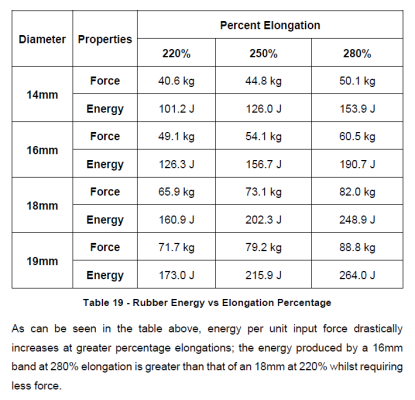
in this case it's down to the rubber latex material, coating or not etc. with the same brand of rubbers, thicker ones at the same stretch will always have more force so they will contract faster

the main advantage of thin bands with high coeff stretch is increased energy for less force required (the negative in this is that the band loses stored energy faster if we don't take a shot quickly) plus increased active barrel length in classic setups
see pic
in invert rollers it can only result in more comfortable loading if we are to fire quickly
but the rubbers are worn out quicker this way
my go-to personally is explosive rubbers with 3,2-3,4 stretch since i don't have to worry about recoil but because i also don't want uncomfortable loading, i usually go with 17-18mm rubbers and never thinner but also not thicker (unless it's the main one)

i see the vid, it's very similar to the one i found too
but isn't that turbulence? probably not, i looked up the terms and apparently had them mixed
so it would be cavitation, but from what it seems it doesn't follow the shaft. which makes sense since it decelerates past the muzzle (or even before it, in classic guns). if it continued it would be good from what i found, since it reduces skin friction with water thus reducing drag.
theoretically classic guns would have higher cavitation (from what we see in vids also) but this does not stop the shaft from experiencing immense losses, to the point where muzzle exit speed is only ~1m/s higher than that of a roller or invert roller
 

Attachments

  • t. 19 from Spiller 2021.png
    t. 19 from Spiller 2021.png
    34 KB · Views: 46
also the ai's response to the different band diameter was similar to what i theorized earlier
  • Unequal diameters don’t change the fact that the spear’s speed is determined by the total force. The thicker band may still have significant residual force, while the thinner band’s force is lower – but their sum still provides a positive net force.
  • The force curve is still a linear decline (Hooke's law applies to each band), but the proportion of force from each band stays constant throughout the stroke.
    The thicker band always contributes, say, 70% of the total force; the thinner band 30%. There’s no “staging” or delay.
 
Last edited:
I think we need to order the discussion to simplify the discussion.

1. The foto is just for reference that we DO have cavitation effects in place for spearing. It is so clearly visible ONLY becouse the shaft bent down ( I am holding the gun sideway) halfway going through the barrel and at this shaft lenght it was significant bent.
It looks like its going left becouse im holding the gun sideways as its been easier this way to get the proper footage.
This is a 140cm double roller at non crazy preload (probably around 10kg) with 14mm very progressive bands at 300-320% (?) (epsealon blizzard) and 190cm 7.5mm shaft.
I have yet to isolate the issue of the shaft flying left and right (its actually down) on 2 identical guns and why its been crazy unusable at even 2m for blue water.
The total dry mass with shaft and rubbers of the gun is around 3.4kg (shaft is around 750g). Ermes avatar and ermes double roller ceramic muzzle. If someone wants to put that in the technicaspeargun calculator ;)
We have not been able to understand what is the reason for this shaft behaviour - not enough testing.
- is the shaft beyond its elasticity limit at this lenght (probably, maybe?)
- is it the double roller muzzle couses issues (probably and maybe, we had so many various issues with them - like rubbers with wishbones overflying the muzzle (!), shaft not detaching from wishbones - even with double wishbones, shaft line getting stuck on top of the U of the muzzle with wishbones)

2. When you mentioned cavitation helps - it doesnt unless we are under super cavitation regime where the cavitation would create bubble around the object thus lowering drag. A cavitation in general as I understand is your worst enemy becouse you do not have laminar flow around the object. Its couses tremendous amount of drag due to turbulance of the flow around it.
This comes down from my aeronatics knowledge aswell as Formula 1 fan.

3, I think it would be good to detach and separate various aspects of the rubber and shaft mechanics IN THE WATER.
a) what is the bands Vmax based on their typical stretch ratio and diameter WITHOUT load
b) what is the bands Vmax based on their typical stretch ratio and diameter WITH load NON and ASSISTED by multi bands setups
c) what is the bands distance where delta change from V(0) to Vmax under typical loads and how ASSISTED by multi bands setups affects.
d) what is the bands distance where delta change from V(0) to V 50%, 75%, 85%, 90%, 95% percentile happens under typical loads and how ASSISTED by multi bands setups affects.

The 3a-b-c-d is an INSANE amount of lab work but only than wouldnt we be able to judge properly the setups and actually integrate proper engineering mechanics.

4. When I mention equilibrium state - I mean a moment (distance) when both drag and propeling force are equal and the shaft from that moment more or less should maintain (rubber might still have some affect when within barrel regime) and start its decelaration.
I think its one crazy important number becouse of it allows to judge
a) forces applied onto the shaft for bending and whipping calculations
b) how to apply multi band setups and their stretch ratio. It could work for both standard and roller type guns.
However its very dificult to work if we do not really know entire point 3.

Appendix for point 4 and example but id need to put some baseline IMAGINARY numbers lets say for invert rollers/multiband
THIS IS PURE SPECULATION and EXTREME SIMPLIFICATION in order to give an example. A LOT IFs, we do NOT know if thinner bands at higher stretch ratio can accelate to faster speeds.
- 20mm rubber Vmax 25ms/s at d(10cm) at 300% for 400g shaft
- 14mm rubber Vmax 35ms/s at d(15cm) at 400% (I will skip the shaft weight here, the Vmax is more important)
If both would be true, the main work would be done by main 20mm rubber to propel the shaft to 25m/s in 10cm distance and extra velocity gain could only be achieved by putting am extra faster 14mm rubber in the system to achieve anything beyond 25m/s.

We have very limited info I believe. If different stretch ratios and diameters WOULD behave differently like in this example that would open a huge window for optimizations.
However we have too many ifs at this point, but becouse I have had 2 sources tell me not to mix rubbers for inverted for EXACLY ABOVE REASON, maybe its plausible or maybe the difference is NOT as big to actually make a difference?

It is a bit like space travel calculation for delta V neccesary to travel to the moon/mars becouse of the mass of the object and propelland mass and engine efficiency. Changing 1 factor, is gonna influence all others. When they are update all others need to be updated again, and again, and again...
Recent Everyday Astronaut video on YT is amazin on this.

5. At this point id totally leave the idea how different system accelerate smoother or more violent. Yes its clear as day it happens but its just too much, for now :P
 
1. damn that sounds like such a pain to deal with lmao i'm glad i gave up on rollers
i highly doubt it's the shaft's specs causing the issue, there are some bleutec 145cm 4-bands with 7.5 and 8mm shafts so a lot more load on the shaft and they seem to shoot ok. crazy recoil aside
2x soft 14,5mm bands is like a 70kg load it's practically nothing
have you checked the offset on all parts? handle, barrel, muzzle. lower offset on the barrel or/and higher on the muzzle can cause shaft bending

2. i just checked out its effects on underwater projectiles. i did give it a second run and it says that
  • As the spear accelerates, cavitation bubbles form along its surface, especially near the tip and any protruding features (like barbs or notches). These bubbles collapse violently as the spear moves into higher-pressure zones, creating shockwaves and localized turbulence.
  • This collapse (called cavitation erosion) increases hydrodynamic drag compared to a perfectly streamlined, non-cavitating spear. The spear slows down faster, reducing effective range and impact velocity.
as for what we can do about it i don't know. high velocity is almost always guaranteed with any two-band classic setup, rollers and invert rollers will have maybe slightly lower maximum velocity ceiling. but if we try to bring the speed down then the speargun is simply not powerful enough, so we basically just have to deal with it. considering the super powerful setups that exist out there (3x16 with 6,75 comes into memory) and shoot incredibly well, i don't know if it's a significant issue. probably not. it definitely doesn't seem to play a role in performance by itself

3. that could be something to measure, definitely. what info would it give us that would allow us to tune setups though? i'm confused as to its application

4. yes that's what i called "coasting"
wouldn't it be easy to pinpoint it by the spear's velocity rate though? as soon as it starts decelerating it has exited the equilibrium state
my guess is this would correlate with KE and overall performance. so we can use our current understanding as a proxy for it in terms of what bands to use. because deceleration is involved, inefficient equilibrium duration would mean a worse shot and efficient = good shot. or would that be an inaccurate guess?

Appendix:
i'm pretty sure we can test that with invert rollers. get a 1x20+1x14,5 setup and compare to a 2x20 setup
or for a classic just set a tripod and measure performance. e.g. does it reach 4m at max 150ms?

as for not mixing together rubbers for invert rollers, i will have to take a hard stance on that that it's mistaken. we have real life experience of thousands of such setups performing better than other setups with similar rubber diameters. ultimately what matters is just the force an individual rubber pair can exert, and the stored energy in it, resulting in total work done over the barrel.
basically every observation we have is that it works well. so the right approach according to the scientific theory is to assume that the mix (eg upgrading a 3x16 to 1x19+2x16) is the logical way to improve shot power and not the other way around as it is unsupported by any observation
we can speculate as to the why, but we already know that it works fine. for classic setups i'm not that sure, from experience mixing rubbers can work fine too with no visible drawback, the power is just inbetween, kind of like 1.5 is between 1 and 2.
so in theory there could be some losses, or some discrepancy... but when used, it's not enough to make a significant difference.

i did use ai again for it. gave it the inputs of 25m/s for band A and 28m/s for band B

"

Why "maximum speed potential" is misleading​

A rubber band doesn't have a fixed "max speed" it can give any shaft. That speed depends on:

  • Shaft mass (same here)
  • Barrel length (same here)
  • Force profile over distance
If band B alone reaches 28 m/s, that means the integral of its force over the barrel length (divided by mass) gives that velocity. Band A alone gives 25 m/s. When both pull together, the total force at every point is FA(x)+FB(x)FA(x)+FB(x). The total impulse is larger than either alone, so kinetic energy is larger → speed > max(25,28).


Simple example with constant forces (to illustrate)​

Assume:

  • Shaft mass m=1 kgm=1 kg
  • Barrel length L=1 mL=1 m
  • Band A alone: constant force FA=312.5 NFA=312.5 N → work = 312.5 J312.5 J → v=2×312.5=25 m/sv=2×312.5=25 m/s
  • Band B alone: constant force FB=392 NFB=392 N → work = 392 J392 J → v=784=28 m/sv=784=28 m/s
Together: Ftotal=704.5 NFtotal=704.5 N → work = 704.5 J704.5 J → v=1409≈37.5 m/sv=1409≈37.5 m/s

That's higher than both.

In reality, forces aren't constant, but the principle holds: the sum of two positive force curves yields a higher integral than either individually.
"

Not sure if the final output is accurate (highest number i've seen measured is 42m/s). there is a speed cap on shafts from what i've seen where it's super hard to gain any additional speed (but increasing mass can lead to higher energy).


EDIT:
I also asked it to clarify because at this point i haven't delved in this theoretical areas before

"
"Mechanically linked" isn't a fancy physics law name—it just means connected so they must move together. In your setup, both rubber bands are attached to the same shaft. The shaft is a single rigid object. When it moves, both bands are forced to change length at exactly the same rate because their rear ends are fixed at the muzzle and their front ends are both tied to the same moving point (the shaft).


The underlying physics principle: Kinematic constraint​

In mechanics, when two objects are attached to the same rigid body, their motions are constrained. The relevant law is that the velocity of the attachment point is the same for both bands.

Mathematically:
Let L1(t)L1(t) = length of band 1, L2(t)L2(t) = length of band 2.
The shaft's position x(t)x(t) relative to the muzzle determines both lengths:
L1(t)=x(t)+constant1L1(t)=x(t)+constant1 (if attached at different notches, the constants differ, but the rate of change is the same).

Thus:

dL1dt=dL2dt=dxdt=vshaftdtdL1=dtdL2=dtdx=vshaft
So both bands must shorten at exactly the shaft's speed. There is no way for one band to shorten faster than the other because they are tied to the same moving object. That's the constraint.


Is this a law? Yes, it's from rigid body kinematics​

It's not a separate "law of mechanical linkage" but a consequence of Newtonian mechanics and the definition of a rigid body. If two points are fixed to the same rigid body (the shaft), they have identical velocity. The bands' attachment points are on the shaft, so their velocities relative to the muzzle are identical.


So to directly answer: Yes, it's a real physics constraint​

It follows from Newton's laws and the fact that two objects attached to the same rigid body must share the same velocity. There's no separate law named "mechanical linkage", but the concept is fundamental to how constraints work in mechanics.
"

so, good to know i guess LOL. had no idea
here i would ask a question that oldheads tend to ask: is all this necessary? for me it looks way too theoretical, since we can already tell what works even if we don't really know the why. so for example if someone advises to not do X, but we can do X and see that it's more powerful than Y, the advice is just erroneous (falsified) no matter the reason (or how much counter-intuitive it was). like something i've heard from an older spearo, "if the shaft acceleartes more slowly while in the barrel then it has more time to be charged with energy". but this never worked in practice (and now we know it's because of work done, not "time under tension" which doesn't make sense here)

Bonus:
"Because real bands have no low speed limit, they both pull throughout – no capping. The shaft speed is determined by the sum of forces, not by a slow band's limit.

That's why speargun you can add multiple bands – more force, more speed, no downside except recoil and aiming difficulty."
 
Last edited:
trial & error testing generally seems to work well with spearguns. i was hearing that "shaft whip" is akin to a death sentence and the shaft will not go anywhere and will be inaccurate etc but then we encounter some crazy setups that prove it wrong and i have tried some myself with some of the best results i've ever seen for those shafts' mass. regarding physics, so far they seem to work in favor of overpowering a gun (so what the tester would do)
i don't even know where the idea that you can "overpower" a gun came from tbh. i guess it's leftover from old gen speculation reaching legend status?

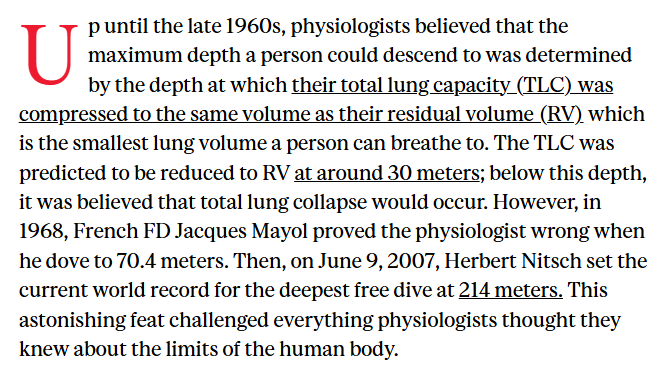
edit: i remembered how some decades ago physiologists thought humans would die if they dove deeper than 50 meters
pic

some nonsequiturs just end up being believable i guess. but in practice they are later refuted
i have experienced this myself a few times as a beginner so i know it can feel highly compelling and "make sense" even if it isn't actually true in the end. as long as we can test something it would be easy to compare setups and put theory A or theory B to the test, eliminating possible reasons as to why something happens (eg a missed shot despite good aim, it can be blamed on factor X on gun A but then gun B does not have this problem, so it's not factor X)
 

Attachments

  • diving limit speculation.png
    diving limit speculation.png
    54.7 KB · Views: 50
Last edited:
1. setup with 4 bands 7.5mm 145cm on a barrel gun? Wtf, I might really convert one to 3x14.5 at 350% or 3x16mm 320% but I cant imagine the recoil... My Oceanammo Pelagic 120 triple 3x16mm 300% 4.5kg wooden gun already kicks hard.
- Muzzle everything sits pretty flush
- It might be muzzle lift, even with 150g extra on the muzzle head there is insane amount of force lifting it and since you are 1.5m away the lever created is insane. From that distance the hold is barely efective... A tiny lift can couse tremendous changes if it happens early in the flight.
- RUBBER RIPPLE EFFECT? This is something I am curious how big part it played. Ive had numerous times when the bands would get UNDONE (jump out of the bottom attachment point) DURING THE SHOT with like 15kg more or less preload. JUST HOW?!!!

Worst case my buddy couldnt get this shit to work on 120cm on heavy barreled carbon either. Rip slip tip when the shafts STEEL CABLE got ripped on the muzzle when the wishbones pinched it as it was flying and shaft went flying down into rocks. yaiks...
Got the video too from very close...

Rest points I am almost dead atm and tomorrow water day, but I do not think we can threat rubber propulsion speed with force on the same values as its non linear I believe?
The total potential energy of the loaded rubber CAN be the same in the equation, but it can be achieved by either more work or more speed no? My brain is fried atm.
If thats the case, the only reliable way would be to idealy separate each part of the energy release in segments to get proper datya but that would require something like 1k+ FPS camera at least and very fast shutter speed to calculate segments.
 
DeeperBlue.com - The Worlds Largest Community Dedicated To Freediving, Scuba Diving and Spearfishing

ABOUT US

ISSN 1469-865X | Copyright © 1996 - 2026 DeeperBlue Global Media Limited.

DeeperBlue.com is an independent digital media platform dedicated to Scuba Diving, Freediving, Ocean Advocacy, and Dive Travel.

Since 1996, we’ve been informing, educating, and inspiring the global diving community through trusted news, features, and shared community experience.

ADVERT