Perhaps we could ask the oracle? Richard Lord's Google Group was mentioned in the Guernsey Press yesterday - I haven't investigated yet but it's at:
Discussions - CIenviron | Google Groups

I subscribed and have now received the following very full reply from Richard Lord:
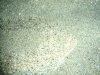
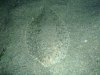
The fish cannot be a brill or a topknot because the fish in the image
on the CIenviron website is right-eyed and brill and topknot are left-
eyed flatfish. What do I mean by this?
All flatfish go through metamorphosis. As larvae they swim upright
with one eye on each side of the head. During metamorphosis one eye
migrates to the other side of the head and there is a 90 degree
rotation in posture as the flatfish begins life on the sea bed. The
pigmentation is also asymmetrical as usually one side becomes white
while the other side retains pigmentation to blend with the colour of
the sea floor.
A flatfish has two sides just like a round fish like a cod for
example. In adult flatfish usually one side is white (the blind side)
and one side is pigmented (the eyed side.) The left-side is blind
(has no eyes) in right-eyed flatfish and the right-side is blind in
left-eyed flatfish. In right-eyed flatfish the left eye migrates to
the right side of the head during metamorphosis - both eyes in
adulthood are on the right side of the head. In left-eyed flatfish
the right eye migrates to the left side of the head.
You can just see the small mouth as a crooked line in front of the
left-eye in the picture. The left eye in the image is actually the
fish's right-eye (from the right side of the head) and the left eye of
the fish (originally from the left-side of the head) is to the right
of it. The left eye has migrated across the top of the head from what
is now the blind side to join the right eye. So the fish in the photo
is right-eyed. Fish in the family soleidae are right-eyed. This fish
is a common or dover sole, Solea vulgaris. The pectoral fin on the
eyed-side has a blackish blotch, which is clearly visible in the image.
.
Best wishes,
Richard
Richard Lord