• Welcome to the DeeperBlue.com Forums, the largest online community dedicated to Freediving, Scuba Diving and Spearfishing. To gain full access to the DeeperBlue.com Forums you must register for a free account. As a registered member you will be able to:

    • Join over 47,943+ fellow diving enthusiasts from around the world on this forum
    • Participate in and browse from over 531,990+ posts.
    • Communicate privately with other divers from around the world.
    • Post your own photos or view from 7,455+ user submitted images.
    • All this and much more...

    You can gain access to all this absolutely free when you register for an account, so sign up today!

"Safe" limits for a solo diver

Thread Status: Hello , There was no answer in this thread for more than 90 days.
It can take a long time to get an up-to-date response or contact with relevant users.
I have yet to hear about some fatal accident at freediving with proper and real buddy safety system involved..... In contrary, at spearfishing, recreational freediving and snorkeling, there are several hundreds of fatal accidents every year.

This is a sobering reminder that it's not just enough to be there - we have to be effective, vigilant and prepared buddies.

I could probably do with some rescue practice... Thankfully I've never had to do it for real.

But I have more than once seen, as I return to the surface, my "buddy" off in the distance and happily finning away from me towards some more interesting object!
 
Over a lot of years, I've been present for 3 B0s while recreational spearfishing or similar diving. Not exactly common, but common enough to suggest that B0s are more prevalent that we would like to believe and way too many of them are fatal. Given the knowledge and gear available today, I'm pretty sure that B0s are getting more common.


" as I return to the surface, my "buddy" off in the distance and happily finning away from me"

Several of my buddies, and especially my sons, can atest to how unpleasant I can become after that situation.
Same with shark back up.

For us, there is a blurry line between serious diving(requiring good buddy practice) and messing around where we don't pay much attention. Works for us, but sometimes makes me nervous and sometimes one of us doesn't switch into serious diving mode fast enough and gets yelled at.

Connor
 
Last edited:
Connor

3 BOs in 'recreational' diving? I wonder, were they pushing themselves or did it come out of nowhere? When we dive for fun we always stay well within our relaxation limits.

As to getting unpleasant with buddies, perhaps I need to do that more. For now I just know who they are (the crap buddies) and dive accordingly. At the same time I try and foster a culture of good buddying.

Telling people they're doing stuff wrong gets them defensive. But perhaps I should be more hard line about it.
 
Telling people they're doing stuff wrong gets them defensive. But perhaps I should be more hard line about it.

At an advanced driving course we were asked if we often drive like our lives depend on it. We said no. He said why not?

I reckon if your life depends on it... you cannot get any less hardline!
But only if they agree that is their job...

I've never dived with a buddy spearing, we all dive independantly and I wont get angry or annoyed at that... but our diving is very basic so its a risk we are happy with...

But if I took more of a risk... pushed depth or time thinking I had a buddy looking out for me, and if I surfaced and realised he did not? I'd be in the boat and he'd be finning home... :ban
 
Connor

3 BOs in 'recreational' diving? I wonder, were they pushing themselves or did it come out of nowhere? When we dive for fun we always stay well within our relaxation limits.

As to getting unpleasant with buddies, perhaps I need to do that more. For now I just know who they are (the crap buddies) and dive accordingly. At the same time I try and foster a culture of good buddying.

Telling people they're doing stuff wrong gets them defensive. But perhaps I should be more hard line about it.

Depends what you trying to achieve - if you are trying to teach them, then you can firmly point out what they should be doing and why.

If you are trying to stay alive, just choose your buddies carefully :-) of course you'll sometimes end up with someone you don't trust, I usually dive more conservatively and tell them that they are supposed to be looking after me if I see them all over the place and then switch buddies at the first opportunity. I also find that if you tell them where you expect them to be while you are explaining what you are about to do (eg a swim through) they seem to focus a bit more..

Anyway as you said, usually if you train with them every week you know what they're like. Interestingly enough I noticed that 'careless' buddies tend to gravitate together - I guess they don't want someone 'busting their balls' every time they are not buddying properly lol
 
Last edited:
Trying to get people to do it in the pool is tough, I guess they think it's unnecessary and they'll do it for real when the dives are for real. But isn't the point of training to drill skills until they're automatic?

That is interesting that the careless gravitate together. I certainly gravitate towards the buddies I trust!

Sometimes I've seen the reverse problem: My buddies aren't failing to look out for me but (in a group of three) one person drifts off and dives when no ones watching them! .... Where's John? .... WTF is John!?

Mmm that's NOT nice.
 
Trying to get people to do it in the pool is tough, I guess they think it's unnecessary and they'll do it for real when the dives are for real. But isn't the point of training to drill skills until they're automatic?

That is interesting that the careless gravitate together. I certainly gravitate towards the buddies I trust!

Sometimes I've seen the reverse problem: My buddies aren't failing to look out for me but (in a group of three) one person drifts off and dives when no ones watching them! .... Where's John? .... WTF is John!?

Mmm that's NOT nice.

Just do the random drills - tell them you'll be practising rescue at the beginning of the session and then tell random people to 'black out' during a length, static etc.

You'll be amazed at what happens - let alone the times when someone just floats there for ages before anyone notices, my favourite one was when during an exercise someone pushed to the side the 'blacked out' diver as they were in the way and were blocking them from completing their length. Lol

Hilarious but sobering!
 
Well, it may be higher than you think. You will not always get to know about all accidents in your country, as long as it was an amateur spearfisher or a snorkeller not known in the community. And it does not always appear in the news either.

I think the NZ number is quite accurate. Diving deaths are pretty well reported here. I also talked to the police and coroner's office about it after Eric's death.
 
"WTF is John!?"

Been there, way way too many times.

Siku, 3 B0s: once, a long time ago, the diver was seriously pushing his limits with multiple long spearfishing dives and we all knew it, so were watching him pretty close. I got to be a spectator for that one. Classic Samba/B0 at about 20 ft. Once, more recently, the diver pushed well past his limit because he got fascinated with a new place, very deep and very beautiful . Diver was still on the bottom(125 ft) playing with fish at 1:50, B0ed as he hit the surface. Once, no ready explanation, the diver was well within his limits, not a big deal dive. We were warming up for some line diving. Diver B0ed about 3 ft from the surface. Both of the last two ended fine because of PFI training.

Connor
 
Last edited:
Well, it may be higher than you think. You will not always get to know about all accidents in your country, as long as it was an amateur spearfisher or a snorkeller not known in the community. And it does not always appear in the news either.

So for example in the official database at DAN, there are 60 reported freediving accidents worldwide in 2008, but that's just a tiny fraction of the real accidents, and only from some countries.

Welcome to DiveWise - the Freediving Education Initiative

dan-stats.jpg


The real numbers can be easily 10 times higher. Of course, that's just a speculation and no hard fact, but you can be pretty sure that the real numbers are much higher than those officially reported to DAN.

The numbers of 15-30 annual deaths in the Med countries come from Terry Maas, who spent a lot of time and a lot of research on this topic after the tragic accident of his son. But those numbers are already around ten years old, and they are no official statistics.

You can help keeping the statistics better, by reporting accidents at DAN: BH Incident Report, but sincerely I hope you will never need to fill that form.

Don't know what the real numbers are, as you say the DAN numbers are probably underreporting but worth pointing out that as per their report, DAN also collects cases by doing automated keyword searches, so I think this would catch most of the fatalities at least.

In the 2008 report there were only 13 -14 accidents cases described (of which 11 fatal I think), which leads me to believe that the rest of the cases (to total 60) they must have collected themselves without any forms being submitted.

Interestingly the cases from pre-existing medical conditions seem to be as frequent, if not more, to SWB ones but one could argue I suppose that if a buddy was around, maybe they could have saved some of those cases with medical issues (in some cases they were taken on a boat but couldn't be revived).
 
I think the NZ number is quite accurate. Diving deaths are pretty well reported here. I also talked to the police and coroner's office about it after Eric's death.
In that case I am afraid they are not so well informed. The NZ Drown Base shows 8 freediving and snorkelling drownings alone in 2011, and although it was lower in the four previous years, even then the average was at 3/year: http://www.watersafety.org.nz/assets/pdfs/drowning/2011-Fact-Sheets/Underwater-2007-2011.pdf

Still, the NZ stats look rather good in comparison with many other countries
 
Don't know what the real numbers are, as you say the DAN numbers are probably underreporting but worth pointing out that as per their report, DAN also collects cases by doing automated keyword searches, so I think this would catch most of the fatalities at least.
I am afraid you are not right here, Simos. Their automated keyword searches do not seem to be very efficient, and very likely only tweeked for English and even that not too reliably. It happens that sometimes I spot a case in the news and report it to them, and in many cases they din't know about it. Their data harvesting from francophone, hispanic, portugese, italian press is rather limited (if any at all), and you can forget completely about the hundreds of more exotic languages. Additionally, drownings are far too common and not interesting news for the mainstream media, so in very most cases they maximally appear in some local press, and won't even popup on the web. Bigger part of them will not be reported at all.
 
I am afraid you are not right here, Simos. Their automated keyword searches do not seem to be very efficient, and very likely only tweeked for English and even that not too reliably. It happens that sometimes I spot a case in the news and report it to them, and in many cases they din't know about it. Their data harvesting from francophone, hispanic, portugese, italian press is rather limited (if any at all), and you can forget completely about the hundreds of more exotic languages. Additionally, drownings are far too common and not interesting news for the mainstream media, so in very most cases they maximally appear in some local press, and won't even popup on the web. Bigger part of them will not be reported at all.

Agree they must be surely under-reporting - was just pointing out that they don't solely rely on reports. I am also curious to find out whether the increase in the incidents mentioned in that graph is not due to more of them being reported/found as the web becomes more widespread...

Why would the incidences increase so much and consistently in these years - could be because more people freedive and could be because they are going deeper but I somehow don't feel these are the main reasons... Probably their data collection got better..
 
short version: there is no info what is shown in the graph. Any explanation what an freediving accident is in DAN´s opinion?

i think drowing stats are of no use for our disscussion. -it´s about buddy system isn´t it?
what i mean is: i can stay with someone ALL the time to prevent being alone after gotten into any sort of trouble. if i were inclined to this i wouldn´t differentiate between being on land and being in the water. - i´m not and i considers this inclination a desease.
so i´d say we have a buddy discussion with special cases of problems in mind. i have the case of "BO after not surfacing in time" in mind.

i assume the one asking for numbers in spearfishing accidents being replied with numbers of freediving (in the broadest sense?) death, was actually interested in numbers of death due to "BO after not surfacing in time" -there are so many different causes for drowing, we are talking about the healthy freediver´s BO, aren´t we?
 
Agree they must be surely under-reporting - was just pointing out that they don't solely rely on reports. I am also curious to find out whether the increase in the incidents mentioned in that graph is not due to more of them being reported/found as the web becomes more widespread...
Absolutely. This is why I tell their reports are just a tiny tip of an iceberg. In fact if the DAN report included only the officially reported US and French fatal accidents, the graph would be already practically the same.

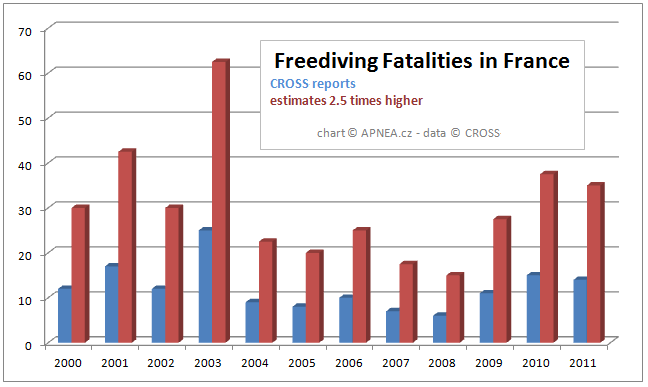
In France the situation with reporting is similar - there are no precise statistics. The best you can base on your estimates are the statistics of the CROSS-MER (equivalent of the Coast Guard). I extracted the freediving and spearfishing related data from the anual reports from 2000 to 2011 and plotted the chart you can see below - the total number of fatal accidents is 158, which makes more than 13 per year in avarage. However, according to their own report from 2003 (when there were 25 freediving related fatalities in France), the real numbers may be 2 to 3 times higher (I added the red estimates 2.5 higher than the blue reported cases, in the chart). CROSS only includes cases where they were involved for the rescue or recovery. In many cases, no Coast Guard is called. Additionally, even in their higher estimates, accidents inlands in fresh water are not considered, but they do exist too.

In contrary to the DAN statistics, the ones from the French CROSS do not show a growing tendency, although they vary quite a lot during the years:

freediving_fatalities_FR.gif
 
Last edited:
short version: there is no info what is shown in the graph. Any explanation what an freediving accident is in DAN´s opinion?
The DAN graph shows fatalities. Accidents are much more frequent. For example in the CROSS reports the anual number of accidents, where CROSS (Coast Guard) is called for rescue of freedivers and spearfishers is around 50-100 in France anually. It does not include accidents, where no rescue was called (injuries, bursted eardrims, barotraumans, DCS, etc...)

i think drowing stats are of no use for our disscussion. -it´s about buddy system isn´t it?
I don't follow you. The NZ total annual drowning cases are much higher (hundreds of cases oer year). Those 8 NZ drownings in 2011 were purely freediving/spearfishing related. Again, incidents like injuries, shark attacks, boat accidents, etc. are not included. So I do not understand why we should not include the drownings when they were freediver fatalities. And do not understand what buddies have to do with it. If buddies were present in these cases, then they did not manage to help. I can't tell whether they failed because they did not properly survey their colleague, or because of another reason.

what i mean is: i can stay with someone ALL the time to prevent being alone after gotten into any sort of trouble. if i were inclined to this i wouldn´t differentiate between being on land and being in the water. - i´m not and i considers this inclination a desease.
so i´d say we have a buddy discussion with special cases of problems in mind. i have the case of "BO after not surfacing in time" in mind. i assume the one asking for numbers in spearfishing accidents being replied with numbers of freediving (in the broadest sense?) death, was actually interested in numbers of death due to "BO after not surfacing in time" -there are so many different causes for drowing, we are talking about the healthy freediver´s BO, aren´t we?
Sorry, I still do not follow and do not understand what you are telling. Are you telling that the fatalities in the statistics are not caused by a blackout, and could not be avoided if a buddy was watching? Well, perhaps not 100% of them, but I would tell that the majority could be indeed rescued.
 
Last edited:
Why would the incidences increase so much and consistently in these years - could be because more people freedive and could be because they are going deeper but I somehow don't feel these are the main reasons... Probably their data collection got better..


well, the more people believe freediving exists, and have a definition in mind, the more fatalities can be put into the freediving category.

ironically this mechanism can lead to a situation, where due to the many deaths, there are people calling for paternalism of (defined) freedivers who don´t want to be freedivers. actually they want to be free divers...

this is not the only way, how the claim of the existance of "freediving" can be connected to fatal accidents.
 
Esom, I think you are misinterpreting what is being discussed here. Nobody associates freediving with accidents here. Quite in the contrary - I clearly wrote that freediving is a safe sport if done with the appropriate safety in place. As I explained, at competitive freediving fatal accidents are extremely rare (except of stunts like No Limits diving). Unlike at competitive freediving, at snorkelling, recreational freediving and spearfishing, where people do not dive in the right safety conditions, the fatal accidents are unfortunately very frequent, although they could be in most cases easily avoided. If you do not want to see this, you need to remove the blinds from your eyes.
 
Sorry, I still do not follow and do not understand what you are telling. Are you telling that the fatalities in the statistics are not caused by a blackout, and could not be avoided if a buddy was watching? Well, perhaps not 100% of them, but I would tell that the majority indeed could be rescued.

yeah that was my point. i keep being sceptical without info on details.
maybe my latest post tells about why i think it´s good to be careful here.

about the drowing: you wrote about snorkeling drownings earlier. i just think it´s important to stick to asured BO accidents when it´s about BO accidents.

best
 
DeeperBlue.com - The Worlds Largest Community Dedicated To Freediving, Scuba Diving and Spearfishing

ABOUT US

ISSN 1469-865X | Copyright © 1996 - 2026 DeeperBlue Global Media Limited.

DeeperBlue.com is an independent digital media platform dedicated to Scuba Diving, Freediving, Ocean Advocacy, and Dive Travel.

Since 1996, we’ve been informing, educating, and inspiring the global diving community through trusted news, features, and shared community experience.

ADVERT