• Welcome to the DeeperBlue.com Forums, the largest online community dedicated to Freediving, Scuba Diving and Spearfishing. To gain full access to the DeeperBlue.com Forums you must register for a free account. As a registered member you will be able to:

    • Join over 47,943+ fellow diving enthusiasts from around the world on this forum
    • Participate in and browse from over 531,990+ posts.
    • Communicate privately with other divers from around the world.
    • Post your own photos or view from 7,455+ user submitted images.
    • All this and much more...

    You can gain access to all this absolutely free when you register for an account, so sign up today!

Cornwall 2010

Thread Status: Hello , There was no answer in this thread for more than 90 days.
It can take a long time to get an up-to-date response or contact with relevant users.
Jonny commented that he thinks some people use a wetsuit vest. This sounds like a much cheaper approach to adding thickness to the suit if you can still get it on and off over a thin vest.

sj


I'm someone who feels the cold - here's my routine with regards to wetsuits:

5mm open cell, often with 1mm/2mm open cell under-vest, in the summer months. When it starts to get a bit colder I replace the 5mm top with a 7mm top (with under-vest). When it gets colder still, in the depths of winter, I will wear a full 7mm suit with under-vest, and then I reverse the whole process as the water begins to warm again.

All of this is a fairly expensive option, and means that I am wearing quite a bit of neoprene during the winter, and need a fair bit of weight as a result. But then I tend to sty in the water for beyond 6 hours in the summer time, and beyond three hours in the winter.

A cheaper option is to wear a shortie wetsuit over you 5mm open cell spearfishing suit during the winter. This isn't as effective, but it definately does work (again, more lead required).

This routine isn't for everyone but, as I said at the top, I do like to keep as warm as possible in the water.

Hope that was helpful to someone.

(P.S: I use wetsuit trousers, as opposed to long-johns - I actually cut my 7mm long-johns down into trousers, to suit my routine)

(PPS: I've heard that there is some talk on the Italian forums that an under-vest can actually be counter productive - but I like mine)

.
 
Last edited:
No probs. I would offer to send you some, but i'm back up at uni and didn't bring all that stuff up with me!

I used this link: Medfish Magazine - How to tie Bands with dyneema wishbone?

Says 1.5mm and 2mm dyneema, but I think I ended up using 1.5 and 1.8mm, seems to work ok!

No probs, Ive got the wishbone as it comes as a ready made piece, Ive just searched the forum and someone else used whipping twine, so I might give that a go.
Cheers again
 
I think what Jonny means is you can just use a 7mm top as its your torso that is the real concern when it omes to keeping warm

that's very much my take on it :) of course i'm no expert, just what i've seen and heard. I dont use a vest myself, or whatever, just the 6mm jacket over 5mm long-john. 5mm gloves and socks. I ordered a 6/5mm elios 'back shadow' last month so hopefully i'll be toasty in that soon...
It might also be of interest that Nequay Ian on here (cant remember his username) is developing a 1 piece suit akin to a surfers suit (entry via the neck) - i'm very keen to try that out too...

also worth remembering that you do get used to the colder water - if you can go regularly.
 
hi all, new to the forum and new this year to spearfishing. just wish i'd started years ago! just got a few questions, if they've been done to death in the past i appologise in advance. firstly i use a second hand 75 band gun and need to replace the bands. what should i look for in the replacements? i feel i could handle a bit more power. is it worth getting an articulated wishbone? i live just outside st austell and have been hunting the local beaches with my best catches being a 3lb bass and the same sized mullet and a slightly smaller golden grey. i know hot spots can be well guarded but if anyone could pm me with some good marks i would be very greatful. many thanks.
 
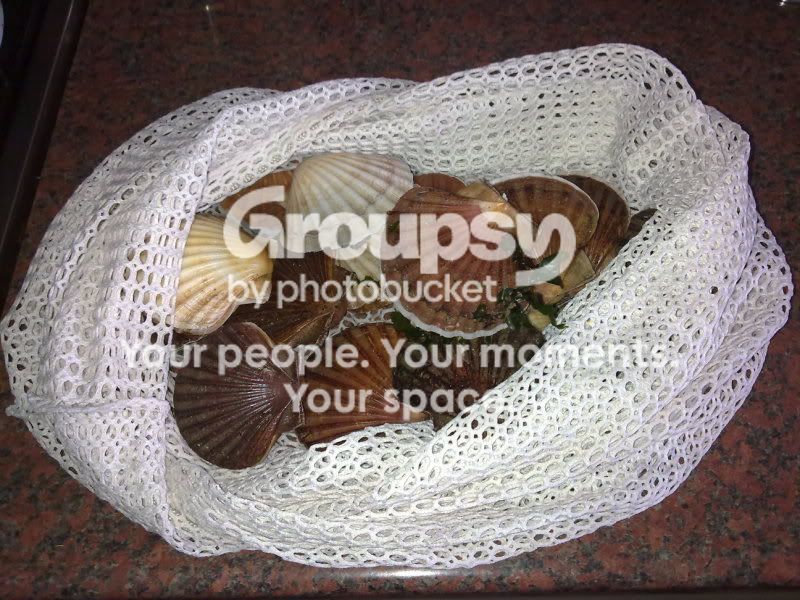
Had my first seal encounter today, scared the crap out of me lol, I'm no expert on them but he was huge, very friendly though trying to nibble my fins before disappearing into the gloom, I somehow missed 2 mullet before that and wondered why it went quiet all of a sudden, still I managed to collect my first bag of scallops so it turned out to be a good day.

For anyone who doesnt know I spoke to Cornwall fisheries today to check a few things out, as long as your not selling them theres no bag limit or permit required but the minimum size is 100mm and you can collect them anytime of the year in Cornwall

rsz_20102010227.jpg
 
Last edited:
Had my first seal encounter today, scared the crap out of me lol, I'm no expert on them but he was huge, very friendly though trying to nibble my fins before disappearing into the gloom, I somehow missed 2 mullet before that and wondered why it went quiet all of a sudden, still I managed to collect my first bag of scallops so it turned out to be a good day.

For anyone who doesnt know I spoke to Cornwall fisheries today to check a few things out, as long as your not selling them theres no bag limit or permit required but the minimum size is 100mm and you can collect them anytime of the year in Cornwall

rsz_20102010227.jpg


Well done Mate!!!!!!
Good on you for checking up on the rules and regs best to be prepared rep on its way :)
 
Had my first seal encounter today, scared the crap out of me lol, I'm no expert on them but he was huge, very friendly though trying to nibble my fins before disappearing into the gloom, I somehow missed 2 mullet before that and wondered why it went quiet all of a sudden, still I managed to collect my first bag of scallops so it turned out to be a good day.

For anyone who doesnt know I spoke to Cornwall fisheries today to check a few things out, as long as your not selling them theres no bag limit or permit required but the minimum size is 100mm and you can collect them anytime of the year in Cornwall

rsz_20102010227.jpg

Nice one.

Although you've just made my life a bit tougher as my better half will pester me even more as to why I can't find them now she's clapped eyes on your haul.

As I'm a beginner any tips on where to find them? Are they in deep water beyond my abilities for example and what sort of locations should I look for? Hints and tips gratefully received.

Thanks for the comments on vest folks. Sounds like I should see how long I can stick it out in my 5mm and worry about it if I start sufferig the cold too bad.

sj
 
Nice one.

Although you've just made my life a bit tougher as my better half will pester me even more as to why I can't find them now she's clapped eyes on your haul.

As I'm a beginner any tips on where to find them? Are they in deep water beyond my abilities for example and what sort of locations should I look for? Hints and tips gratefully received.

Thanks for the comments on vest folks. Sounds like I should see how long I can stick it out in my 5mm and worry about it if I start sufferig the cold too bad.

sj

Haha I know how you feel, some of the other pics on here have had me receiving the same sort of questions ie why dont you get any lobsters.
I found them in various depths around 4-9 metres. :)
 
Sj soft muddy ground is where I find most of mine. After heavy storms they get washed into the rough ground around the sand ready for picking , at least thats my theory anyway.

Heres a video I made lastyear in march, the ground im taking the scallops from was right next a huge sandy drop off


[ame=http://www.youtube.com/watch?v=EyYAKQ0zBdE]YouTube - Scallop Diving 29 March 2009[/ame]

hope this helps.
 
  • Like
Reactions: tribs
Thanks for the tips.

The shallower end of that range should be ok for me, I guess 7m is about as deep as I've been.

I can't think of anywhere I've been though that's muddy, I'll have to think on.

sj
 
Here you go, this from the CEFAS website on scallop cultivation (2002):

Substrate​
Scallops prefer substrates of clean, firm sand, fine
gravel or sandy gravel, sometimes with an admixture
of mud. This is their natural habitat. They will only
survive on fine sediments provided current speeds
are reasonably slow to prevent disturbance of the
sediment, which could suffocate the scallops, if
they became covered. Hard sediments are
unsuitable, as the scallops are unable to bury
themselves sufficiently to avoid predation.​

Depth of water​
Sites with depth of water between 15-30 metres are
ideal. Allowing for tidal fluctuations, it is essential
that nets should not be in contact with the seabed.
This avoids predators such as starfish and crabs,​
which are the two main enemies of scallops, gaining
access to the nets.


Cheers Gaz.

Given a bit more of a steer. Hopefully they're in much shallower water or I've got no hope.....for now.

I'm going to try to get in somewhere after work next week if I can work it in and the weather plays ball.

sj
 
Cheers Gaz.

Given a bit more of a steer. Hopefully they're in much shallower water or I've got no hope.....for now.

I'm going to try to get in somewhere after work next week if I can work it in and the weather plays ball.

sj


No probs.

I've only collected them myself a few times, and the places that I know are fairly shallow (5 meters?) and fairly 'muddy' (if memory serves), but with little current. Although I've spoken to someone who scuba dives them for a living, and he is hunting down below the 20 meter mark.

If you do find any in shallower waters I'd keep the location to yourself, because if word gets out they probably won't last very long - good luck.

(Another way to help ensure that they will still be there when you go back is to only take enough for one meal each time you visit). :)

.


.
 
DeeperBlue.com - The Worlds Largest Community Dedicated To Freediving, Scuba Diving and Spearfishing

ABOUT US

ISSN 1469-865X | Copyright © 1996 - 2026 DeeperBlue Global Media Limited.

DeeperBlue.com is an independent digital media platform dedicated to Scuba Diving, Freediving, Ocean Advocacy, and Dive Travel.

Since 1996, we’ve been informing, educating, and inspiring the global diving community through trusted news, features, and shared community experience.

ADVERT