• Welcome to the DeeperBlue.com Forums, the largest online community dedicated to Freediving, Scuba Diving and Spearfishing. To gain full access to the DeeperBlue.com Forums you must register for a free account. As a registered member you will be able to:

    • Join over 47,943+ fellow diving enthusiasts from around the world on this forum
    • Participate in and browse from over 531,990+ posts.
    • Communicate privately with other divers from around the world.
    • Post your own photos or view from 7,455+ user submitted images.
    • All this and much more...

    You can gain access to all this absolutely free when you register for an account, so sign up today!

Hydrofoil Fin

@7BDiver
maybe drill a few holes for struts and attach them to a shaft inside the wing, fitted there with a bunch of 3d printed plastic supports

then any kind of a spring would work well, torsion spring are back on the table
range stops are just struts banging on the foil, maybe 3d print the socket fittings for strut holes

and rubber shrouds
 
okay it's a lot bigger of a deal than I anticipated, CFD sweep not yet done, but the picture is getting clearer
with the hinge outside the wing we get a larger arm -> bigger spring load ranges -> spring needs to operate the wing in the sweetspot under more challenging conditions
for a hinge in the foil fast vs slow swimming is lets say 1.3x load, for the spring outside that's 2x load

a linear spring is not a good choice for this case it seems idk
in short it has to be a lot tougher, while being more sensitive sensitive in relative terms, which is not not a linear response
yeah those number are waay off but the general idea stands I think
 
okay, the first simulation numbers are back, and somewhat good news

for the full foil swing cycle the hydrodynamic load on the foil is mostly consistent with what a spring would have done to counteract rotation, but the further the hinge - the less favourable it becomes even within a single regime
meaning maintaining a single speed with a spring tuned for that speed your peak efficiency tanks the further away from the blade edge you put the hinge, cause the spring linear response becomes less sensitive for smaller hydrodynamic loads

hingepitch share
0.1c (within foil)2.1 %
0.00c (right at edge)2.8 %
−0.50c (about 62.5 mm from edge)6.8 %

pitch share is how much work must be done that the spring can't do for the optimal foil cycling
seems like the further ahead hinge - the less physical optimal foil angles of attack cycling becomes

it seems to work like a multiplier of this divergence - the further the hinge the less physical it becomes
which totally makes sense - a linear spring loses sensitivity for small force when it has to handle high forces
 
I saw an efficiency estimate of 70% for the best monofin
with that number being the best of 10 monofins tested and the best number they could get under all the tested regimes

which is actually pretty darn good

all these foil 2D CFD I've been doing I can't quite get anything above 82%
even with flexible extension (I put it away for now, a full blown openfoam CFD for it is too bothersome, I did some other modeling approximations)

and accounting for a few percent losses for going 3d, a few more for the straps and struts, a few more for real-world spring's "pitch share" (from the table above) would land at best maybe around mid 70-ish?


I feel like it should be a whole lot more efficient for a certain regime like slow kicking since its not drag based thrust, but lift-based
I've been modeling for leasurely kicking thus far, and with admittedly long struts of 300mm they seem to produce lots of thrust for quite limited human power

overall it seems like they indeed should dominate recreational niche idk
 
maybe it's not very human to swim like that?
I myself prefer to kick and glide, although probably we learn to do that cause that works good for drag-based thrust our bodies and familiar fins can produce

@7BDiver what do you think about placing a rod in the foil that can be used as a hinge?
securing it there is then pretty much the only concern, and any spring can be used
I myself like to imagine the rod being supported with 2 3d printed plastic pieces fitted to the foil insides that have a hole for the rod
slide those in, secure the rod, have torsion springs on the rod, attach one end to the strut, the other to the foil hull

and there we go


the great thing about this arrangement is that you have separate up-down springs and tune them independently, swapping them wouldn't be too easy, but easy nonetheless
 
maybe it's not very human to swim like that?
I myself prefer to kick and glide, although probably we learn to do that cause that works good for drag-based thrust our bodies and familiar fins can produce

@7BDiver what do you think about placing a rod in the foil that can be used as a hinge?
securing it there is then pretty much the only concern, and any spring can be used
I myself like to imagine the rod being supported with 2 3d printed plastic pieces fitted to the foil insides that have a hole for the rod
slide those in, secure the rod, have torsion springs on the rod, attach one end to the strut, the other to the foil hull

and there we go


the great thing about this arrangement is that you have separate up-down springs and tune them independently, swapping them wouldn't be too easy, but easy nonetheless
 
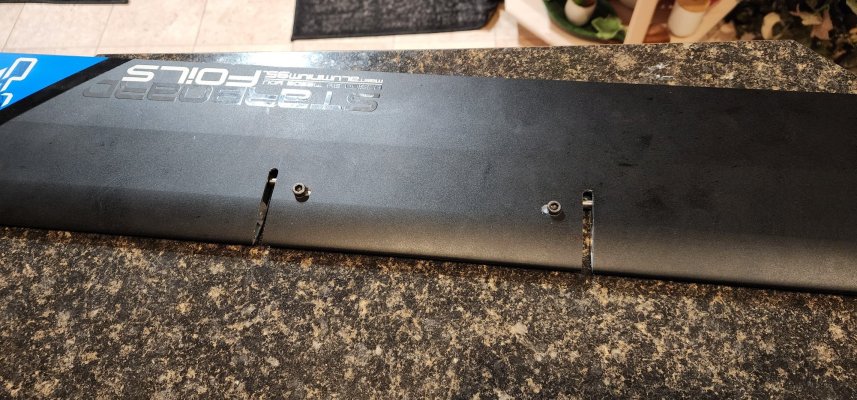
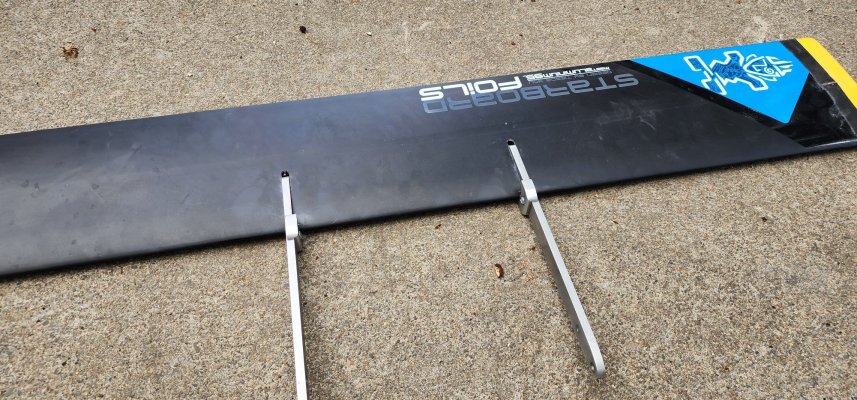
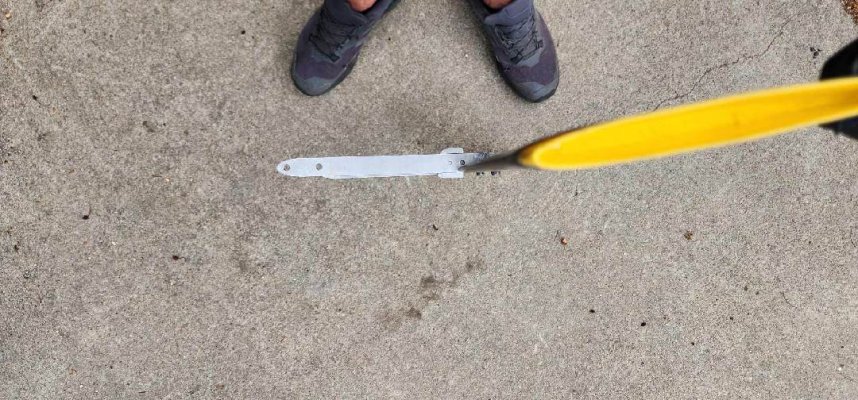
The extrusion I used had a round slot at the 25% chord that could have worked for a hinge, at least the rod would have compensated for the lost MOI. My brother used a different extrusion with rectangular pockets and he placed blocks with pins on the inside. He did not use a spring, just stops at the leading edge witch worked well enough for a prototype. The hydrofoil fin will feel more natural, like swimming without the feel of pushing a ton of water with your feet. Only way around that with the monofin is to do a lot of undulating which flexible people can do well. Thanks for the CFD analysis, I can see it being problematic with the angle of attack increasing significantly with larger amplitude kicks. Easier to design around that with the hinge inside the chord.
 

Attachments

  • Resized_20250603_220609_1749013586380 (1).jpeg
    Resized_20250603_220609_1749013586380 (1).jpeg
    591.6 KB · Views: 16
  • Resized_20250628_141802_1751145808424.jpeg
    Resized_20250628_141802_1751145808424.jpeg
    665.3 KB · Views: 14
  • Resized_20250628_141615_1751145802470.jpg
    Resized_20250628_141615_1751145802470.jpg
    130.6 KB · Views: 8
Fascinating discussion, but way beyond my technical ability. I'm a fan of the concept and am very glad to see divers still pursuing the idea. Maybe some practical experience would be helpful.

I own the last prototype bike shoe dol-fin before the bike shoe model went to production and I love it. I'm a "reef crawler", cover a lot of ground, move around like a spearo but seldom actually shot a fish. I've shoot enough in my life and if somebody else on the trip want to shoot, fine with me. In a mono I wanted more speed and needed something maneuverable enough to spearfish. I've tried many different monos, including the monoflap and could find nothing that would work for spearing, until the dol-fin. The dol-fin, the way I use it, is not particularly faster than bifins,(it can be) but appears to be much more efficient. I'm much less tired after a day of diving than if I was using bifins. Given I'm and old fart, thats important. Not sure how to quantify it, but, for me, the dol-fin appears to be a niche tool. When conditions are good, its great. When conditions get crummy, current, rough, dirty, uncertain, etc, I go back to bifins.

It might be instructive to look at how the hinge is done in my Dol-fin. Its made of what looks like tire side wall rubber(pretty stiff). The top limit is a plastic bar that has some flex to it and the bottom is a shorter plastic bar with a metal stop than can be changed to give more or less flex. Top or bottom, the force to get the blade to flex goes up with the amount of flex.
 
Fascinating discussion, but way beyond my technical ability. I'm a fan of the concept and am very glad to see divers still pursuing the idea. Maybe some practical experience would be helpful.

I own the last prototype bike shoe dol-fin before the bike shoe model went to production and I love it. I'm a "reef crawler", cover a lot of ground, move around like a spearo but seldom actually shot a fish. I've shoot enough in my life and if somebody else on the trip want to shoot, fine with me. In a mono I wanted more speed and needed something maneuverable enough to spearfish. I've tried many different monos, including the monoflap and could find nothing that would work for spearing, until the dol-fin. The dol-fin, the way I use it, is not particularly faster than bifins,(it can be) but appears to be much more efficient. I'm much less tired after a day of diving than if I was using bifins. Given I'm and old fart, thats important. Not sure how to quantify it, but, for me, the dol-fin appears to be a niche tool. When conditions are good, its great. When conditions get crummy, current, rough, dirty, uncertain, etc, I go back to bifins.

It might be instructive to look at how the hinge is done in my Dol-fin. Its made of what looks like tire side wall rubber(pretty stiff). The top limit is a plastic bar that has some flex to it and the bottom is a shorter plastic bar with a metal stop than can be changed to give more or less flex. Top or bottom, the force to get the blade to flex goes up with the amount of flex.
Connor, thanks for you input, I recall you have had a hand in the testing of the fin and feedback for its design. The spring stiffness increase at different points in the kick is one of the design constraints that has a large impact on the efficiency and thrust generated. The spring is soft at the beginning of the kick which is where the most available strength and force is put into it, leading to a larger than desired angle of attack and limited trust out of the gate. The end of the kick is where the power of the kick tapers off but incidentally when the pitch angle needs to be greatest to reduce having too steep of an angle of attack. The only practical work around, which can be done with the monofin as well, was to have the hydrofoil near perpendicular to the body (knees bend 90 Deg) and basically use the large surface area of the blade to kick off a wall of water.

To put it into "fish" terms: In thunniform finning, angle of attack is managed by coupling lateral heaving motions with active phase-shifted pitch (rotation). As oscillation amplitude increases, fish and bio-inspired systems scale the maximum pitch angle and phase lag to maintain an optimal angle relative to direction of flow, preventing flow separation and maximizing thrust.
 
Fascinating discussion, but way beyond my technical ability. I'm a fan of the concept and am very glad to see divers still pursuing the idea. Maybe some practical experience would be helpful.

I own the last prototype bike shoe dol-fin before the bike shoe model went to production and I love it. I'm a "reef crawler", cover a lot of ground, move around like a spearo but seldom actually shot a fish. I've shoot enough in my life and if somebody else on the trip want to shoot, fine with me. In a mono I wanted more speed and needed something maneuverable enough to spearfish. I've tried many different monos, including the monoflap and could find nothing that would work for spearing, until the dol-fin. The dol-fin, the way I use it, is not particularly faster than bifins,(it can be) but appears to be much more efficient. I'm much less tired after a day of diving than if I was using bifins. Given I'm and old fart, thats important. Not sure how to quantify it, but, for me, the dol-fin appears to be a niche tool. When conditions are good, its great. When conditions get crummy, current, rough, dirty, uncertain, etc, I go back to bifins.

It might be instructive to look at how the hinge is done in my Dol-fin. Its made of what looks like tire side wall rubber(pretty stiff). The top limit is a plastic bar that has some flex to it and the bottom is a shorter plastic bar with a metal stop than can be changed to give more or less flex. Top or bottom, the force to get the blade to flex goes up with the amount of flex.
https://emojipedia.org/waving-handhttps://emojipedia.org/waving-handhttps://emojipedia.org/waving-hand very nice to meet you

and I got none of the experience, but captivated by the design :D
are you the one who reviewed the dol fin in the good old 2015? hats off to you sir

hopefully we can manage to get a prototype going and test it properly out, veeery interesting to see some real numbers
 
So regarding what clang was finding in the CFD analysis, depending where the foil rotates within the chord, the spring will have less of a change in stiffness (more linear response) over a larger pitch range and perhaps maintain a more optimal angle of attack relative to the direction of flow. As with the fish, at the broad end of the kick it realigns the fin towards the direction of flow. This does still leave the issue of the spring not being stiff enough at the beginning of the kick if someone wants to give it the goose, a fish can stiffen and relax as needed to optimize the angle in cruise or sprint.
 
https://emojipedia.org/waving-handhttps://emojipedia.org/waving-handhttps://emojipedia.org/waving-hand very nice to meet you

and I got none of the experience, but captivated by the design :D
are you the one who reviewed the dol fin in the good old 2015? hats off to you sir

hopefully we can manage to get a prototype going and test it properly out, veeery interesting to see some real numbers
Clang, would you be able to determine if there was a effective hinge position within the chord where the correct pitch range is always maintained based on a ratio of how much lateral force is acting on the surface area forward and aft of the hinge point. This would hopefully allow a minimal spring to counteract rotation. I think the Dol-fin design may have gone in this direction, but hard to say.
 
Clang, would you be able to determine if there was a effective hinge position within the chord where the correct pitch range is always maintained based on a ratio of how much lateral force is acting on the surface area forward and aft of the hinge point. This would hopefully allow a minimal spring to counteract rotation. I think the Dol-fin design may have gone in this direction, but hard to say.
I've primarily been testing 0.1 of the chord, with aerodynamic center at 0.25c, have been okay thus far

I'll do a hinge chord distance simulation sweep sometime over the weekend, I'd guess 0.15 might turn out to be a very good option
 
yeah, very well might be that the dol fin pilot is an excellent design, and a potentially better hinge and springs working both ways buys nothing
a piece of rubber might

another iteration: a few coils, plastic straps and a rod
now it's exclusively about what foil I can obtain, and sadly its looking like none :'(
Chinese folks make nice aluminium extrusions of the shape we need, but seem to ship only in tons
where did you guys get your foils? @7BDiver

1787100129048.png
 
yeah, very well might be that the dol fin pilot is an excellent design, and a potentially better hinge and springs working both ways buys nothing
a piece of rubber might

another iteration: a few coils, plastic straps and a rod
now it's exclusively about what foil I can obtain, and sadly its looking like none :'(
Chinese folks make nice aluminium extrusions of the shape we need, but seem to ship only in tons
where did you guys get your foils? @7BDiver

View attachment 61857
The hydrofoil I used was called a Windknife extrusion made my Duckworks but they no longer sell the part. The other one used was a mast for a hydrofoil surfboard (foilboard) but was rather heavy, maybe lighter duty ones are available, lots of manufacturers in that market. At least those are symetrical foils. You might look at using a torsion axle spring design, easy to make but a pain to assemble. Played around with designs in that fashion a bit.
1787104114542.png
 
I have been running an ablation study for the design space of the foil and its movement.
Varying its size and angle of attack during the sweep in different ways.

The simulations are not yet mechanically coupled, meaning the foil's position is preprogrammed.
Halving the foil chord from 125mm to 62mm seems to buy about 3-4 percent efficiency while tanking thrust about 40 percent in regimes I've been testing against.
But at a leisurely swim it requires 18% less leg power input, mostly because 125mm foil there is not very efficient, if driven like 62mm one it accelerates - 17 Watt vs 14 Watt

Thus the foil hydrodynamic efficiency can be brought to about 86%


The next big design knob: the foil angle of attack, about 20% of the cycle it does almost nothing (less bad for foil half the size, cause it's just smaller relative to kick)
I ran a few experiments for angle of attack: made it mostly maintain an optimal one, derive it from the fin geometry with stops and springs, and added frictions resisting roll - the idea is that right at reversal we lose most of the potential useful work foil can be doing thus if the foil resists that sudden change the friction would be doing useful work for us
And it even works! a little bit of friction adds almost 1 percent efficiency and a huge +25% thrust!
But adding a bit more of it results in flow separation and a we're cooked:
1787121621619.gif


The runs with non-physical angles of attack I tested: cosine AoA and the one where it maintains best AoA for thrust in a square.
Their efficiencies were not that good, cosine was close to passive, square was about 4 percent worse but produced DOUBLE the thrust, cosine produced 1.8x thrust.
1787122357677.gif
1787122370710.gif


I guess the whole hinge engineering comes down to the single question now: how do we make it produce the cosine AoA or remain as close to it as possible for as many operating regimes as we can.


Here's the torque that must be applied to the hinge to obtain that cosine AoA pattern for the current design (I think the shape of data will be similar for other designs as well):
1787123524565.png


And would you look at that! the acos angle of attack is basically a spring (don't worry about the friction one, spikes are where it hit the angle limits basically)

A single springs can't really serve that ideally everywhere, so the design process needs to continue.
The next step basically is to have coupled CFD - where the physical feedback from springs, etc gets fed back into the simulation.

@7BDiver yeah looks like a torsion bar is an appropriate thing for such a design.
But I will experiment with other mechanical things once I have coupled CFD, another option is to have something that just resists roll - the orange bar above shows that it can resemble the spring quite closely; BTW I got about half the thrust winnings of the spring with it.
I'm pretty sure there are other things we can think of as well - maybe the rubber thingy that dol fin did, IDK how to model it though
 
although IDK, coupled CFD results will be a lot more telling

cause a spring acting on hinge can't produce a pattern that looks like an oscillating spring across the phase, it's something else
more like a spring + some friction
 
and btw friction might scale well with increased load passively - potentially the best knob that adapts passively to the regime
although once again - needs coupled CFD first
 
dol fin's "elastomer & nylon composite, configured for a non-linear response" is sounding more and more appealing
cause I think it does roughly both? its a spring with significant internal losses? thus both a spring and friction?
 
DeeperBlue.com - The Worlds Largest Community Dedicated To Freediving, Scuba Diving and Spearfishing

ABOUT US

ISSN 1469-865X | Copyright © 1996 - 2026 DeeperBlue Global Media Limited.

DeeperBlue.com is an independent digital media platform dedicated to Scuba Diving, Freediving, Ocean Advocacy, and Dive Travel.

Since 1996, we’ve been informing, educating, and inspiring the global diving community through trusted news, features, and shared community experience.

ADVERT