

Guest viewing limit reached
- You have reached the maximum number of guest views allowed
- Please register below to remove this limitation
- Already a member? Click here to login
-
Welcome to the DeeperBlue.com Forums, the largest online community dedicated to Freediving, Scuba Diving and Spearfishing. To gain full access to the DeeperBlue.com Forums you must register for a free account. As a registered member you will be able to:
- Join over 47,943+ fellow diving enthusiasts from around the world on this forum
- Participate in and browse from over 531,990+ posts.
- Communicate privately with other divers from around the world.
- Post your own photos or view from 7,455+ user submitted images.
- All this and much more...
You can gain access to all this absolutely free when you register for an account, so sign up today!
You are using an out of date browser. It may not display this or other websites correctly.
You should upgrade or use an alternative browser.
You should upgrade or use an alternative browser.
Hydrofoil Fin
- Thread starter 7BDiver
- Start date

mechanically coupled CFD numbers are in
the foil movement is not preporgrammed with these, but reacts physically to the flow/spring interactions
it improves peak efficiency - it went up to 87% in the best case, around 85% is now in the band of very much possible
the next refinement pass will address the power input - right now the only preprogrammed thing left is the foil motion (foil reacts to it)
it leaves us with a required power input from the swimmer which isn't very human
next I want to put model human leg power output through the kick phase and hook it into the CFD simulation
thus I'll be able to see what load response we need for a typical human kick to produce greatest thrust/efficiency
and we could tune the design against somewhat realistic human swimming biomechanics
@7BDiver do you maybe know what power human kick produces across the cycle phases? I think I saw you mention something like that
"definitive" foil CFD needs to take biomechanics into consideration here
a sample graph of required power input, don't take the numbers too seriously, it's one of the extreme case simulations:
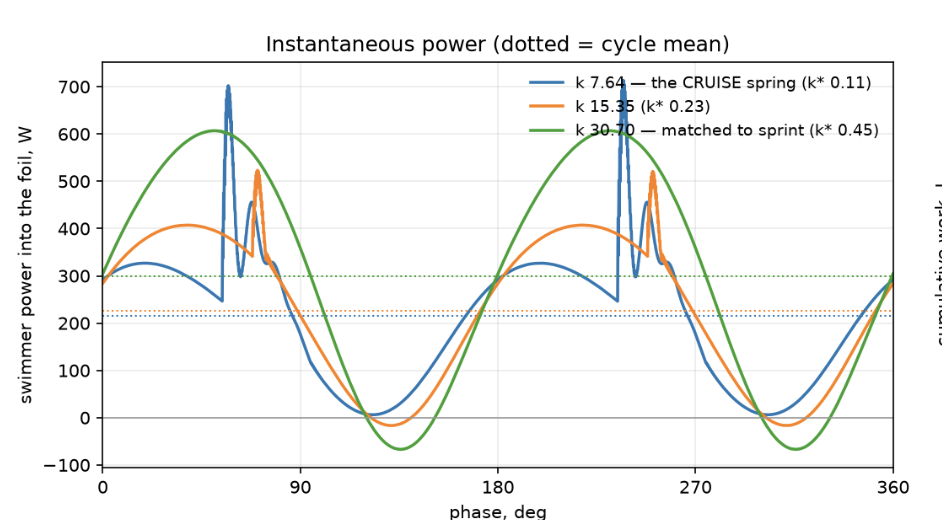
sudden jumps are where it bumps into the angle range limiters, we definitely need some cushioning there at least, at best - a compliant mechanism with nonlinear response
the foil movement is not preporgrammed with these, but reacts physically to the flow/spring interactions
it improves peak efficiency - it went up to 87% in the best case, around 85% is now in the band of very much possible
the next refinement pass will address the power input - right now the only preprogrammed thing left is the foil motion (foil reacts to it)
it leaves us with a required power input from the swimmer which isn't very human
next I want to put model human leg power output through the kick phase and hook it into the CFD simulation
thus I'll be able to see what load response we need for a typical human kick to produce greatest thrust/efficiency
and we could tune the design against somewhat realistic human swimming biomechanics
@7BDiver do you maybe know what power human kick produces across the cycle phases? I think I saw you mention something like that
"definitive" foil CFD needs to take biomechanics into consideration here
a sample graph of required power input, don't take the numbers too seriously, it's one of the extreme case simulations:
sudden jumps are where it bumps into the angle range limiters, we definitely need some cushioning there at least, at best - a compliant mechanism with nonlinear response

I am at a little bit of a loss to where the friction is most important along the amplitude of the foil, I'm guessing at the steepest angle relative to the strut? Is the heaving motion is making the center of lift move forward of the static center of pressure (25% chord) making the nose roll and pitch up creating more lift? If significant, the heaving motion itself could increase the upper limit of effective angle of attack. The CFD is assuming the direction of flow for the foil is coming parallel to the strut/diver, but is it realistically more of an angle between the direction of heaving and direction the diver is heading. In my mind we want to demonstrate trust which is perpendicular to lift in the CFD. How is the CFD for a propeller set up? The angle of the foil in this simulation would simulate a "feathered" prop relative to the direction of flow.
I would guess the kicking force to be around 50 lbs/223 N, that would be flexing the fin quite a bit.mechanically coupled CFD numbers are in
the foil movement is not preporgrammed with these, but reacts physically to the flow/spring interactions
it improves peak efficiency - it went up to 87% in the best case, around 85% is now in the band of very much possible
the next refinement pass will address the power input - right now the only preprogrammed thing left is the foil motion (foil reacts to it)
it leaves us with a required power input from the swimmer which isn't very human
next I want to put model human leg power output through the kick phase and hook it into the CFD simulation
thus I'll be able to see what load response we need for a typical human kick to produce greatest thrust/efficiency
and we could tune the design against somewhat realistic human swimming biomechanics
@7BDiver do you maybe know what power human kick produces across the cycle phases? I think I saw you mention something like that
"definitive" foil CFD needs to take biomechanics into consideration here
a sample graph of required power input, don't take the numbers too seriously, it's one of the extreme case simulations: View attachment 61865
sudden jumps are where it bumps into the angle range limiters, we definitely need some cushioning there at least, at best - a compliant mechanism with nonlinear response
where the friction is most important along the amplitude of the foil, I'm guessing at the steepest angle relative to the strut?I am at a little bit of a loss to where the friction is most important along the amplitude of the foil, I'm guessing at the steepest angle relative to the strut? Is the heaving motion is making the center of lift move forward of the static center of pressure (25% chord) making the nose roll and pitch up creating more lift? If significant, the heaving motion itself could increase the upper limit of effective angle of attack. The CFD is assuming the direction of flow for the foil is coming parallel to the strut/diver, but is it realistically more of an angle between the direction of heaving and direction the diver is heading. In my mind we want to demonstrate trust which is perpendicular to lift in the CFD. How is the CFD for a propeller set up? The angle of the foil in this simulation would simulate a "feathered" prop relative to the direction of flow.
it did matter most when foil angle was preprogrammed - the cosine foil AoA trajectory needed nonlinear the hinge torque, it had some friction component
the friction works at reversals - it holds blade's deflected state a little bit there, it's was an overall efficiency gain
CFD with physical feedback driving foil's AoA has shown that just a spring gets very close to that cosine AoA pattern
Is the heaving motion is making the center of lift move forward of the static center of pressure (25% chord) making the nose roll and pitch up creating more lift?
across simulations the centre of pressure sits at 0.26-0.4c
unsteady added-mass force acts at roughly 0.5c - midpoint, taking CP back
If significant, the heaving motion itself could increase the upper limit of effective angle of attack.
yeah, it takes the stall angle from theoretical 10-12 degrees to 12-18 degrees of dynamic stall angle in these simulations
The CFD is assuming the direction of flow for the foil is coming parallel to the strut/diver
the setup assumes flow is parallel to the direction of swimming, and the foil moves through it, the foil sees the vector sum, it's angle of attack should be pretty realistic through
the custom part is that in the latest iteration the foil pitch is a solved DOF instead of preprogrammed
I want to take it a bit further and make the motion itself a solved DOF
I might have misunderstood the question, or its parts
and in general I've been posting too much stuff, I should probably do it less frequently
right now the main mechanical engineering concerns I have is how the biomechanics - how to make it work most where the human body exerts most power, and how to make the angle range limiter engagement smoother, ideally the spring would get a stiffer linearly most of the way, but get very stiff very fast close and at the angle range limit
I'll get back when I have the fully passive / elastically-mounted CFD (heave becomes a DOF) - then I could run it against human biomechanics models: where in the kick cycle how much power can a human apply
in short one blatantly unrealistic thing still left in CFD is that heave is preprogrammed, making it a degree of freedom allows to put biomechanics models into the simulation - heave will be driven by "realistic" power input
right now it assumes power on demand basically for the programmed heave
right now it assumes power on demand basically for the programmed heave
I feel like friction will turn out to be not important
but non-linearity of the spring probably will be very important for ergonomics
it's okay to tune the spring for slow-ish swimming, it performs well for fast swimming nonetheless if there are hard angle limiters
but then to not have a sudden wall of resistance at the angle limit I'd love it if the spring was linear most of the way, and accelerated at close to the end of its range of motion basically, that's the non-linearity I want in it
but first I'll work on the CFD model a bit
and I'm very much open for ideas/corrections etc, I'm relearning CFD with this one in a sense
but non-linearity of the spring probably will be very important for ergonomics
it's okay to tune the spring for slow-ish swimming, it performs well for fast swimming nonetheless if there are hard angle limiters
but then to not have a sudden wall of resistance at the angle limit I'd love it if the spring was linear most of the way, and accelerated at close to the end of its range of motion basically, that's the non-linearity I want in it
but first I'll work on the CFD model a bit
and I'm very much open for ideas/corrections etc, I'm relearning CFD with this one in a sense