Over the years we have seen a few manufacturers come up with alternatives to the legacy monofins like Lunocet, Swordfish Fins, DOL-Fin and the like. These have largely come and gone due to product cost, lack of large volume sales. Has anyone played with home building their own hydrofoil monofin from off the shelf parts? Has anyone entertained the idea of using one of those pump hydrofoils they attach to surfboards to make monofin? Not sure if the construction can take any depth or not, maybe they are too large and heavy.


Guest viewing limit reached
- You have reached the maximum number of guest views allowed
- Please register below to remove this limitation
- Already a member? Click here to login
-
Welcome to the DeeperBlue.com Forums, the largest online community dedicated to Freediving, Scuba Diving and Spearfishing. To gain full access to the DeeperBlue.com Forums you must register for a free account. As a registered member you will be able to:
- Join over 47,943+ fellow diving enthusiasts from around the world on this forum
- Participate in and browse from over 531,990+ posts.
- Communicate privately with other divers from around the world.
- Post your own photos or view from 7,455+ user submitted images.
- All this and much more...
You can gain access to all this absolutely free when you register for an account, so sign up today!
You are using an out of date browser. It may not display this or other websites correctly.
You should upgrade or use an alternative browser.
You should upgrade or use an alternative browser.
Hydrofoil Fin
- Thread starter 7BDiver
- Start date
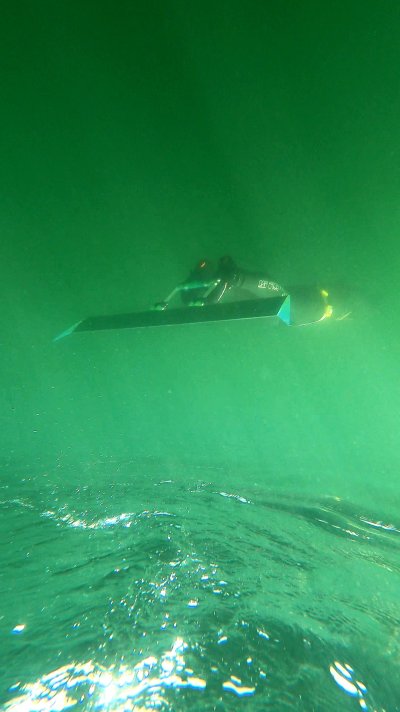
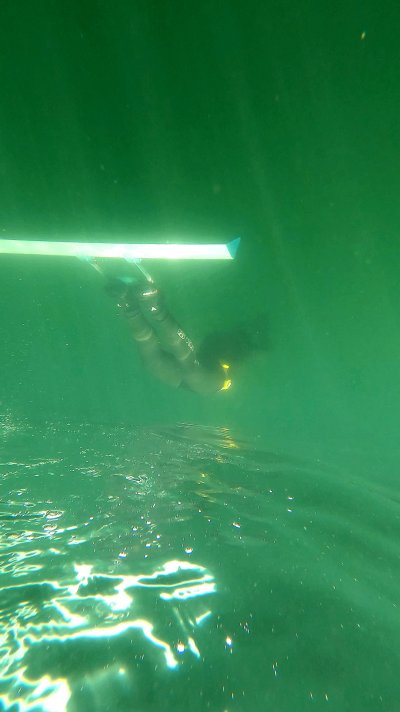
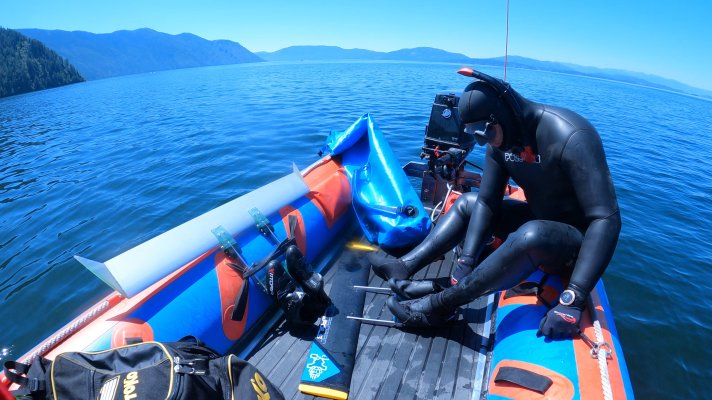
I ended up making my own design for a Monofoil using a Duckworks Windknife extrusion with about a 5" chord and 43" wide. The rest is some 3D printed parts, polyurethane bushings and and standard hardware. Works quite well and the weight is 7 lb compared to my 8.6 lb carbon Leaderfin.
Things I really like about it: smooth glide, very comfortable, great spring response, durable, straps to my boat nicely, flashy, light weight, slight negative buoyancy, my wetsuit makes it float on the surface easy, doesn't try to pass me up on the decent.
Things I don't like: a little more difficult to direct than standard hyperfin due to width, can't go through small tunnels or crevices easily, not as easy to use on the surface but does fine, doesn't launch from stationary as well.
Things I really like about it: smooth glide, very comfortable, great spring response, durable, straps to my boat nicely, flashy, light weight, slight negative buoyancy, my wetsuit makes it float on the surface easy, doesn't try to pass me up on the decent.
Things I don't like: a little more difficult to direct than standard hyperfin due to width, can't go through small tunnels or crevices easily, not as easy to use on the surface but does fine, doesn't launch from stationary as well.
Attachments
Looks very similar to the Dolfin prototype I own. I concur with your performance report with the exception that I had to add floats to mine to keep it from passing me on descent. Too bad the finished product was so expensive: it as a great idea. Very very efficient and non tiring for long open water sessions
There are a lot of similar elements, it looks like the chord is a similar size but this one is a symmetrical chord (has no camber). The Dol-Fin was not as wide, mine probably does not need to be. I did go through a bit of design effort to make it more streamline and certainly has a lot less bracketry holding the foil to the shoes. Smith's Aerospace likely did not have the luxury of durable 3D printed parts to work with either. I did use Smith's recommended 28 Deg angle for the shoes and his idea of using the cycling shoes. I do not know if there was a spring element to his design or not, perhaps you can reply to that. My design feels very much like a standard monofin as far as the feedback to kicking. The blade will pivot up to approximately 30 deg and springs back to neutral depending how hard one kicks. Do you have an idea how much the Dol-Fin weighed?Looks very similar to the Dolfin prototype I own. I concur with your performance report with the exception that I had to add floats to mine to keep it from passing me on descent. Too bad the finished product was so expensive: it as a great idea. Very very efficient and non tiring for long open water sessions
That is the primary reason I made my own, either all other models are not in production now or so expensive that they never lived long enough to fill any orders. All in all I spent about $500 to make my prototype which is pretty darn cheap for such an effort.Looks very similar to the Dolfin prototype I own. I concur with your performance report with the exception that I had to add floats to mine to keep it from passing me on descent. Too bad the finished product was so expensive: it as a great idea. Very very efficient and non tiring for long open water sessions
No springs in a Dolfin, but the blade is attached to the frame with what looks like a strip of automobile tire rubber. This limits the ability of the blade to flex and apparently keeps it near the optimal angle for thrust. No signs of wear after 3 or four owners and testors and lots of hours. I' ll find a scale and weigh it.There are a lot of similar elements, it looks like the chord is a similar size but this one is a symmetrical chord (has no camber). The Dol-Fin was not as wide, mine probably does not need to be. I did go through a bit of design effort to make it more streamline and certainly has a lot less bracketry holding the foil to the shoes. Smith's Aerospace likely did not have the luxury of durable 3D printed parts to work with either. I did use Smith's recommended 28 Deg angle for the shoes and his idea of using the cycling shoes. I do not know if there was a spring element to his design or not, perhaps you can reply to that. My design feels very much like a standard monofin as far as the feedback to kicking. The blade will pivot up to approximately 30 deg and springs back to neutral depending how hard one kicks. Do you have an idea how much the Dol-Fin weighed?
Weight 5.51 lbs with shoes and floats. Forgot to mention, the metal frame stops the amount of pivot the blade will do, in one direction, tire rubber attachment controls the other direction.No springs in a Dolfin, but the blade is attached to the frame with what looks like a strip of automobile tire rubber. This limits the ability of the blade to flex and apparently keeps it near the optimal angle for thrust. No signs of wear after 3 or four owners and testors and lots of hours. I' ll find a scale and weigh it.
I adjusted to floats until the fin is slightly positive, makes for easy and straight descentsThat is lighter than I was expecting but imagine my design would be fairly close if it wasn't 43" wide. Thanks for the details!
Found an excellent and interesting article as to why traditional "flexible" monofins and bifins work as well as they do compared to rigid foil type structures. One of the primary hurdles of monofins and bifins is the heave kinematics where the large surface area has to push the water as it moves up and down but with having very flexible trailing edges they gain a lot in creating thrust and efficiency. As shown above, the rigid foil is has a great ability to create lift at higher angles of attack with less drag. The flexible oscillating wing "fin" has more efficiency and thrust at lower amplitudes especially if direction is being changed rapidly as fish do.
There are more interesting articles cited at the bottom of the article that may be more relevant to fin design.
Effect of chordwise flexibility on propulsive performance of high inertia oscillating-foils
https://www.sciencedirect.com/science/article/abs/pii/S0889974618304894There are more interesting articles cited at the bottom of the article that may be more relevant to fin design.
I tried the link. I comes up clear for a fraction of a second and then goes blurry. Can you fix that?Found an excellent and interesting article as to why traditional "flexible" monofins and bifins work as well as they do compared to rigid foil type structures. One of the primary hurdles of monofins and bifins is the heave kinematics where the large surface area has to push the water as it moves up and down but with having very flexible trailing edges they gain a lot in creating thrust and efficiency. As shown above, the rigid foil is has a great ability to create lift at higher angles of attack with less drag. The flexible oscillating wing "fin" has more efficiency and thrust at lower amplitudes especially if direction is being changed rapidly as fish do.
Effect of chordwise flexibility on propulsive performance of high inertia oscillating-foils
https://www.sciencedirect.com/science/article/abs/pii/S0889974618304894
There are more interesting articles cited at the bottom of the article that may be more relevant to fin design.

found this footage of a great white stiff "monofin", and seems it has powerful springs on the lateral sides of the tail - would be great to add those springs to hydrofoil fins - not only for comfort, but kinda to accuulae and output energy and to eventually change gears (adding removing springs somehow), tuning a monofin from sprinter to freediving, etc]] -- a slowmo vid with a simplistic schematic on my insta :

There is no manual thus far, hydrofoil designs are still rather experimental in the sense they do not match the performance of a standard composite monofin yet. My own design needs a bit of work and it has been a while since I worked on it. Much of the design will rely on the materials and manufacturing capabilities you have available locally. Are there any aspects of a design you have questions about?hey there gentlemen
can somebody pls share a manual for how to DIY myself a hydrofoil monofin? I don't think I can buy any right now
Primarily about the footplate-to-struts joint you did, is it 3d printed plastic and 4 bots into it through the struts? is that enough to keep it in one piece?Are there any aspects of a design you have questions about?
And did you perform any real-world load-testing your design, to check how far away it sways under load - that determines the foil efficiency a lot
I'm running some 2D CFD currently to make it easy to optimize a spring design for the greatest efficiency in a regular usage regime for recreational swimming/freediving
Thus far it looks like the literature is mostly right - the foil swinging more that 15-20 degrees gives you flow detachment/turbulence and efficiency tanks for marginal thrust
Yes, SLA printed parts, FDM would probably be stronger, the resin tends to load relax too much and gets soft if much over 80 deg F. The SLA print was really nice for clean and accurate printing. I did a good amount of testing of the fin in the water, here is my review of testing and design iterations:Primarily about the footplate-to-struts joint you did, is it 3d printed plastic and 4 bots into it through the struts? is that enough to keep it in one piece?
And did you perform any real-world load-testing your design, to check how far away it sways under load - that determines the foil efficiency a lot
I'm running some 2D CFD currently to make it easy to optimize a spring design for the greatest efficiency in a regular usage regime for recreational swimming/freediving
Thus far it looks like the literature is mostly right - the foil swinging more that 15-20 degrees gives you flow detachment/turbulence and efficiency tanks for marginal thrust
- The distance from the feet to the blade was based on the standard length to the middle of the blade for a composite monofin.
- The tradeoff is if the struts are too short you would have to undulate the legs radically to get speed and power. If the strut is too long, the footpockets and bracket holding the struts will have to be quite strong.
- Less angle of attack for the hydrofoil will make a faster fin, if the blade hinges too much it will just be slow.
- If possible, just forward of 25% of the chord is the ideal location for the foil to hinge, further forward starts to require a lot of spring to counteract large hinge angles.
- A high aspect ratio will be a lot more efficient and lighter but must take care to ensure it is strong enough, my design was some 40" wide with a chord of 0.5" x 5.0".
- Symmetrical wing fences with a toe-in angle is helpful to keep the hydrofoil from side slipping significantly and maintain heading.
- Make sure threaded hardware has locking features or anaerobic adhesive, water will loosen things up fairly easily.
- Shoes or foot pockets will need to have a fairly rigid sole.
- A passive but springy trailing edge would improve power and efficiency greatly.
yeah, the hinge is the bane of producing this thing
I'm planning to put it at around 15-20 percent of the chord (don't really know how to put it there yet) - I want the wing to work in both directions
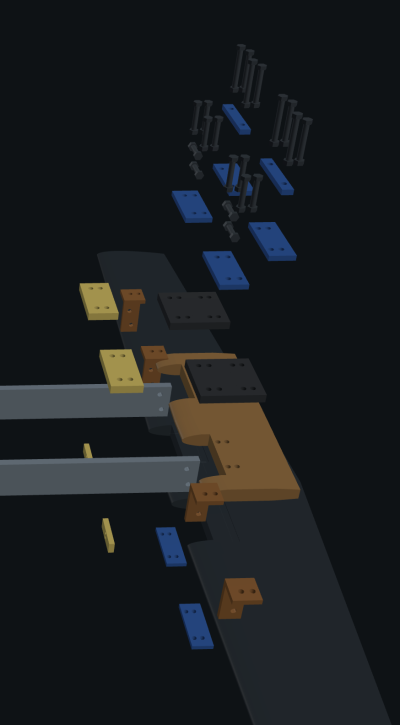
the initial hinge design iteration is looking mighty complicated (attachment below)
I was hoping the test out your spring design too - much less complex, if its load response it optimal
I'm planning to put it at around 15-20 percent of the chord (don't really know how to put it there yet) - I want the wing to work in both directions
the initial hinge design iteration is looking mighty complicated (attachment below)
I was hoping the test out your spring design too - much less complex, if its load response it optimal