
sorry forgot to answer your postYes, SLA printed parts, FDM would probably be stronger, the resin tends to load relax too much and gets soft if much over 80 deg F. The SLA print was really nice for clean and accurate printing. I did a good amount of testing of the fin in the water, here is my review of testing and design iterations:
- The distance from the feet to the blade was based on the standard length to the middle of the blade for a composite monofin.
- The tradeoff is if the struts are too short you would have to undulate the legs radically to get speed and power. If the strut is too long, the footpockets and bracket holding the struts will have to be quite strong.
- Less angle of attack for the hydrofoil will make a faster fin, if the blade hinges too much it will just be slow.
- If possible, just forward of 25% of the chord is the ideal location for the foil to hinge, further forward starts to require a lot of spring to counteract large hinge angles.
- A high aspect ratio will be a lot more efficient and lighter but must take care to ensure it is strong enough, my design was some 40" wide with a chord of 0.5" x 5.0".
- Symmetrical wing fences with a toe-in angle is helpful to keep the hydrofoil from side slipping significantly and maintain heading.
- Make sure threaded hardware has locking features or anaerobic adhesive, water will loosen things up fairly easily.
- Shoes or foot pockets will need to have a fairly rigid sole.
- A passive but springy trailing edge would improve power and efficiency greatly.


Guest viewing limit reached
- You have reached the maximum number of guest views allowed
- Please register below to remove this limitation
- Already a member? Click here to login
-
Welcome to the DeeperBlue.com Forums, the largest online community dedicated to Freediving, Scuba Diving and Spearfishing. To gain full access to the DeeperBlue.com Forums you must register for a free account. As a registered member you will be able to:
- Join over 47,943+ fellow diving enthusiasts from around the world on this forum
- Participate in and browse from over 531,990+ posts.
- Communicate privately with other divers from around the world.
- Post your own photos or view from 7,455+ user submitted images.
- All this and much more...
You can gain access to all this absolutely free when you register for an account, so sign up today!
You are using an out of date browser. It may not display this or other websites correctly.
You should upgrade or use an alternative browser.
You should upgrade or use an alternative browser.
Hydrofoil Fin
- Thread starter 7BDiver
- Start date
I meant forgot to attach my reply to your postsorry forgot to answer your post

I am not quite sure how your hinge system works from the picture but the number of parts and hardware look like it may get heavy easily, simplicity is the best path to take if possible. I am looking at a departure from the hinge designs I started with and will try to mock something up in CAD. It will allow the the foil to rotate using linkages mounted to top and bottom surfaces of the foil at the desired chord distance. Links cross one another to rotate one surface forward and the other back. Strut will have a Y shape in front of leading edge with hinge at end of each leg. Not sure what to use for a spring or limit travel at this point.
Another thing to look at carefully is the angle of the feet to the struts, I found about 30 Deg is best to keep the foil angle neutral with the shins.
Another thing to look at carefully is the angle of the feet to the struts, I found about 30 Deg is best to keep the foil angle neutral with the shins.
definitely, I'm kinda new to 3d designI am not quite sure how your hinge system works from the picture but the number of parts and hardware look like it may get heavy easily, simplicity is the best path to take if possible. I am looking at a departure from the hinge designs I started with and will try to mock something up in CAD. It will allow the the foil to rotate using linkages mounted to top and bottom surfaces of the foil at the desired chord distance. Links cross one another to rotate one surface forward and the other back. Strut will have a Y shape in front of leading edge with hinge at end of each leg. Not sure what to use for a spring or limit travel at this point.
Another thing to look at carefully is the angle of the feet to the struts, I found about 30 Deg is best to keep the foil angle neutral with the shins.
I want to simplify, but limiting foil angle and having an easy to produce struts is kinda difficult - I want to make the v1 core with 3d printed plastics, laser cut metals and screws and bolts
maybe something like dol fin pilot is better - 2 cut steel plates that pinch rubber, but then I'd probably have to bend the metal
not so many shops here do it
btw CFD results for the blade angle of attack produced in openfoam with different viscosity modelsdefinitely, I'm kinda new to 3d design
I want to simplify, but limiting foil angle and having an easy to produce struts is kinda difficult - I want to make the v1 core with 3d printed plastics, laser cut metals and screws and bolts
maybe something like dol fin pilot is better - 2 cut steel plates that pinch rubber, but then I'd probably have to bend the metal
not so many shops here do it
looks like limiting it at around 12-15 degrees is the sweetspot
but it depends on the stroke frequency - higher frequency and lower amplitude shift the nu decline right
all the data quite preliminary at this point, but seems to be in agreement with what I found
btw, having a lower aspect ratio seems to help for the high angle of attack with foil efficiency cause amplitude relative to foil size matters for flow separation. it simply has less time to separatebtw CFD results for the blade angle of attack produced in openfoam with different viscosity models
looks like limiting it at around 12-15 degrees is the sweetspot
but it depends on the stroke frequency - higher frequency and lower amplitude shift the nu decline right
all the data quite preliminary at this point, but seems to be in agreement with what I found
View attachment 61848
below is AR 8 at the top vs AR 4 bottom at the same speed, Strouhal number
The clip in shoe design has a huge advantage with weight savings, comfort and versatility. The large aspect ratio hydrofoil will always have better efficiency and lift than a low aspect ratio monofin. The hitch is that the solid hydrofoil lacks a passive flexible trailing edge which helps generate thrust and is better at vortex shedding.
I mean practically - do you prefer to use the foil for long and slow swims, fast swims, etcThe clip in shoe design has a huge advantage with weight savings, comfort and versatility. The large aspect ratio hydrofoil will always have better efficiency and lift than a low aspect ratio monofin. The hitch is that the solid hydrofoil lacks a passive flexible trailing edge which helps generate thrust and is better at vortex shedding.
asking cause you mentioned previously that the foil is not as good as carbon fiber ones
The foil was more comfortable, didn't require as much work but was still a little slower. Just didn't feel like I was pushing a wall of water. The foil could not "launch" from rest like the monofin but felt very smooth. I really liked how I could just strap it to the side of my boat and not worry about it getting pumped or beat by the wind. It did nicely in the turn at the bottom but was really awkward to straighten out without some wing fences if forward momentum wasn't maintained.
For a really long swim, the foil would be easier on the body especially if going slow. Just like long fins, if the trailing edge is not flexing a lot, the whole point of the low aspect ratio design is being lost. Monofins are good for two things, low drag when gliding and creating tons of thrust.
Here is the latest hinge design, maybe a bit robust and chunky but the idea is there. The hinge allows the correct angle for the direction of finning and the linkage also limits how far it will swing. This allows the hinges to be mounted to the surface of the hydrofoil without creating critical cross-sections or splices.
Attachments
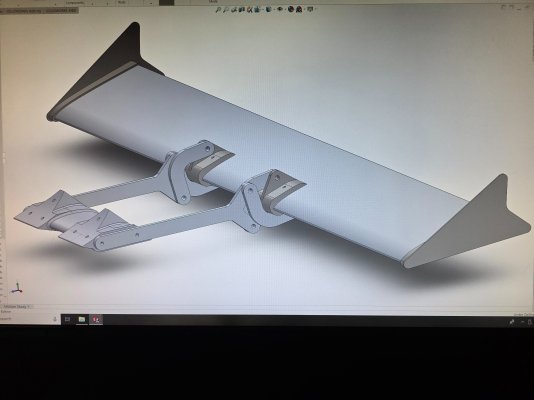
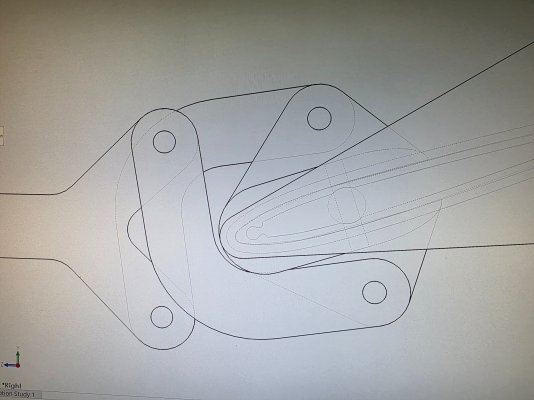
oh wow, looks very niceHere is the latest hinge design, maybe a bit robust and chunky but the idea is there. The hinge allows the correct angle for the direction of finning and the linkage also limits how far it will swing. This allows the hinges to be mounted to the surface of the hydrofoil without creating critical cross-sections or splices.
admire your CAD / mechanical engineering skills
simulating a flexible attachment to the foil's end is a lot more complicated than rigid foil simulation
the whole cycle efficiency of the bare foil is >80% in its sweetspot max angle range of about 9-12 degrees, given the spring response behaves well; doubt it can go much further than that
but the flexible extension can very well help with versatility though - adding an extension shouldn't buy that much efficiency for sweet spot case, but could if you want fast thrust output (outside of sweet spot regime)
I'll try to simulate it after I'm done testing different regimes
thus far the properties of my foil model seems to favour sprinting at 2m/s, given a certain stroke pattern
the whole cycle efficiency of the bare foil is >80% in its sweetspot max angle range of about 9-12 degrees, given the spring response behaves well; doubt it can go much further than that
but the flexible extension can very well help with versatility though - adding an extension shouldn't buy that much efficiency for sweet spot case, but could if you want fast thrust output (outside of sweet spot regime)
I'll try to simulate it after I'm done testing different regimes
thus far the properties of my foil model seems to favour sprinting at 2m/s, given a certain stroke pattern
It really would be simpler to just have the foil hinge from a single bolt at the strut with linkages going to top and bottom surfaces, similar to my original design. The Y would limit the maximum angle. Not sure if the foil rotating about a point within the chord rather than swinging forward of the chord would have advantages or not other than requiring less spring to counteract the pivot and bring it back to neutral.
yea, definitelyIt really would be simpler to just have the foil hinge from a single bolt at the strut with linkages going to top and bottom surfaces, similar to my original design. The Y would limit the maximum angle. Not sure if the foil rotating about a point within the chord rather than swinging forward of the chord would have advantages or not other than requiring less spring to counteract the pivot and bring it back to neutral.
I ran simulations for my design with the hinge 10 percent the length of chord
I'll go run simulations with hinge outside of the foil
okay it's a lot bigger of a deal than I anticipated, CFD sweep not yet done, but the picture is getting clearer
with the hinge outside the wing we get a larger arm -> bigger spring load ranges -> spring needs to operate the wing in the sweetspot under more challenging conditions
for a hinge in the foil fast vs slow swimming is lets say 1.3x load, for the spring outside that's 2x load
a linear spring is not a good choice for this case it seems idk
in short it has to be a lot tougher, while being more sensitive sensitive in relative terms, which is not not a linear response
with the hinge outside the wing we get a larger arm -> bigger spring load ranges -> spring needs to operate the wing in the sweetspot under more challenging conditions
for a hinge in the foil fast vs slow swimming is lets say 1.3x load, for the spring outside that's 2x load
a linear spring is not a good choice for this case it seems idk
in short it has to be a lot tougher, while being more sensitive sensitive in relative terms, which is not not a linear response