

Guest viewing limit reached
- You have reached the maximum number of guest views allowed
- Please register below to remove this limitation
- Already a member? Click here to login
-
Welcome to the DeeperBlue.com Forums, the largest online community dedicated to Freediving, Scuba Diving and Spearfishing. To gain full access to the DeeperBlue.com Forums you must register for a free account. As a registered member you will be able to:
- Join over 47,943+ fellow diving enthusiasts from around the world on this forum
- Participate in and browse from over 531,990+ posts.
- Communicate privately with other divers from around the world.
- Post your own photos or view from 7,455+ user submitted images.
- All this and much more...
You can gain access to all this absolutely free when you register for an account, so sign up today!
You are using an out of date browser. It may not display this or other websites correctly.
You should upgrade or use an alternative browser.
You should upgrade or use an alternative browser.
AIDA DEPTH WC 2009 in the Bahamas.
- Thread starter Will
- Start date
Thread Status: Hello
, There was no answer in this thread for more than 90 days.
It can take a long time to get an up-to-date response or contact with relevant users.
It can take a long time to get an up-to-date response or contact with relevant users.


Its Wills cat.
We had this argument about if cats always landed on their feet.
So I suggested tossing the cat to various hights and takes notes of when it landed on its feet and when it did not.
Will was a bit sceptical - but in the end he found the scientific rewards greater than the risk of injury to the domestic animal.
After a few throws we started hitting the ceiling with the pet.
So Will came up with this idea (he is always methodical) and throw the cat against the door net and see if it would stick.
It did!
And thats probably the most intresting thing that happened so far on this WC.
We had this argument about if cats always landed on their feet.
So I suggested tossing the cat to various hights and takes notes of when it landed on its feet and when it did not.
Will was a bit sceptical - but in the end he found the scientific rewards greater than the risk of injury to the domestic animal.
After a few throws we started hitting the ceiling with the pet.
So Will came up with this idea (he is always methodical) and throw the cat against the door net and see if it would stick.
It did!
And thats probably the most intresting thing that happened so far on this WC.
Attachments
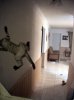


I can tell from the cat's expression that this is an experimental model. Since Will has a reasonable hallway and a smooth floor there near the entrance you may want to try 'kitty bowl-a-rama' in order to determine it's horizontal recovery capability.
A good test of landing response time is to hold the cat by the feet (feet up) about 10cm above the floor and drop it - decreasing the height 1 or 2 cm on each attempt.
I've established by scientific means that failure to properly experiment with a kitten often results in a curmudgeonly adult cat.
A good test of landing response time is to hold the cat by the feet (feet up) about 10cm above the floor and drop it - decreasing the height 1 or 2 cm on each attempt.
I've established by scientific means that failure to properly experiment with a kitten often results in a curmudgeonly adult cat.
Last edited:
Aaah you obviously have experience with these things. This suggestion is exactly what I have tried. Every time I have to discuss certain boring issues regarding the running of the comp with Will, this little kitten attacks me with claws out. Since I am a believer in "physical education" and am well informed of the psychologists Pavels studies, I give the cat a nice shove with my foot and delights in the distance it glides. Cat seems to think this is a game, so new methods of conditioning have to be thought out.Since Will has a reasonable hallway and a smooth floor there near the entrance you may want to try 'kitty bowl-a-rama' in order to determine it's horizontal recovery capabilit.
I could tell you about the startlist for the women CWT, but I find the catdiscussion quite intrieging.
Sebastian

Hi All, I just wish to say publically a HUGE thank you for all the support I have received after my result. Overwhelming to say the least.
Dave Mullins had it right, where I have very little experience with CNF, but I tried, thew my hat in the ring and gave it a shot. I had done that dive in training, so I was comfortable with the nomination, although a little nervous. Sebastian was correct, I was banking on the fact that one of the others above me would have a penalty or other in order to make the finals. I was not prepared to play it safe as I knew I was right on the edge therefore backing myself to make the dive, come up clean and use that as pressure for the ones above. Unfortunately, it did not play out that way.
Regardless, I am happy. I got to challenge for one of those top spots, gave it 100% and came away knowing that on that day I could not have done better.
But I can tell you, some of you might have seen the post on my blog a while back about my thoughts of the people and quality of people in freediving, the amazing feed back pending my dive has just shown that to me even more. You people rock. That's what I love about this sport.
Dont worry, I will be back to give this puppy another go.
Dave Mullins had it right, where I have very little experience with CNF, but I tried, thew my hat in the ring and gave it a shot. I had done that dive in training, so I was comfortable with the nomination, although a little nervous. Sebastian was correct, I was banking on the fact that one of the others above me would have a penalty or other in order to make the finals. I was not prepared to play it safe as I knew I was right on the edge therefore backing myself to make the dive, come up clean and use that as pressure for the ones above. Unfortunately, it did not play out that way.
Regardless, I am happy. I got to challenge for one of those top spots, gave it 100% and came away knowing that on that day I could not have done better.
But I can tell you, some of you might have seen the post on my blog a while back about my thoughts of the people and quality of people in freediving, the amazing feed back pending my dive has just shown that to me even more. You people rock. That's what I love about this sport.
Dont worry, I will be back to give this puppy another go.
Ok back to business
There are some new things at this WC, some things that not all may recognize.
- There is a STOP for the lanyards 1 m above the plate.
- There is no oxygen at the platform.
- Safety divers do not give rescue breaths.
1) One meter above the plate is a STOPKNOT (and a funnel (some use a
tennis ball)).
This is to stop the lanyard from getting entangled on the bottom plate.
In case of a deep complication and the diver is not coming up - the
lanyard IS THE ONLY THING that will save the divers life. Dropped or
released lanyards are a major safety risk. The tags are secured around
the plate (in this case 16 tags at the start of each session).
2) There is no oxygen on the platform, this is instead kept 30 meters
away on the beach.
Generally giving oxygen is done for DCS problems and people with
respiratory problems. There are not indications that giving oxygen
after a Blackout is essential. Oxygen levels return to normal within a
few breaths in a freediver. Giving oxygen after BO is just a habit we
have - it looks good and efficient. If you have arguments for giving
O2 to a concious breathing person - it will be intresting to hear.
In a squeeze situation oxygen is essential. The uptake of oxygen is
impaired, oxygen may be needed for longer periods. This will be
provided away from the competition area, in this case on the beach
under the tent, or in the evacuation car.
3) Safety divers do not do rescue breaths.
Rescue breaths are something medical personal use as "auxillary"
breathing on patients that does not breath themselves. It is not in
medical situations used to unblock a laryngospasm. We freedivers have
unique knowledge about the efficiency of the freediver laryngospasm,
not studied by science. It is in many cases hard to release (the
survival instinct of holding ones breath under water even when
unconscious is strong).
Some say an RB does the trick, other say an RB can prolong the
Freedíver laryngospasm, specially if done in water an small amounts
of water get into the throat.
In any case a BO victim seldom (ever?) come back within 10-15 seconds
WHATEVER WE do. In the WC 2009 we use these 15 seconds to do BTT and
haul the BO diver onto the plat form where the doctor has full access
to the diver on a stable "floor".
Sebastian
There are some new things at this WC, some things that not all may recognize.
- There is a STOP for the lanyards 1 m above the plate.
- There is no oxygen at the platform.
- Safety divers do not give rescue breaths.
1) One meter above the plate is a STOPKNOT (and a funnel (some use a
tennis ball)).
This is to stop the lanyard from getting entangled on the bottom plate.
In case of a deep complication and the diver is not coming up - the
lanyard IS THE ONLY THING that will save the divers life. Dropped or
released lanyards are a major safety risk. The tags are secured around
the plate (in this case 16 tags at the start of each session).
2) There is no oxygen on the platform, this is instead kept 30 meters
away on the beach.
Generally giving oxygen is done for DCS problems and people with
respiratory problems. There are not indications that giving oxygen
after a Blackout is essential. Oxygen levels return to normal within a
few breaths in a freediver. Giving oxygen after BO is just a habit we
have - it looks good and efficient. If you have arguments for giving
O2 to a concious breathing person - it will be intresting to hear.
In a squeeze situation oxygen is essential. The uptake of oxygen is
impaired, oxygen may be needed for longer periods. This will be
provided away from the competition area, in this case on the beach
under the tent, or in the evacuation car.
3) Safety divers do not do rescue breaths.
Rescue breaths are something medical personal use as "auxillary"
breathing on patients that does not breath themselves. It is not in
medical situations used to unblock a laryngospasm. We freedivers have
unique knowledge about the efficiency of the freediver laryngospasm,
not studied by science. It is in many cases hard to release (the
survival instinct of holding ones breath under water even when
unconscious is strong).
Some say an RB does the trick, other say an RB can prolong the
Freedíver laryngospasm, specially if done in water an small amounts
of water get into the throat.
In any case a BO victim seldom (ever?) come back within 10-15 seconds
WHATEVER WE do. In the WC 2009 we use these 15 seconds to do BTT and
haul the BO diver onto the plat form where the doctor has full access
to the diver on a stable "floor".
Sebastian

sebastian, i so totally disagree with what you say about the rescue breath.
we have seen on so many occasions where the bo diver is waking up IMMEDIATELY after receiving the rescue breath. and there's absolutely no proof that a rescue breath can be harmful. so there's no reason why not to do it.
as you might know, normal doctors have no clue about a bo in a freediver. i've seen doctors freaking out completely by the sight of a bo, because for them a blcked out freediver looks exactly like a dead person. and when the diver wakes up few seconds later looking pink and happy they get completely shocked (ask will when he was in sharm trying one of his wr; the doctor thought he was dead!)
a doctor who is not a freediver is the last person that should take charge of a blacked out diver!!
about your statement about bo's lasting more than 10/15 seconds, i disagree again. most bo divers wake up within 2/3 seconds, and those who don't, which luckily are a minority, should be "awakened" by the rescue breath.
of course that's only my opinion (which many other share), but i think i've seen a fair amount of bo's to base it on something concrete...
linda
we have seen on so many occasions where the bo diver is waking up IMMEDIATELY after receiving the rescue breath. and there's absolutely no proof that a rescue breath can be harmful. so there's no reason why not to do it.
as you might know, normal doctors have no clue about a bo in a freediver. i've seen doctors freaking out completely by the sight of a bo, because for them a blcked out freediver looks exactly like a dead person. and when the diver wakes up few seconds later looking pink and happy they get completely shocked (ask will when he was in sharm trying one of his wr; the doctor thought he was dead!)
a doctor who is not a freediver is the last person that should take charge of a blacked out diver!!
about your statement about bo's lasting more than 10/15 seconds, i disagree again. most bo divers wake up within 2/3 seconds, and those who don't, which luckily are a minority, should be "awakened" by the rescue breath.
of course that's only my opinion (which many other share), but i think i've seen a fair amount of bo's to base it on something concrete...
linda
No worries, I can take it. I am glad that I was wrong in this case. I much prefer white cards. Gutted about Kerian though.Sorry Arjen, just had to rub it in.
I still think the basic principles of game theory are quite valid though and were applicable in Aarhus for example. We will see what the future will bring, especially when we get a greater group of athletes that are closer together than ever before.

I agree with Linda on the rescue breaths - I've seen it done a few times recently and it has an instant effect. Without it I'm really not sure if the freediver would have come back. It's not something I would want to risk not doing! I'd also want the oxygen pretty close, as you say for squeezes rather than blackouts, but if squeezes need it, they need it fast.
I DO agree with the lanyard stopper though!
I DO agree with the lanyard stopper though!
Exactly the kind of discussion I like to see - more please.
And yes, I the case of freediving issues I trust doctors very little. But there are different kind of doctors, some that are freedivers, others that do research on freediving. John Fitzclarck would be one of the latter.
Linda. Could it be that the BO you think you wake up with a RB, actually wakes up not because of the airpressure against the epiglottis/vocal cords, but because their brain decides itself to become conscious and release the freediver laryngospasm. That the RB is so similar to BTT, touch in an area that is very responsive.
Is the laryngospasm a mechanical thing that reacts to pressure (air being blown against it). The body more a mechanical machine - than an electro chemical psychological machine?
Is unconciousness something that goes away because the body feel air pressure against the epiglottis/vocalcords - is this the place where the brain is "switched on", down in the throat?
Could it be that the RB seem to work just because it RESEMBLES BTT, that it involves touching and air in a sensitive area.
Could it be that the BO cases that started breathing after the RB would have reacted the same way to more intenses BTT.
And yes Squeeze victims resoiratory can be so impaired that they hardly can move or oxygenate themselves.
Sebastian
And yes, I the case of freediving issues I trust doctors very little. But there are different kind of doctors, some that are freedivers, others that do research on freediving. John Fitzclarck would be one of the latter.
Linda. Could it be that the BO you think you wake up with a RB, actually wakes up not because of the airpressure against the epiglottis/vocal cords, but because their brain decides itself to become conscious and release the freediver laryngospasm. That the RB is so similar to BTT, touch in an area that is very responsive.
Is the laryngospasm a mechanical thing that reacts to pressure (air being blown against it). The body more a mechanical machine - than an electro chemical psychological machine?
Is unconciousness something that goes away because the body feel air pressure against the epiglottis/vocalcords - is this the place where the brain is "switched on", down in the throat?
Could it be that the RB seem to work just because it RESEMBLES BTT, that it involves touching and air in a sensitive area.
Could it be that the BO cases that started breathing after the RB would have reacted the same way to more intenses BTT.
And yes Squeeze victims resoiratory can be so impaired that they hardly can move or oxygenate themselves.
Sebastian
hi, since i'm too lazy to start a new thread, i'll keep writing here, and anybody else please feel free to move it
sebastian, i don't have an answer to your questions, and of course it would be very interesting to have real answers and not just theories and opinions (like we are always forced to do because there is basically no research in this field).
however, i stick to the rb because i see it working, whatever is the reason for it to work...
maybe it doesn't have anything to do at all with air pressure, and maybe yes, it is just a "turbo" kind of btt. but you cannot replace rb with btt. how many times did we do btt for 10/20 or more seconds and the person was still unconscious?
i heard of bo's lasting for over a minute, and nobody would do rb to the diver! no wonder if that happened few years ago, when none of us had a clue what we were doing, but the last one i heard of happened last summer...how can nobody come up with the idea of doing rb? however bad anybody can think rb is, it can't be any worse than a full minute of unconsciousness.
could it be a coincidence that the person just wakes up at the precise moment they are given a rb? maybe sometimes, but i really have a hard time to believe that every time you do rb, at that very instant, the person wakes up just for a coincidence.
we should add a line in the announcements papers saying "if you black out, do you want a rb?". maybe we'll do that for triple depth so nobody is getting upset (however, if somebody is blacking out in my comp for over 15seconds, he's getting a rb no matter what
sebastian, i don't have an answer to your questions, and of course it would be very interesting to have real answers and not just theories and opinions (like we are always forced to do because there is basically no research in this field).
however, i stick to the rb because i see it working, whatever is the reason for it to work...
maybe it doesn't have anything to do at all with air pressure, and maybe yes, it is just a "turbo" kind of btt. but you cannot replace rb with btt. how many times did we do btt for 10/20 or more seconds and the person was still unconscious?
i heard of bo's lasting for over a minute, and nobody would do rb to the diver! no wonder if that happened few years ago, when none of us had a clue what we were doing, but the last one i heard of happened last summer...how can nobody come up with the idea of doing rb? however bad anybody can think rb is, it can't be any worse than a full minute of unconsciousness.
could it be a coincidence that the person just wakes up at the precise moment they are given a rb? maybe sometimes, but i really have a hard time to believe that every time you do rb, at that very instant, the person wakes up just for a coincidence.
we should add a line in the announcements papers saying "if you black out, do you want a rb?". maybe we'll do that for triple depth so nobody is getting upset (however, if somebody is blacking out in my comp for over 15seconds, he's getting a rb no matter what

we should add a line in the announcements papers saying "if you black out, do you want a rb?". maybe we'll do that for triple depth so nobody is getting upset (however, if somebody is blacking out in my comp for over 15seconds, he's getting a rb no matter what
I´m all for the RB... especially if you could state who you want to have it performed by ;D
But back to topic... results please!